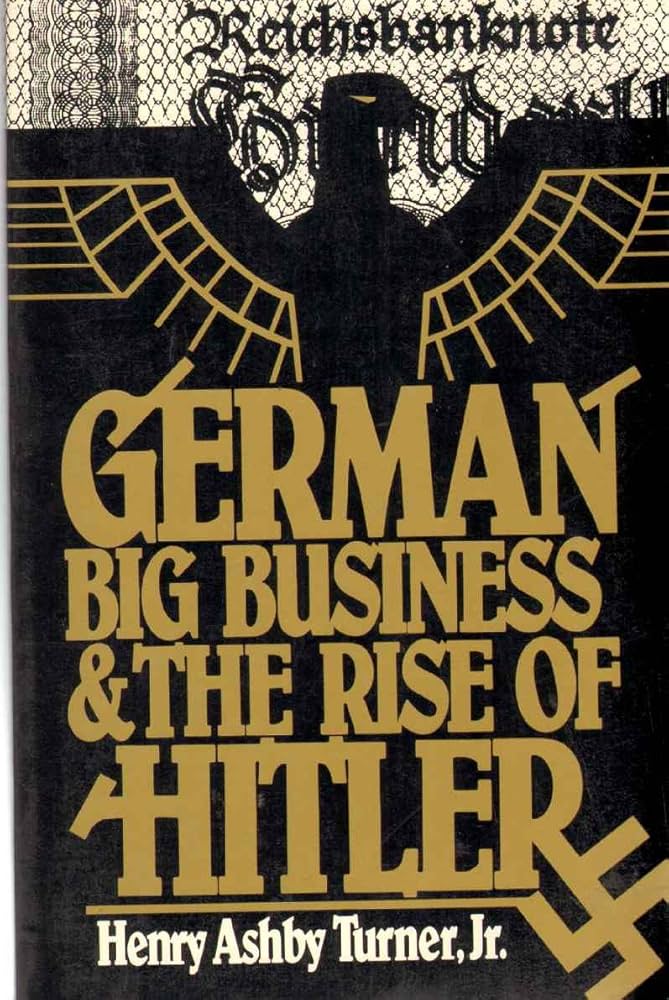
On 'German big business and the rise of Hitler' Book by Henry Ashby Turner
Hitlerites frequently give a handwave to this book and pretend as if it debunks the body of evidence that Hitler was financed by Jews and big business. This has several problems as seen below.
For starters:
This entire forum has a ton of evidence that Hitler was supported and financed by Jews through different avenues.
Second:
We know for a fact that Jewish funding, in many cases, is kept undocumented. Not to mention, at that time, there were very few established rules and laws concerning party funding, so much of it was done under the table.
Here is one example of Jewish bankers attempting to conceal large payments in the advancement of their conspiracy
https://archive.ph/qluzy
Third:
Institute for New Economic Thinking.
Hitler and the German Coal Industrialists: Passing the Keys to A Kingdom
“Earlier in 1923, for example, the major German industrialist Hugo Stinnes had declared:
‘Therefore [...] a dictator must be found, endowed with the power to do whatever is necessary. Such a man must speak the language of the people and be bourgeois himself.’
The list of such examples, in which the majority of Germany's leading industrialists spoke out against democracy and thus in favor of dictatorial conditions in Germany in the early 1930s at the latest, could be multiplied indefinitely. [Note: Two posts above, there is a quote about industrialist Jews supporting Hitler in the 20s]
Nevertheless, ever since the publication of Henry Turner’s German Big Business and the Rise of Hitler, most historians in both Germany and the United States have dismissed the idea that support from German major industry played a key role in bringing Hitler to power.
But the consensus is wrong, as I have shown in a series of works that began with my doctoral dissertation at the Free University of Berlin and now extends to more than ten different works, including two books. These works rely extensively on archival resources that were either inaccessible or only selectively open to earlier researchers.
This very comprehensive research cannot, of course, be exhaustively presented in a single essay. Instead, this essay deals in detail with one of the most crucial episodes in Hitler’s rise to power – one that previous historians, particularly Turner, have profoundly misjudged thanks, in part at least, to shortcomings in the documentary sources available to them.”
Imagine confidently asserting that Hitler wasn't Jewish funded on the basis of one historian, as many Hitlerites do. Most of them don't even do their own research, so what can you expect. These types will watch the "Greatest Story never told" or "Battle Europa", and then pretend they came to their beliefs through some kind of deep study.
Also to note:
The book admits (p. 54) “No precise answer to that question [on the funding of the NSDAP in its early years] will ever be possible since whatever records the party kept were destroyed.”
And:
“Unfortunately Turner says nothing about the role American big business and freemasonry played in Hitler's rise to the top. At the Nuremberg trials everything possible was done to avoid disclosing the activities of those Americans that had financed Hitler.”
The Popular Review: monthly illustrated literary magazine, June 1941, June, p. 63
“There has been a Bolshevization of Germany. It is worth recalling that in the penultimate Reichstag elections, thirteen million voters voted for the Communists; HITLER defeated them, on the political terrain or with blows from the truncheon, thanks to the support of HUGO STINNES & others.”
A Review of Revolutionary Movements in Foreign Countries, Section 'Miscellaneous': [July 21, 1920]
"M. Briand is the representative among French public men of the JEWISH MASONIC INFLUENCE, so closely allied to International High Finance and to HERR HUGO STINNES, the most powerful of the German "Heavy" Industrials."
Review the other posts on this forum for more evidence. The above is but a small sample.
On 'German big business and the rise of Hitler' Book by Henry Ashby Turner
Hitlerites frequently give a handwave to this book and pretend as if it debunks the body of evidence that Hitler was financed by Jews and big business. This has several problems as seen below.
For starters:
This entire forum has a ton of evidence that Hitler was supported and financed by Jews through different avenues.
Second:
We know for a fact that Jewish funding, in many cases, is kept undocumented. Not to mention, at that time, there were very few established rules and laws concerning party funding, so much of it was done under the table.
Here is one example of Jewish bankers attempting to conceal large payments in the advancement of their conspiracy
Hitler and the German Coal Industrialists: Passing the Keys to A Kingdom
“Earlier in 1923, for example, the major German industrialist Hugo Stinnes had declared:
‘Therefore [...] a dictator must be found, endowed with the power to do whatever is necessary. Such a man must speak the language of the people and be bourgeois himself.’
The list of such examples, in which the majority of Germany's leading industrialists spoke out against democracy and thus in favor of dictatorial conditions in Germany in the early 1930s at the latest, could be multiplied indefinitely. [Note: Two posts above, there is a quote about industrialist Jews supporting Hitler in the 20s]
Nevertheless, ever since the publication of Henry Turner’s German Big Business and the Rise of Hitler, most historians in both Germany and the United States have dismissed the idea that support from German major industry played a key role in bringing Hitler to power.
But the consensus is wrong, as I have shown in a series of works that began with my doctoral dissertation at the Free University of Berlin and now extends to more than ten different works, including two books. These works rely extensively on archival resources that were either inaccessible or only selectively open to earlier researchers.
This very comprehensive research cannot, of course, be exhaustively presented in a single essay. Instead, this essay deals in detail with one of the most crucial episodes in Hitler’s rise to power – one that previous historians, particularly Turner, have profoundly misjudged thanks, in part at least, to shortcomings in the documentary sources available to them.”
Imagine confidently asserting that Hitler wasn't Jewish funded on the basis of one historian, as many Hitlerites do. Most of them don't even do their own research, so what can you expect. These types will watch the "Greatest Story never told" or "Battle Europa", and then pretend they came to their beliefs through some kind of deep study.
Also to note:
The book admits (p. 54) “No precise answer to that question [on the funding of the NSDAP in its early years] will ever be possible since whatever records the party kept were destroyed.”
And:
“Unfortunately Turner says nothing about the role American big business and freemasonry played in Hitler's rise to the top. At the Nuremberg trials everything possible was done to avoid disclosing the activities of those Americans that had financed Hitler.”
The Popular Review: monthly illustrated literary magazine, June 1941, June, p. 63
“There has been a Bolshevization of Germany. It is worth recalling that in the penultimate Reichstag elections, thirteen million voters voted for the Communists; HITLER defeated them, on the political terrain or with blows from the truncheon, thanks to the support of HUGO STINNES & others.”
A Review of Revolutionary Movements in Foreign Countries, Section 'Miscellaneous': [July 21, 1920]
"M. Briand is the representative among French public men of the JEWISH MASONIC INFLUENCE, so closely allied to International High Finance and to HERR HUGO STINNES, the most powerful of the German "Heavy" Industrials."
"Midway through World War II, both countries, with the full knowledge of their governments and central bank directors, ignored warnings from the Allies about the nature of the gold and other assets they were buying from Germany and continued the trade until the end of the war. As late as 1944, the Swedish National Bank ordered its Swiss financial partners to melt gold bars so they could be stamped with a Swedish insignia to conceal their origin."
-https://www.rferl.org/a/1083119.html
"According to documents recently cited in Swedish reports, the family of Raoul Wallenberg, the wartime Swedish diplomat in Budapest who saved the lives of hundreds of thousands of Jews and later died in Russia, is revealed to have participated in the trade of Nazi Germany's wartime gold. The documents suggest the Wallenberg family was sympathetic to the Germans and thought they would win the war." -Ibid
"Wallenberg was aware of his one-sixteenth Jewish ancestry and proud of it." -https://en.wikipedia.org/wiki/Raoul_Wallenberg
Raoul Wallenburg died in a soviet gulag.
"Midway through World War II, both countries, with the full knowledge of their governments and central bank directors, ignored warnings from the Allies about the nature of the gold and other assets they were buying from Germany and continued the trade until the end of the war. As late as 1944, the Swedish National Bank ordered its Swiss financial partners to melt gold bars so they could be stamped with a Swedish insignia to conceal their origin."
-https://www.rferl.org/a/1083119.html
"According to documents recently cited in Swedish reports, the family of Raoul Wallenberg, the wartime Swedish diplomat in Budapest who saved the lives of hundreds of thousands of Jews and later died in Russia, is revealed to have participated in the trade of Nazi Germany's wartime gold. The documents suggest the Wallenberg family was sympathetic to the Germans and thought they would win the war." -Ibid
"Wallenberg was aware of his one-sixteenth Jewish ancestry and proud of it." -https://en.wikipedia.org/wiki/Raoul_Wallenberg
Josh - here is an example of how the NAZI's used backdoor secret financing. Basically they invented new financial instruments (and shell companies) which could be bought by foreigners looking to finance the NAZI war machine.
Transitional Financing: More Creative Financial Engineering
In March 1935, the Nazi regime declared rearmament to be the country’s top priority. Existing programs to stimulate employment were folded into the armament program, with Hjalmar Schacht, the Reichsbank governor, at the helm of a new financing strategy. This had to cover the regime’s planned massive increase in military spending without creating inflationary pressures.32 A key component of Schacht’s strategy was to expand the use of Mefo bills, which had been introduced in the context of the employment creation program, for armament financing. Mefo bills were drawn by armament contractors and accepted by a limited liability company, the Metallurgische Forschungsgesellschaft, m.b.H. (MEFO), set up solely for financing purposes. The drawer could present Mefo bills to any qualifying German bank for discount. The banks, in turn, could rediscount the bills at the Reichsbank at any point within the last three months of their earliest maturity. The bills essentially added a shadow company to the financing scheme conceived for the public works program (Figure 6.6).
Mefo bills served as a key financing source for the armament program, covering more than one-third of German military spending during April 1935–March 1938.33 The stock of Mefo bills increased sixfold over this period, and by March 1938, the bills had grown into the largest component of total (reported and unreported) debt. Mefo bills, however, were not included in official debt statistics. Reporting on government spending and its components was already discontinued as early as 1935. Published financial sector balance sheets that could have identified holdings of these bills were also carefully sanitized.34
Mefo bills circulated widely outside the Reichsbank among companies and financial institutions. They carried a government guarantee, had an attractive 4 percent interest rate, and could be discounted (and rediscounted). The Reichsbank anticipated that until the economy had reached full employment, the pace of rediscounting the bills would be in line with the rebound in economic activity and hence would not be a source of excessive money creation.35 By early 1938, once the economy had reached full employment, issuance of Mefo bills was discontinued. Reliance on institutional savers to place medium- and long-term debt now gained importance (Figure 6.7).
The new financing instruments and mechanisms shifted the pattern of government borrowing. By the late 1930s, however, the sharp increase in overall government borrowing and the accumulation of Reichsbank claims on the state could no longer be concealed. Other sectors of the economy were increasingly crowded out (Figure 6.8).
The above chart shows how much money was being created in the buildup to WW2. Basically the NAZI government was mortgaging the future and increasing socialization over the whole economy. Hitler's "economic miracle" was long term debt financing to socialized industries which is why inflation was kept low, (for the short pre-war time). Had Germany won they would have faced hyperinflation and economic depression.
Josh - here is an example of how the NAZI's used backdoor secret financing. Basically they invented new financial instruments (and shell companies) which could be bought by foreigners looking to finance the NAZI war machine.
Transitional Financing: More Creative Financial Engineering
In March 1935, the Nazi regime declared rearmament to be the country’s top priority. Existing programs to stimulate employment were folded into the armament program, with Hjalmar Schacht, the Reichsbank governor, at the helm of a new financing strategy. This had to cover the regime’s planned massive increase in military spending without creating inflationary pressures.32 A key component of Schacht’s strategy was to expand the use of Mefo bills, which had been introduced in the context of the employment creation program, for armament financing. Mefo bills were drawn by armament contractors and accepted by a limited liability company, the Metallurgische Forschungsgesellschaft, m.b.H. (MEFO), set up solely for financing purposes. The drawer could present Mefo bills to any qualifying German bank for discount. The banks, in turn, could rediscount the bills at the Reichsbank at any point within the last three months of their earliest maturity. The bills essentially added a shadow company to the financing scheme conceived for the public works program (Figure 6.6).
Mefo bills served as a key financing source for the armament program, covering more than one-third of German military spending during April 1935–March 1938.33 The stock of Mefo bills increased sixfold over this period, and by March 1938, the bills had grown into the largest component of total (reported and unreported) debt. Mefo bills, however, were not included in official debt statistics. Reporting on government spending and its components was already discontinued as early as 1935. Published financial sector balance sheets that could have identified holdings of these bills were also carefully sanitized.34
Mefo bills circulated widely outside the Reichsbank among companies and financial institutions. They carried a government guarantee, had an attractive 4 percent interest rate, and could be discounted (and rediscounted). The Reichsbank anticipated that until the economy had reached full employment, the pace of rediscounting the bills would be in line with the rebound in economic activity and hence would not be a source of excessive money creation.35 By early 1938, once the economy had reached full employment, issuance of Mefo bills was discontinued. Reliance on institutional savers to place medium- and long-term debt now gained importance (Figure 6.7).
The new financing instruments and mechanisms shifted the pattern of government borrowing. By the late 1930s, however, the sharp increase in overall government borrowing and the accumulation of Reichsbank claims on the state could no longer be concealed. Other sectors of the economy were increasingly crowded out (Figure 6.8).
The above chart shows how much money was being created in the buildup to WW2. Basically the NAZI government was mortgaging the future and increasing socialization over the whole economy. Hitler's "economic miracle" was long term debt financing to socialized industries which is why inflation was kept low, (for the short pre-war time). Had Germany won they would have faced hyperinflation and economic depression.
Josh this supports your point that Jewish money is often secretive. The Nazi's went to great length to hide their financing:
Data Obfuscation and Fiscal Non-transparency under the Nazi Regime
The Nazi regime allowed for regular publication of the country’s debt data until well into WWII. But information available within the public domain was increasingly restricted. For instance, the Debt Council no longer issued public reports. The government also discontinued the publication of data on government spending or the fiscal deficit and its financing. In the absence of public information on debt management and fiscal policies, the Nazi regime could allow for the statistical release of Reich debt data in the Weimar format, suggesting an illusory transparency.36
The Nazi regime also went to great lengths to legitimize its financial practices. It left the fiscal and debt management legislation from the Weimar period largely in place, but budgetary powers were transferred from Parliament to the Cabinet.37 An amendment to the Weimar Constitution approved on March 23, 1933, gave the Cabinet legislative powers with respect to constitutional provisions regarding budgetary and sovereign loan authorizations.38 The Finance Ministry continued to prepare an annual budget proposal and budgetary accounts but no longer submitted them to Parliament. In February 1935, the ceiling on borrowing authorizations was removed. From this point, the government could borrow any amount authorized by the Chancellor upon request, but the public was left in the dark on the amount actually approved.
The inflationary effects of rapidly increasing government spending under the Nazi regime were also masked. From 1934, price controls were imposed. One consequence was covert inflation, in which prices remained fixed but the quality of goods deteriorated. This was especially true of textiles and shoes, but it also applied to some foodstuffs, where the use of substitute (ersatz) materials for expensive imported goods was a consequence of exchange control legislation.39
The regime issued exhortatory statements about fiscal restraint intended to reassure Germans who were worried about the possibilities of a new bout of inflation. In 1933, the periodical Währung und Wirtschaft explained that the government needed to avoid “any threat to the currency” by “resisting the endless demands made at all times on public funds” (James 1986, 379). Hitler boasted: “I had to also make it clear to Schacht that the first cause of our currency stability is the concentration camp: the currency is stable when anyone who demands more is dealt with” (Jochmann 1980, 88).
Josh this supports your point that Jewish money is often secretive. The Nazi's went to great length to hide their financing:
Data Obfuscation and Fiscal Non-transparency under the Nazi Regime
The Nazi regime allowed for regular publication of the country’s debt data until well into WWII. But information available within the public domain was increasingly restricted. For instance, the Debt Council no longer issued public reports. The government also discontinued the publication of data on government spending or the fiscal deficit and its financing. In the absence of public information on debt management and fiscal policies, the Nazi regime could allow for the statistical release of Reich debt data in the Weimar format, suggesting an illusory transparency.36
The Nazi regime also went to great lengths to legitimize its financial practices. It left the fiscal and debt management legislation from the Weimar period largely in place, but budgetary powers were transferred from Parliament to the Cabinet.37 An amendment to the Weimar Constitution approved on March 23, 1933, gave the Cabinet legislative powers with respect to constitutional provisions regarding budgetary and sovereign loan authorizations.38 The Finance Ministry continued to prepare an annual budget proposal and budgetary accounts but no longer submitted them to Parliament. In February 1935, the ceiling on borrowing authorizations was removed. From this point, the government could borrow any amount authorized by the Chancellor upon request, but the public was left in the dark on the amount actually approved.
The inflationary effects of rapidly increasing government spending under the Nazi regime were also masked. From 1934, price controls were imposed. One consequence was covert inflation, in which prices remained fixed but the quality of goods deteriorated. This was especially true of textiles and shoes, but it also applied to some foodstuffs, where the use of substitute (ersatz) materials for expensive imported goods was a consequence of exchange control legislation.39
The regime issued exhortatory statements about fiscal restraint intended to reassure Germans who were worried about the possibilities of a new bout of inflation. In 1933, the periodical Währung und Wirtschaft explained that the government needed to avoid “any threat to the currency” by “resisting the endless demands made at all times on public funds” (James 1986, 379). Hitler boasted: “I had to also make it clear to Schacht that the first cause of our currency stability is the concentration camp: the currency is stable when anyone who demands more is dealt with” (Jochmann 1980, 88).
"Midway through World War II, both countries, with the full knowledge of their governments and central bank directors, ignored warnings from the Allies about the nature of the gold and other assets they were buying from Germany and continued the trade until the end of the war. As late as 1944, the Swedish National Bank ordered its Swiss financial partners to melt gold bars so they could be stamped with a Swedish insignia to conceal their origin."
-https://www.rferl.org/a/1083119.html
"According to documents recently cited in Swedish reports, the family of Raoul Wallenberg, the wartime Swedish diplomat in Budapest who saved the lives of hundreds of thousands of Jews and later died in Russia, is revealed to have participated in the trade of Nazi Germany's wartime gold. The documents suggest the Wallenberg family was sympathetic to the Germans and thought they would win the war." -Ibid
"Wallenberg was aware of his one-sixteenth Jewish ancestry and proud of it." -https://en.wikipedia.org/wiki/Raoul_Wallenberg
Raoul Wallenburg died in a soviet gulag.
He 'died in a gulag' ...Or so we're told in some sources. How he died is not a confirmed fact & remains a mystery.
Something like this is probably closer to the truth;
More Information on the Wallenberg family.
“The most famous of the Wallenberg family, RAOUL Wallenberg”
para 2
https://en.wikipedia.org/wiki/Wallenberg_family
“His mother was of partly Jewish descent”
para 6
https://sv.wikipedia.org/wiki/Raoul_Wallenberg
“RAOUL Wallenberg's Jewish ancestry is supported by Sweden researcher Paul A. Levine”
“He returned to Sweden in 1936, securing a job in Stockholm in an export-import company, owned by Kálmán Lauer, a Hungarian Jew.”
“1936. After graduation, Raoul Wallenberg returns to Sweden. Shortly thereafter he leaves again to work commercially in South Africa and Haifa, Palestine. During his time working at a Dutch bank in Haifa, he becomes acquainted with anti-semitism.”
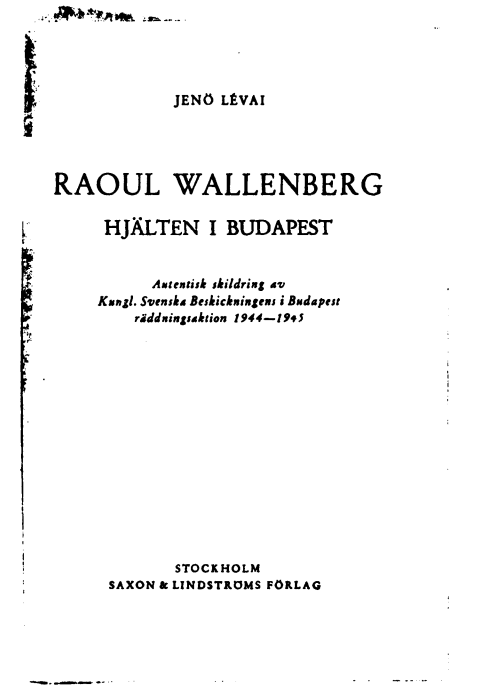
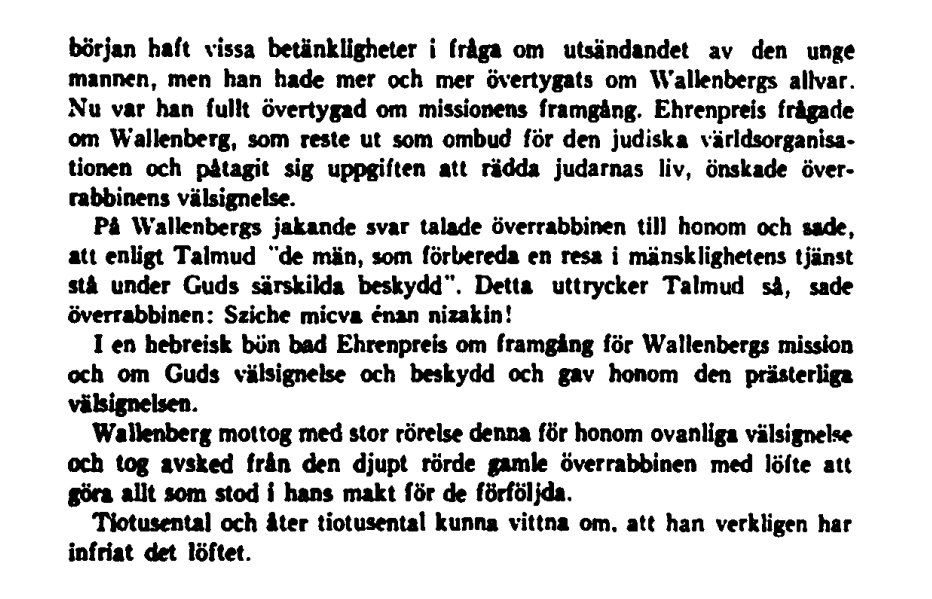
Swedish book - “Raoul Wallenberg” Vol. 4, by Jeno Lèvai
"Raoul Wallenberg once traveled as a REPRESENTATIVE of the Jewish World Organization & wanted the Chief Rabbi's blessing.
“Upon Wallenberg's affirmative answer, the chief rabbi spoke to him and said that according to the Talmud "men who prepare a journey in the service of humanity are under God's special protection." In Hebrew, Ehrenpreis prayed for the success of Wallenberg's mission and for God's blessing and protection, and gave him the priestly blessing.
Wallenberg received this unusual blessing with great emotion and took leave of the deeply moved old chief rabbi with a promise to do everything in his power for the persecuted.”
A Jewess served as the executive director of the Raoul Wallenberg Association from 1979
https://sv.wikipedia.org/wiki/Sonja_Sonnenfeld
Many already know of (Jew) Barbara Specter who proudly and boastfully admitted that Jews are behind multiculturalism in Europe. She is the founder of Paideia - The European Institute for Jewish Studies in Sweden.
The Wallenbergs are also one of the founders of Paidea:
“Paideia was founded in 2000 with financial support from the Swedish state and the Marianne and Marcus Wallenberg Foundation.”
https://sv.wikipedia.org/wiki/Paideia_(stiftelse)
Marcus Wallenberg, Chairman of the Board of SEB and former CEO of Investor, is married to the jew Fanny Sachs. Fanny comes from the Sachs family, known to Josef Sachs, founder of NK, and Daniel Sachs, former CEO of the Urwitz company Segulah. The latter has boasted of his jewish identity in the Swedish Jewish Chronicle. Fanny's daughter Emelie is married to Peder Bonnier, son of Carl-Johan Bonnier who is the head of the Jewish Bonnier Empire. Fanny's second daughter Ellen is married to Jan Dinkelspiel, from another rich Jewish family: the Dinkelspiel family owns the Öhman Group and Claes Dinkelspiel sits on the board of Nordnet.
Jacob Wallenberg, Chairman of Investor AB and Vice chairman of ABB, Ericsson, FAM and Patricia Industries is married to the Jewess Annika Levin.
Obama went to a synagogue in Stockholm to praise Raoul Wallenberg.
Marcus and Jacob Wallenberg can be seen with both Trump and Klaus Schwab.
"Midway through World War II, both countries, with the full knowledge of their governments and central bank directors, ignored warnings from the Allies about the nature of the gold and other assets they were buying from Germany and continued the trade until the end of the war. As late as 1944, the Swedish National Bank ordered its Swiss financial partners to melt gold bars so they could be stamped with a Swedish insignia to conceal their origin."
-https://www.rferl.org/a/1083119.html
"According to documents recently cited in Swedish reports, the family of Raoul Wallenberg, the wartime Swedish diplomat in Budapest who saved the lives of hundreds of thousands of Jews and later died in Russia, is revealed to have participated in the trade of Nazi Germany's wartime gold. The documents suggest the Wallenberg family was sympathetic to the Germans and thought they would win the war." -Ibid
"Wallenberg was aware of his one-sixteenth Jewish ancestry and proud of it." -https://en.wikipedia.org/wiki/Raoul_Wallenberg
Raoul Wallenburg died in a soviet gulag.
He 'died in a gulag' ...Or so we're told in some sources. How he died is not a confirmed fact & remains a mystery.
Something like this is probably closer to the truth;
More Information on the Wallenberg family.
“The most famous of the Wallenberg family, RAOUL Wallenberg”
“1936. After graduation, Raoul Wallenberg returns to Sweden. Shortly thereafter he leaves again to work commercially in South Africa and Haifa, Palestine. During his time working at a Dutch bank in Haifa, he becomes acquainted with anti-semitism.”
Swedish book - “Raoul Wallenberg” Vol. 4, by Jeno Lèvai
"Raoul Wallenberg once traveled as a REPRESENTATIVE of the Jewish World Organization & wanted the Chief Rabbi's blessing.
“Upon Wallenberg's affirmative answer, the chief rabbi spoke to him and said that according to the Talmud "men who prepare a journey in the service of humanity are under God's special protection." In Hebrew, Ehrenpreis prayed for the success of Wallenberg's mission and for God's blessing and protection, and gave him the priestly blessing.
Wallenberg received this unusual blessing with great emotion and took leave of the deeply moved old chief rabbi with a promise to do everything in his power for the persecuted.”
Many already know of (Jew) Barbara Specter who proudly and boastfully admitted that Jews are behind multiculturalism in Europe. She is the founder of Paideia - The European Institute for Jewish Studies in Sweden.
The Wallenbergs are also one of the founders of Paidea:
“Paideia was founded in 2000 with financial support from the Swedish state and the Marianne and Marcus Wallenberg Foundation.”
Marcus Wallenberg, Chairman of the Board of SEB and former CEO of Investor, is married to the jew Fanny Sachs. Fanny comes from the Sachs family, known to Josef Sachs, founder of NK, and Daniel Sachs, former CEO of the Urwitz company Segulah. The latter has boasted of his jewish identity in the Swedish Jewish Chronicle. Fanny's daughter Emelie is married to Peder Bonnier, son of Carl-Johan Bonnier who is the head of the Jewish Bonnier Empire. Fanny's second daughter Ellen is married to Jan Dinkelspiel, from another rich Jewish family: the Dinkelspiel family owns the Öhman Group and Claes Dinkelspiel sits on the board of Nordnet.
Jacob Wallenberg, Chairman of Investor AB and Vice chairman of ABB, Ericsson, FAM and Patricia Industries is married to the Jewess Annika Levin.
Obama went to a synagogue in Stockholm to praise Raoul Wallenberg.
Marcus and Jacob Wallenberg can be seen with both Trump and Klaus Schwab.
“Erich Neumann (31 May 1892 – 23 March 1951) was a German lawyer and civil servant, a member of the Nazi party and an SS-Oberführer”
para 1
“Shortly after Adolf Hitler's seizure of power, Neumann was promoted to the post of Permanent Secretary (Ministerialdirektor) on 11 February 1933 and was made a deputy plenipotentiary to the Reichsrat for Prussia, where he served until its abolition on 14 February 1934. Formerly a member of the German National People's Party, Neumann joined the Nazi Party in May 1933 (membership number 2,645,024). On 15 September of that year, he was appointed to the Prussian State Council by Prussian Minister President Hermann Göring and served as its secretary until 1942. In October 1933, he became a founding member of Hans Frank's Academy for German Law, serving on its committees for administrative law and municipal constitutions. In the summers of 1935 through 1937, he participated in military training exercises with the Reiter Regiment 9, headquartered in Fürstenwalde, and later advanced to the rank of Rittmeister of reserves.[1]
On 23 October 1936, Neumann was appointed the director of the Foreign Currency Department of the Office of the Plenipotentiary for the Four Year Plan, headed by Göring. On 23 July 1938, Neumann was promoted to State Secretary and Deputy to Paul Körner, Göring's chief deputy in the Four Year Plan, and sat as a member of its general council (Generalrats). Neumann attended Göring's 12 November 1938 meeting about the "Aryanisation" of the German economy.”
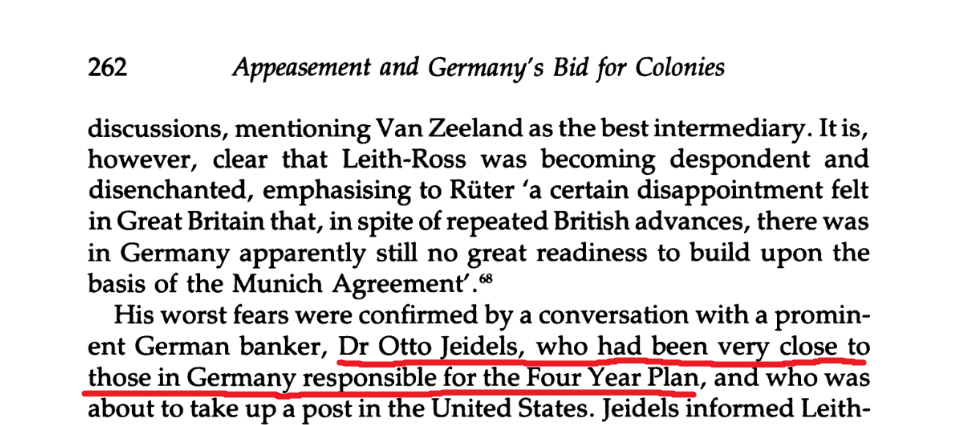
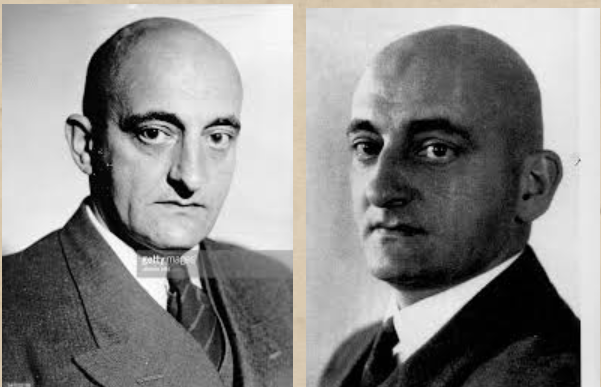
Otto Jields, one of Hitler's Jewish bankers. Also very close with Schacht.
I couldn't find anything about who his parents were, the only thing I could find was his father was a factory owner. Which is a hint in itself when you couple it with the surname Neumann which is a common Jewish surname.
The meaning of Neumann is also very interesting.
Meaning of Neumann
A German and Jewish occupational surname referring to a newcomer or stranger to a settlement or community.
Newcomer? Stranger to a settlement or community? What does that sound like? Doesn't really indicate that he was German…but Jewish.
Here, an article of a woman who related when she was still 17 years old, she had met a man from Mexico who called her Jewish even though at this time she had no idea she was Jewish. This is how their exchange went:
“I was baffled. I’ve never been good at witty comebacks, but I was thrilled to manage: “I’m sorry, you’re mistaken. I’m not Jewish, and you’re not good-looking.”
“You need glasses,” Elliot responded cheerfully, undeterred. “But you’re Latin and, of course, you’re Jewish. With a name like Neumann, you have to be.”
So if this man was Jewish, which I think he clearly was (more info further down), that would mean Hitler had a Jew handle the “aryanization” of the German economy which is quite a cozy position for Jews in Germany to have. This way, they can rig the economy for their other crypto buddies. Like how the Jewish-owned Deutsche Bank grew significantly in size when Hitler came to power. And how some 'Aryanized' businesses still had Jews as members of their board.
See also for a bonus follow-up:
In 1938, the Jewish bank, H. Aufhäuser was Aryanized. A man by the name of Josef Bayer was chosen as a general representative of this bank and remained a top leader for this bank while it was known that he was married to a Jewish woman. Bayer is a surname that's known to be adopted by Ashkenazi Jews. Bayer was a banker who was also a close confidant to the Jewish banking family of Aufhäuser. And, as mentioned already - was married to a Jewish woman.
Jews in the 19th century had a dominant role in the German economy, which included their prominent role in the industrial sector. Many Jews were indeed factory owners and we know Neumann's father was a factory owner.
“Prior to 1812, only two Jews had lived in Pasewalk, but an 1812 edict from the Prussian king allowed more Jews to settle there. The population quickly grew. By 1830, more than 100 Jews inhabited the town. In 1834 they built a synagogue, and shortly after that a Jewish cemetery. By the mid-19th century, some 300 Jews lived in Pasewalk, constituting more than 5 percent of its population and making it the second-most populous Jewish community in Pomerania. “Jews had equal rights, they were recognized citizens, and they made major contributions here as traders, doctors, lawyers, factory owners, and [in] other professions. They played an important role in the economy,” Krüger says.
“There have been Jewish communities in many Thuringian towns and cities since the Middle Ages, and a number of cultural treasures bear witness to these earlier times. The Old Synagogue in Erfurt is one of the largest and best preserved medieval synagogues in Europe. The mikveh bath in Erfurt is another important part of Jewish tradition along with the synagogue and cemetery.
In many places, houses and factories belonging to Jewish families are still intact. This region would not have enjoyed such prosperity had it not been for the skill and savings of the Jewish factory owners and merchants. Notable examples include the Simson factory in Suhl and the Tietz department store in Gera, where the former department store chain Hertie was founded. Festivals such as the Yiddish Summer in Weimar and events at Jewish cultural centers reflect the traditions of the Jewish people.”
Important to note that Neumann was a participant in the Wannsee Conference.
Alfred Meyer was a Nazi Party official & was also at the Conference.
He joined a Masonic lodge in 1924.
“To further his career prospects, he strives to make contacts. He seeks and finds them among the Freemasons. With the help of a close relative, he gained access to the Soest Freemasons in 1924. Fortunately for him, he got off lightly during his Nazi career.”
“On January 5, 1837, the entrepreneur, who was soon able to trade with the title of court coppersmith, became a member of the Johannis Masonic Lodge in the Orient of Hanover. Less than two decades later, his son Julius Louis Paulmann was admitted to the lodge on April 1, 1856.
The food chemist Wilhelm Paulmann was his grandson.”
A core group of the NSDAP was formed in Kassel between October and December 1923. This included, among others, Wilhelm Paulmann, Karl Schaumlöffel , Max Köhler, Fritz Lengemann , Rudolf Likus , Heinrich Messerschmidt and Heinrich Moog, the later Gauleiter Walter Schultz and Karl Weinrich as well as the later President of the People's Court Roland Freisler. [5] In 1924 he was on a list of the Völkisch-Social Bloc as a city councilor in Kassel and served as an honorary city councilor until 1933.
The lawyer and later SS judge Karl Werner Paulmann was his younger son.”
“Erich Neumann (31 May 1892 – 23 March 1951) was a German lawyer and civil servant, a member of the Nazi party and an SS-Oberführer”
para 1
“Shortly after Adolf Hitler's seizure of power, Neumann was promoted to the post of Permanent Secretary (Ministerialdirektor) on 11 February 1933 and was made a deputy plenipotentiary to the Reichsrat for Prussia, where he served until its abolition on 14 February 1934. Formerly a member of the German National People's Party, Neumann joined the Nazi Party in May 1933 (membership number 2,645,024). On 15 September of that year, he was appointed to the Prussian State Council by Prussian Minister President Hermann Göring and served as its secretary until 1942. In October 1933, he became a founding member of Hans Frank's Academy for German Law, serving on its committees for administrative law and municipal constitutions. In the summers of 1935 through 1937, he participated in military training exercises with the Reiter Regiment 9, headquartered in Fürstenwalde, and later advanced to the rank of Rittmeister of reserves.[1]
On 23 October 1936, Neumann was appointed the director of the Foreign Currency Department of the Office of the Plenipotentiary for the Four Year Plan, headed by Göring. On 23 July 1938, Neumann was promoted to State Secretary and Deputy to Paul Körner, Göring's chief deputy in the Four Year Plan, and sat as a member of its general council (Generalrats). Neumann attended Göring's 12 November 1938 meeting about the "Aryanisation" of the German economy.”
Otto Jields, one of Hitler's Jewish bankers. Also very close with Schacht.
I couldn't find anything about who his parents were, the only thing I could find was his father was a factory owner. Which is a hint in itself when you couple it with the surname Neumann which is a common Jewish surname.
The meaning of Neumann is also very interesting.
Meaning of Neumann
A German and Jewish occupational surname referring to a newcomer or stranger to a settlement or community.
Newcomer? Stranger to a settlement or community? What does that sound like? Doesn't really indicate that he was German…but Jewish.
Here, an article of a woman who related when she was still 17 years old, she had met a man from Mexico who called her Jewish even though at this time she had no idea she was Jewish. This is how their exchange went:
“I was baffled. I’ve never been good at witty comebacks, but I was thrilled to manage: “I’m sorry, you’re mistaken. I’m not Jewish, and you’re not good-looking.”
“You need glasses,” Elliot responded cheerfully, undeterred. “But you’re Latin and, of course, you’re Jewish. With a name like Neumann, you have to be.”
So if this man was Jewish, which I think he clearly was (more info further down), that would mean Hitler had a Jew handle the “aryanization” of the German economy which is quite a cozy position for Jews in Germany to have. This way, they can rig the economy for their other crypto buddies. Like how the Jewish-owned Deutsche Bank grew significantly in size when Hitler came to power. And how some 'Aryanized' businesses still had Jews as members of their board.
See also for a bonus follow-up:
In 1938, the Jewish bank, H. Aufhäuser was Aryanized. A man by the name of Josef Bayer was chosen as a general representative of this bank and remained a top leader for this bank while it was known that he was married to a Jewish woman. Bayer is a surname that's known to be adopted by Ashkenazi Jews. Bayer was a banker who was also a close confidant to the Jewish banking family of Aufhäuser. And, as mentioned already - was married to a Jewish woman.
Jews in the 19th century had a dominant role in the German economy, which included their prominent role in the industrial sector. Many Jews were indeed factory owners and we know Neumann's father was a factory owner.
“Prior to 1812, only two Jews had lived in Pasewalk, but an 1812 edict from the Prussian king allowed more Jews to settle there. The population quickly grew. By 1830, more than 100 Jews inhabited the town. In 1834 they built a synagogue, and shortly after that a Jewish cemetery. By the mid-19th century, some 300 Jews lived in Pasewalk, constituting more than 5 percent of its population and making it the second-most populous Jewish community in Pomerania. “Jews had equal rights, they were recognized citizens, and they made major contributions here as traders, doctors, lawyers, factory owners, and [in] other professions. They played an important role in the economy,” Krüger says.
“There have been Jewish communities in many Thuringian towns and cities since the Middle Ages, and a number of cultural treasures bear witness to these earlier times. The Old Synagogue in Erfurt is one of the largest and best preserved medieval synagogues in Europe. The mikveh bath in Erfurt is another important part of Jewish tradition along with the synagogue and cemetery.
In many places, houses and factories belonging to Jewish families are still intact. This region would not have enjoyed such prosperity had it not been for the skill and savings of the Jewish factory owners and merchants. Notable examples include the Simson factory in Suhl and the Tietz department store in Gera, where the former department store chain Hertie was founded. Festivals such as the Yiddish Summer in Weimar and events at Jewish cultural centers reflect the traditions of the Jewish people.”
Important to note that Neumann was a participant in the Wannsee Conference.
Alfred Meyer was a Nazi Party official & was also at the Conference.
He joined a Masonic lodge in 1924.
“To further his career prospects, he strives to make contacts. He seeks and finds them among the Freemasons. With the help of a close relative, he gained access to the Soest Freemasons in 1924. Fortunately for him, he got off lightly during his Nazi career.”
“On January 5, 1837, the entrepreneur, who was soon able to trade with the title of court coppersmith, became a member of the Johannis Masonic Lodge in the Orient of Hanover. Less than two decades later, his son Julius Louis Paulmann was admitted to the lodge on April 1, 1856.
The food chemist Wilhelm Paulmann was his grandson.”
A core group of the NSDAP was formed in Kassel between October and December 1923. This included, among others, Wilhelm Paulmann, Karl Schaumlöffel , Max Köhler, Fritz Lengemann , Rudolf Likus , Heinrich Messerschmidt and Heinrich Moog, the later Gauleiter Walter Schultz and Karl Weinrich as well as the later President of the People's Court Roland Freisler. [5] In 1924 he was on a list of the Völkisch-Social Bloc as a city councilor in Kassel and served as an honorary city councilor until 1933.
The lawyer and later SS judge Karl Werner Paulmann was his younger son.”
Further verification of the liberation script, identified years ago, to extend communism over E. Europe.
"In the 1930s, Stalin supported Nazism and fascism in Europe. They were necessary for him to fight the Social Democrats, the main competitors of the Communists. They were also necessary for Stalin to conquer capitalist Europe by the Nazis: let Hitler go through Europe, said Molotov, to prepare the ground for the world revolution that the Bolshevik liberators dreamed of. In the film "If Tomorrow is War" (1939), it is directly stated how we will liberate this very Europe, however, it is not said who. When Marshal Stalin gives the signal, Baidukov wrote in Pravda, "we will attack the enemy with all the colossal force of socialist justice and bring happiness to all mankind. Our war is liberating and just."
Stalin not only supported Hitler's rise to power, but welcomed cooperation with Germany shortly after Hitler's rise to power. In 1934, expressing deep contempt for the "weak" democratic governments of Europe, he exclaimed in a fit of sympathy: "This is the leader!". And in December 1939, responding to Hitler's congratulation on the occasion of his 60th birthday, he wrote: "The friendship of the peoples of Germany and the Soviet Union, bound in blood, has every reason to be long-lasting and durable" (Truth, December 25, 1939 - easy to check: find and read!) On August 23, 1939, during a meeting with Ribbentrop in the Kremlin, Stalin made a toast: "I know, how the German people love their Fuehrer. Therefore, I would like to drink for my health." The second toast was made by Stalin for Himmler, "a man who ensures the security of the German state." Introducing Beria to the guest, Stalin jokingly said: "This is our Himmler." Ribbentrop later shared his "Moscow impressions" with his Italian colleague Count Ciano: "I felt like I was among old party comrades in the Kremlin."
It is hard to believe, but already after Hitler seized half of Europe, Stalin sent the Führer a congratulatory telegram, which spoke of the "dizzying victories of the Wehrmacht", and in 1939, Stalin personally congratulated Adolf Hitler on the successful operation to occupy Poland... Until the attack on the USSR, the Pravda newspaper more than once praised the courageous struggle of the German people against the Anglo-French plutocrats
Hitler did not remain in debt: "To Mr. Joseph Stalin. Moscow. On the day of your sixtieth birthday, I ask you to accept my most sincere congratulations. With this I associate my best wishes, I wish you good health personally, as well as a happy future for the peoples of the friendly Soviet Union. Adolf Hitler" (Pravda, December 23, 1939).
“I enquired of Herr Weismann (the Prussian Secretary of State) whether he knew the source from which the National Socialists had drawn the funds for their election campaign. He replied that these funds must come from Russia, thereby confirming the statement to that effect alleged by the press to have been made by M. Besedowski, the former counsellor of the Soviet Embassy at Paris.
A few Jews might have contributed, in spite of the fact that the National Socialists are very hostile to that race.”
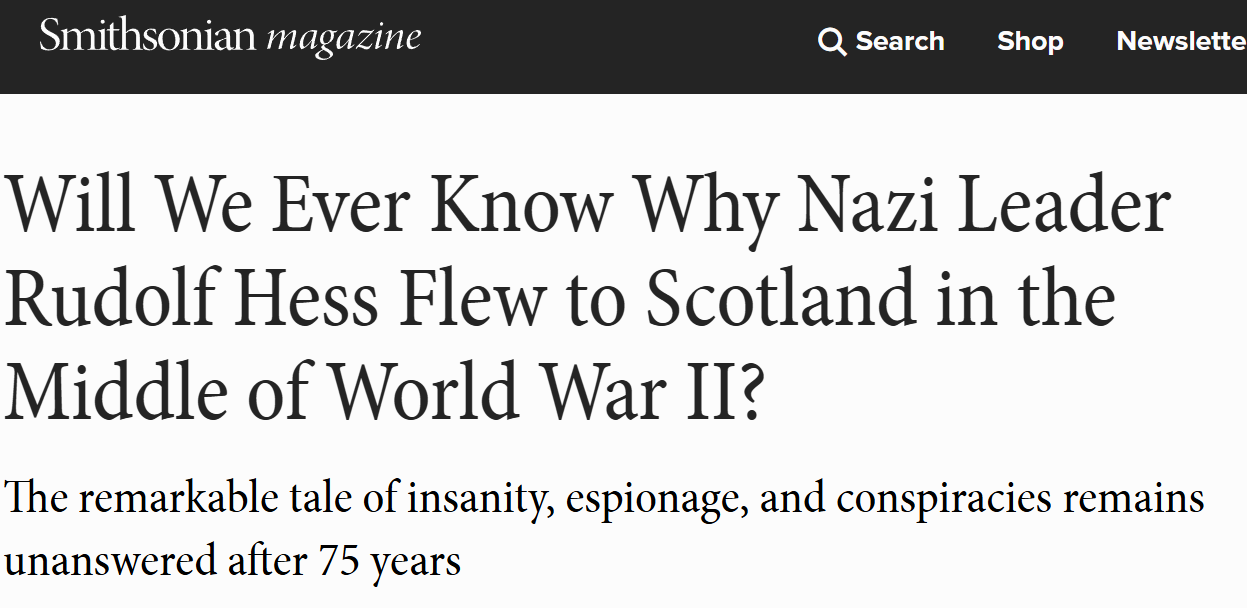
It's more likely that Hess was sent to "confess" to Generalplan Ost, thereby giving the Jews a justification against the goyim armies and allowing the Soviets to "liberate" Eastern Europe, i.e., to place it under the yoke of communism.
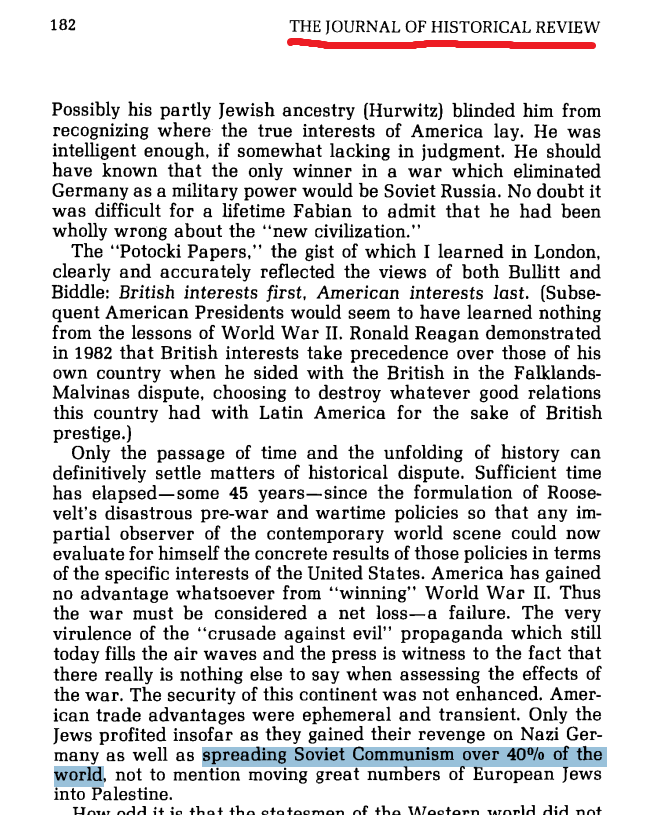
"The World War (1914-1918) will see the establishment of Communism in Russia; a second world war will extend its control over Europe; and a third world war will be necessary to make it worldwide"
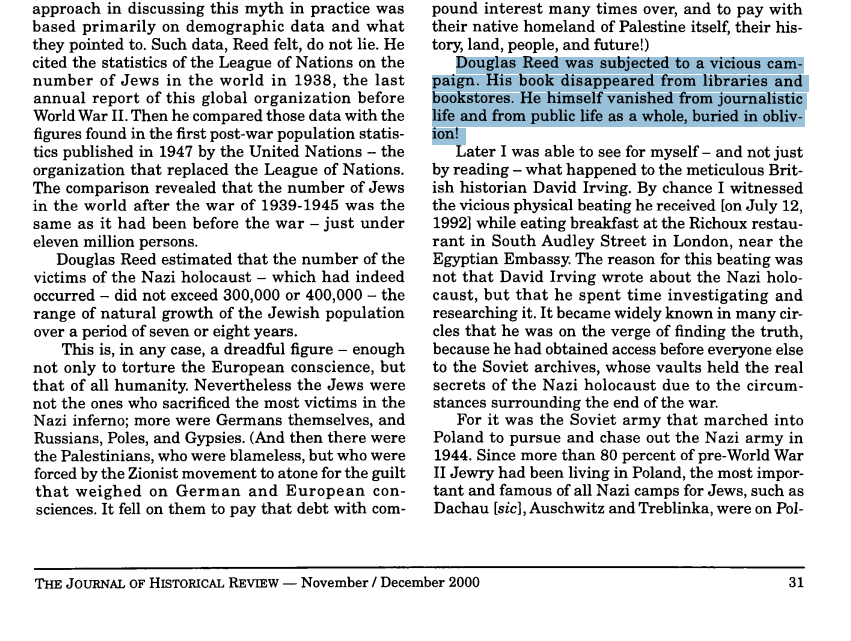
"Douglas Reed was also staunchly anti-Communist, believed that there existed a Communist-Zionist-Supercapitalist nexus, and argued that National Socialism was a "stooge or stalking horse" meant to further the aims of the Communist Empire[2] and the Zionist ambition,[3] reasoning that "for great successes, which they could not otherwise achieve, Soviet Communism and Political Zionism needed an apparent antithesis, as a heavyweight champion needs a sparring partner."
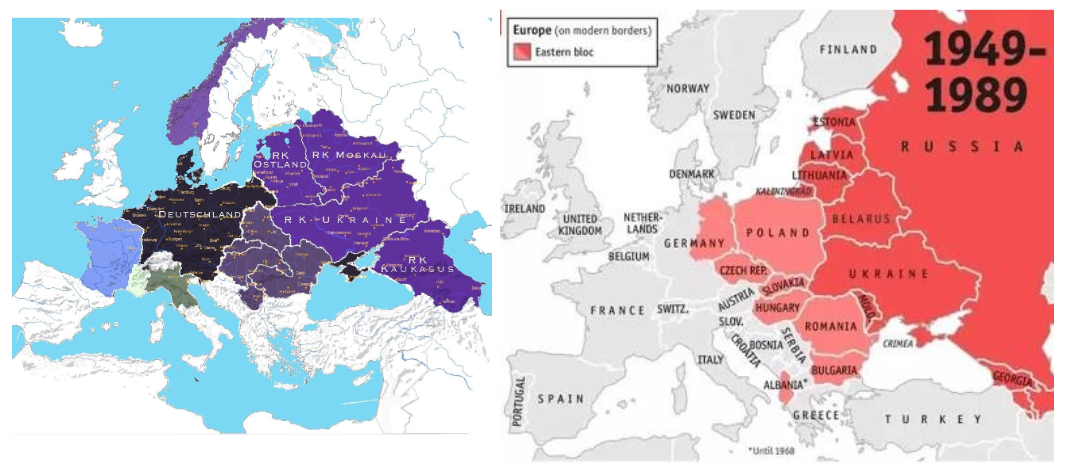
Just so happens that the Nazi Generalplan Ost (left) was the land 'liberated' by the Soviets (right)
Further verification of the liberation script, identified years ago, to extend communism over E. Europe.
"In the 1930s, Stalin supported Nazism and fascism in Europe. They were necessary for him to fight the Social Democrats, the main competitors of the Communists. They were also necessary for Stalin to conquer capitalist Europe by the Nazis: let Hitler go through Europe, said Molotov, to prepare the ground for the world revolution that the Bolshevik liberators dreamed of. In the film "If Tomorrow is War" (1939), it is directly stated how we will liberate this very Europe, however, it is not said who. When Marshal Stalin gives the signal, Baidukov wrote in Pravda, "we will attack the enemy with all the colossal force of socialist justice and bring happiness to all mankind. Our war is liberating and just."
Stalin not only supported Hitler's rise to power, but welcomed cooperation with Germany shortly after Hitler's rise to power. In 1934, expressing deep contempt for the "weak" democratic governments of Europe, he exclaimed in a fit of sympathy: "This is the leader!". And in December 1939, responding to Hitler's congratulation on the occasion of his 60th birthday, he wrote: "The friendship of the peoples of Germany and the Soviet Union, bound in blood, has every reason to be long-lasting and durable" (Truth, December 25, 1939 - easy to check: find and read!) On August 23, 1939, during a meeting with Ribbentrop in the Kremlin, Stalin made a toast: "I know, how the German people love their Fuehrer. Therefore, I would like to drink for my health." The second toast was made by Stalin for Himmler, "a man who ensures the security of the German state." Introducing Beria to the guest, Stalin jokingly said: "This is our Himmler." Ribbentrop later shared his "Moscow impressions" with his Italian colleague Count Ciano: "I felt like I was among old party comrades in the Kremlin."
It is hard to believe, but already after Hitler seized half of Europe, Stalin sent the Führer a congratulatory telegram, which spoke of the "dizzying victories of the Wehrmacht", and in 1939, Stalin personally congratulated Adolf Hitler on the successful operation to occupy Poland... Until the attack on the USSR, the Pravda newspaper more than once praised the courageous struggle of the German people against the Anglo-French plutocrats
Hitler did not remain in debt: "To Mr. Joseph Stalin. Moscow. On the day of your sixtieth birthday, I ask you to accept my most sincere congratulations. With this I associate my best wishes, I wish you good health personally, as well as a happy future for the peoples of the friendly Soviet Union. Adolf Hitler" (Pravda, December 23, 1939).
“I enquired of Herr Weismann (the Prussian Secretary of State) whether he knew the source from which the National Socialists had drawn the funds for their election campaign. He replied that these funds must come from Russia, thereby confirming the statement to that effect alleged by the press to have been made by M. Besedowski, the former counsellor of the Soviet Embassy at Paris.
A few Jews might have contributed, in spite of the fact that the National Socialists are very hostile to that race.”
It's more likely that Hess was sent to "confess" to Generalplan Ost, thereby giving the Jews a justification against the goyim armies and allowing the Soviets to "liberate" Eastern Europe, i.e., to place it under the yoke of communism.
"The World War (1914-1918) will see the establishment of Communism in Russia; a second world war will extend its control over Europe; and a third world war will be necessary to make it worldwide"
"Douglas Reed was also staunchly anti-Communist, believed that there existed a Communist-Zionist-Supercapitalist nexus, and argued that National Socialism was a "stooge or stalking horse" meant to further the aims of the Communist Empire[2] and the Zionist ambition,[3] reasoning that "for great successes, which they could not otherwise achieve, Soviet Communism and Political Zionism needed an apparent antithesis, as a heavyweight champion needs a sparring partner."
Jewish newspapers supporting Hitler and National Socialism.
Article: Controlled opposition according to the Protocols of the Learned Elders of Zion
“After meeting Hitler, Hanussen turned his Berliner Wochenschau and Die Hanussen-Zeitung, both of which had a circulation of 200,000, into Nazi propaganda outlets. [14] With the exception of three people, the entire editorial staff of the Berliner Wochenschau consisted of Jews. [15]”
Journal of Contemporary History (2018), volume 53, issue 1:
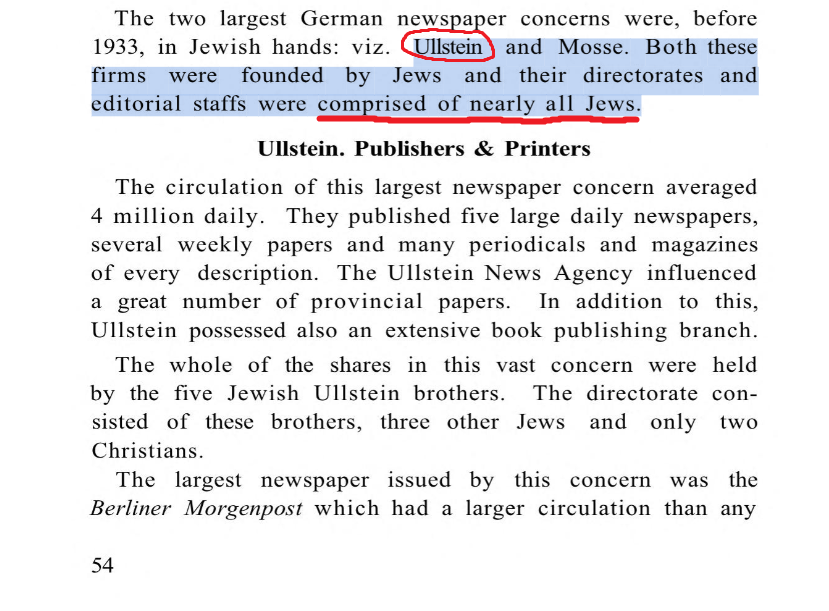
The Jewish Ullstein Publishing House “contributed to Hitler’s rise to power.” (p. 173)
“It is not clear how much influence this paper really had on the company’s politics, but embracing Nazi sympathizers now clearly belonged to its strategy.”
Note: The paper it's talking about is Vossische Zeitung, a paper owned by Ullstein.
“Many commentators criticized Ullstein for apparently trying to appease or pander to the Nazis.” (pp. 167-168)
The New York Times had this to say about Ullstein publishing house in 1930:
“This enormous chain publishing industry is unmatched by any similar organization in the United States. Naturally it wields tremendous power in Germany. The combined circulations of its newspapers and periodicals number millions and its influence extends into nearly every field, for there is scarcely a home throughout the length and breadth of the land that is not reached by at least one Ullstein publication.”
Jewish newspapers supporting Hitler and National Socialism.
Article: Controlled opposition according to the Protocols of the Learned Elders of Zion
“After meeting Hitler, Hanussen turned his Berliner Wochenschau and Die Hanussen-Zeitung, both of which had a circulation of 200,000, into Nazi propaganda outlets. [14] With the exception of three people, the entire editorial staff of the Berliner Wochenschau consisted of Jews. [15]”
Journal of Contemporary History (2018), volume 53, issue 1:
The Jewish Ullstein Publishing House “contributed to Hitler’s rise to power.” (p. 173)
“It is not clear how much influence this paper really had on the company’s politics, but embracing Nazi sympathizers now clearly belonged to its strategy.”
Note: The paper it's talking about is Vossische Zeitung, a paper owned by Ullstein.
“Many commentators criticized Ullstein for apparently trying to appease or pander to the Nazis.” (pp. 167-168)
The New York Times had this to say about Ullstein publishing house in 1930:
“This enormous chain publishing industry is unmatched by any similar organization in the United States. Naturally it wields tremendous power in Germany. The combined circulations of its newspapers and periodicals number millions and its influence extends into nearly every field, for there is scarcely a home throughout the length and breadth of the land that is not reached by at least one Ullstein publication.”