In August 1912, on the day of the centenary of the victory over Napoleon, the capital publishing house "Razum" published a book by Jewish historian Saul Moiseevich Ginzburg "The Patriotic War of 1812 and Russian Jews". This is the first and only such detailed study of the role of Russian Jews in Russia's wars with Napoleon opened a new page in both Jewish and Russian historical science. According to the reviewer, Semyon Markovich Dubnov: "The author did a difficult feat: he revised all available modern and later literature about the war of 1812 <...> extracted from there scattered grains of information about the role of Jews in the events of that era and <...> recreated a clear picture of the moment previously surrounded by fog". Ginzburg's book and the accompanying publications of his colleagues, reconstructing the era of the war of 1812, convincingly demonstrated the commitment of former Polish and Lithuanian Jews to their new fatherland, their active role in achieving Russia's victory in the war with Napoleon.
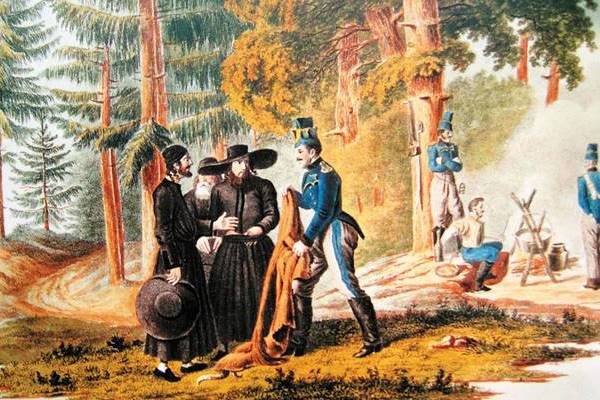
Christian Wilhelm von Faber du For. The bargain of a French soldier with the Jews in Moleto. 1812
Reflecting on the motives that prompted the Jews to actively support the Russian army, Ginzburg wrote: "France in the eyes of orthodous Jewry was a hotbed of freethinking and godlessness, Napoleon was the source of a revolution that rose not only against earthly power, but also heavenly. <...> It was clear that it was necessary to counter the onslaught of this destructive force in every possible way in order to defend, to save what is most valuable and above all". Napoleon's victory would have led to the return of the former Polish territories with their Jewish population to Poland (at that time to the Duchy of Warsaw), where Jews were subjected to extreme restrictions. Therefore, as Ginzburg believed, "regardless of other motives, the elementary political meaning had to tell Russian Jews <...> the need for them to promote <...> the defeat of the enemy".
This observation of Ginzburg met with objection from his most authoritative colleague - Dubnov: "Not the "political meaning", which under Jewish disenfranchisement in Russia could say something in favor of the homeland of emancipation - France, but simply - the psyche of people whose nests were destroyed by the invading French-German gangs, moved by the whim of the despot to a senseless massacre. The Jewish commoner understood that the Frenchman or the German had to rob and rape him - that's why he was an "enemy" - while a dashing Cossack could both rob and beat a Jew, but he had to protect him, because it was still "his own". The instinct of self-preservation pushed an ordinary Jew to the Russian side and forced the Russians to provide services against a common enemy"S. 476."].
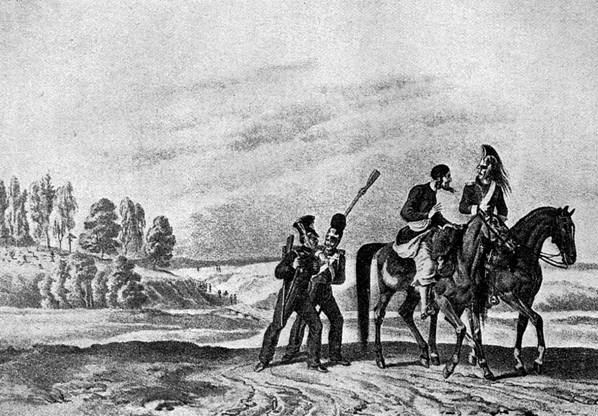
Christian Wilhelm von Faber du For. In the vicinity of Lubavichy. 1812
One of the most popular Jewish figures of the early 20th century, writer and ethnographer Semyon Akimovich Ansky, offered his explanation of the mass support of the Jews for the Russian army. "Behavior of Jews" during the war was determined by their "national and religious interests", he claimed, explaining that "Orthodox Judaism" experienced two deep crises in the second half of the 18th century, which ended with the fall of two large groups of Jews from Judaism: followers of the "religious-mystical (Fue-messianic)" teachings of Jacob Frank in the East and followers of the "educational-rationalist" teachings of Moses Mendelsohn in the West. As a result, Polish-Russian Jewry "became particularly suspicious of any innovation" and especially of the emancipation carried on their bayonets by the soldiers of the "great army" and which demanded that the Jews "renounce their nationality". "The Jews of that time, with all their surprise at Napoleon's genius, saw in him, first of all, the destroyer of religion, an enemy of all, including Jewish, identity and feared that with his victory would deal a decisive blow to the spiritual unity and autonomous organization of Polish-Lithuanian Jewry. On the contrary, they considered Alexander I a pious sovereign, a guardian of the old foundations and, despite the harsh measures against the Jews, sincerely disposed to them as a special nationality".
These conclusions of the "founding fathers" of Russian-Jewish historical science characterize in their totality the psychological atmosphere of the era, which determined the collective behavior of Jewish communities. Densely scattered in numerous cities and towns of the Western region, Jewish communities turned out to be a reliable support for the Russian army - both during its retreat from the western borders of the empire, and during the expulsion of the remnants of the "great army". Recall that in the so-called "Polish provinces" Jews made up the majority of the urban population. Engaged in trade and crafts, the maintenance of snags and mills, the organization of small industries and crafts, they were naturally involved in the supply of provisions and fodder, ammunition and uniforms to the Russian troops, in providing them with transport and housing, in maintaining the serviceability of waterways and crossings, in the supply of medicines and necessary equipment to military hospitals and infirmaries, in the organization of postal communication, etc. All these industries, mastered by the Jews in the pre-war era, as well as during the wars of Russia with France and Turkey (1805-1812), were oriented in 1812 to support the Russian army.
The active help of Jews changed the traditional attitude of Russian society towards them. This break in the consciousness of a significant part of the military and civil administration - from suspicion to trust - is clearly heard in the review of a contemporary, who was cited on the pages of his book "Napoleon's Invasion of Russia" by a prominent historian of the Russian-French wars Academician E. V. Tarle: "It must be admitted that the Jews do not deserve those reproaches that were once burdened by all the world <...> because, despite all the tricks of the godless Napoleon, who declared himself a zealous defender of the Jews and the worship they sent, remained loyal to their former (Russian) government and, in possible cases, did not miss even various means to prove their hatred and contempt for the proud and inhuman oppressor of peoples".
Under the pressure of wartime circumstances, mutual alienation and suspicion characteristic of the relationship between Jews and Russian authorities in the pre-war era were replaced by partnership relations. These changes were primarily expressed in the attitude of the authorities to the Kahals (the boards of Jewish communities). Through the Kahals, the military leadership and local administration appealed to the Jewish population of cities and towns not only with demands to fulfill certain duties of wartime, but also with requests for help, and with words of gratitude.
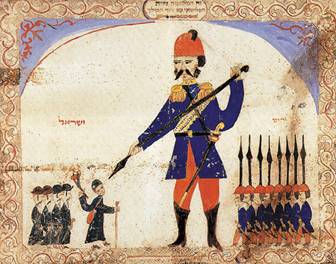
David's fight with Goliath is a Jewish lubok from the congregation of S. An-sky
For example, Major General V. And. Harpe expressed his gratitude to the Jews of Vitebsk in a letter to the Vitebsk Kahal:
I gave this city of Vitebsk to the Jewish kahal in that after the defeat of the enemy, who was in Vitebsk, by my detachment this month on the 26th (October 1812. - V. L.), when the troops entered the city, the zealous society of the Jews, while maintaining loyalty to our most merciful sovereign together with the Russians, was met with joyful exclamations and glorification of the name of our monarch; even when the enemy lit the bridge on the Dvina, they instantly ran away with buckets to extinguish it; where did the runaway enemy infantry hide, regardless of the shots, they caught (enemies everywhere. - V. L.), not allowing them in the last minutes of possession to ruin the city on the eve of my attack. As soon as they learned about the arrival of the troops to Vitebsk, they secretly and skillfully sent two Russian and Jewish burghers to me at night with a notification of their enemy disposition; in short, they made quite an effort in our favor, as true sons of the fatherland and loyal subjects of the emperor's sovereign. I brought such a act worthy of praise and gratitude of the Russians and Jews of Vitebsk to the attention of the commander-in-chief, Mr. Cavalry General and Cavalier Count Witttgenstein, and his Excellency expressed my special gratitude to them.
The most important function of the kahal for the army during the war was his participation in the formation of intelligence personnel. Director of the military police of the 1st Army Y. I. de-Sanglen, who headed the army intelligence service at the beginning of the war, recalled: "I made ties with the Kahal of Vilnius Jews, and on their guarantee sent a Jew to Warsaw, who was traveling with the goods; he was the first to notify me about the future arrival of Narbon (Napoleone's adjutant general, French envoy and spy. - V. L.) to Vilna and sent Napoleon's proclamation".
The same method of recruiting Jews for intelligence through Kahals is evidenced by the documents of the native of Stary Bykhov Naftali-Herz Shulman, which, being in 1812 under Major General Tuchkov, "was used in different places in Poland and Lithuania for the establishment, with the general consent of the Jewish people, of the so-called secret kahals, which served to notify Russian troops about enemy movements, to give guides, scouts and other secret military-related assignments, which he performed with excellent activity and loyalty, not sparing himself in the upcoming dangers".
The mechanism of allocation of secret agents by the communities reveals the report of the Radomysly mayor: "The Old Bykh Jew Hertz Shulman, who arrived in the city of Radomysl, ordered <...> the senior local Kagal to gather all the Jews to elect three people from them, conscientious and knowing Jewish laws, with the fact that he would lead them to the oath and reveal to them a secret that they should not discover until the need for it".
The same method of attracting Jews to the secret police service in wartime was also used by the civil administration, as evidenced by the report on the authorities of the Volyn governor M. And. Komburleya:
Having made sure by experience of the commitment of the Jewish people to Russia and that they, prosperous under the state of Russia, do not want a change of government, I decided to use the behavior of landlords, their correspondence with foreign and any preparations for their ability to secret intelligence in reasoning. As a result, at the invitation of police chiefs, mayors and zemstvo correctional officers of the best and most reliable people from Jewish societies and at the suggestion of my confidence in their loyalty to Russia, with great willingness and pleasure they agreed to choose two, three or more agile people who would observe the lifestyle and behavior of not only the landlords, but also the peasants, note every action and preparation if any tends to harm the public peace, and would try to scout about correspondence and connections with foreign ones. They obliged these people to keep the secret with oaths according to their law and promised them that if they were not awarded by the Government, then to give them a reward from themselves, and especially on the occasion of the most important discoveries.
Thus, under the communities in the war zone, groups of several people were formed, elected as Kagal elders or including themselves, who were called "secret Kahals". Commanders of military units, if necessary, used members of "secret kahals" as scouts or guides, and the civil administration as secret police agents.
Kahal stamp seal
Jews sincerely reacted to proposals for cooperation in intelligence or secret police, perceiving this dangerous activity as a natural expression of their commitment to Russia. Their choice was supported by the anti-Napoleonic agitation of the leader of the Belarusian Jewry, the founder of the Chabad movement Rabbi Shneur-Zalman. As a rabbi of the town of Lyady, Alter Rebe took on the task of practical organization of intelligence. Evidence of this was left by his son, Lubavitch Tzadik Rabbi Dov-Ber: "Father sent many envoys to Tolochin, reported everything to Vitebsk according to the general's request, actively took care of the dispatch of scouts"- and his widow Stern: "During his stay in the town of Lyadakh and upon the approach of the enemy, he tried to open the locations of enemy troops to the Russian army out of the sole zeal for the subject power, in which he had testimony from Major General Neverovsky".
As an incentive measure, the military leadership in some cases promised to release its secret agents from wartime duties or, as stated in the "security certificate" issued to Shulman, "freed from all harassment and standing". Despite the fact that these groups of secret agents were called "secret kahals" during the war, their alleged secret service was difficult to hide from local residents, among whom there was always a slanderer.
According to one of the "heroes of the invisible front", Vitebsk kahal Nohim Bogorad, he was sent by the governor "to find out about the approach of the enemy's troops to the provincial city of Vitebsk, did not spare labor and was in danger, having seen about them in the Lepelsky district and, according to my vigility and diligence, the order of the authorities, he had no time and money to think about my property for the quick overtching of the enemy. The onago robbers who ruined the whole city reached me, caught me and exhausted me in prison". The injured scout was supported in his request for help by the Vitebsk civil governor K. K. Leschern: "He was sent by me to Lepel to learn about the enemy troops, which he did exactly with diligence and prudence without the slightest fear and danger. For what diligence and jealousy of the all-Russian throne, giving it fair praise, I testify". P., who succeeded Leschern as governor. P. Tormasov added from himself, "that by occupation by him (the enemy. - V. L.) of the city and upon learning about his service for the benefit of the Fatherland, was oppressed more than others and plundered to the rest, and that now, being in extreme distress with his family, worthy of view on him and assistance".
Information about the "service of the Jewish people and their kahals"regularly came to Emperor Alexander I, who on various incations expressed his "merciful disposition to the Jewish kagals". When at the end of 1812 Alexander I actually assumed the supreme command of the army, among other reorganizations carried out by him together with the Chief of the General Staff P. M. Volkonsky, the army's connections with Jewish communities were centralized. For this purpose, the supreme command attracted two merchants engaged in military supplies to stay at the Main Imperial Apartment: Zundel Sonnenberg from Grodno and Lazer Dillon from Nesvizh. Officially, they were called "deputies of the Jewish people at the Main Apartment of His Imperial Majesty". Probably, the "election" of deputies by the communities of Grodno and Nesvizh was boiled down to obtaining approval from their kagals. It is doubtful that during the ongoing war their high title would be justified by real elections of deputies within the empire or even the province.
When the war soon unfolded in Europe, the task of the Jewish deputies was to provide supplies and other services provided by Jewish communities to Russian troops. Along with official instructions, the deputies also carried out the secret instructions of the supreme power. As Dilon subsequently notified the chief of the high police A. X. Benkendorf: "By the highest order, I established special reliable and secret Jewish kagals in some provinces to provide me with the necessary information on the most important, even political matters, which I had the good fortune to report to His Imperial Majesty in a timely manner".
At the same time, Emperor Alexander I, having the habit of not to rely on anyone completely, determined another candidate for the organization of the secret service of the Kagals. In January 1813, he entrusted the formation of a secret Jewish agency based on the kagals, who acquired the relevant experience of Naftali-Hertz Shulman. This agent network, through its leader, reported directly to the emperor. Here's what Shulman himself writes about the tasks assigned to him and how to solve them:
Having become at the time of the deployment of enemy troops to the Russian Empire, a somewhat well-known <...> to the late Lord Commander-in-Chief of all Russian armies and various orders, Cavalier Prince Kutuzov, and upon the award of His Excellency, I had the luck to appear before His Imperial Majesty and receive the Supreme Order, having traveled to all the cities, to elect under the name of the sagal of the most venerable and firmly observed their law Jews, whom it would be a duty to report not tokmo on the affairs of war, but also about everything that can concern the benefit of the state.
With all the variety of examples of Jewish secret service during the war of 1812, the establishment of a secret Jewish agency under the emperor is an unprecedented fact in the history of Russian Jewry, it recorded the moment of establishing the most trusting attitude of the highest administration to its Jewish subjects and their communal governments. Having essentially expanded the powers of the kagal, the authorities not only made his decisions on which of the members of the community to be a scout or a guide, how to organize surveillance of suspicious landlords or peasants, but also trusted the kagal to decide for himself what "it can benefit the state".
Against this background of increased trust in the Kagal, even the speech of the war hero, the commander of the flying partisan detachment Denis Davydov, in front of the assembled citizens of Grodno after the expulsion of the French from there does not look like an ordinary phenomenon:
I order everyone and in everything to treat the Jewish Kagal. Knowing the loyalty of the Jews to the Russians, I elect the Kagal as the head of the highest police and hold him responsible for all kinds of unrest that may arise in the city, as well as for all secret meetings about which the head of the city will not be notified; the case of the Kagal to choose assistants from the Jews to supervise, both the police and all Polish inhabitants of the city. Kagaly must remember and be proud of the power that I put on him and the Jews, and know that their jealousy and diligence will be known to the highest authorities.
Raising the status of the kagal in the eyes of the military command and civil administration required its own visual design, and the kagal elders found a visible expression of the changed order. They placed the symbol of the Russian Empire - a double-headed eagle - on the Kagal seals.
For the first time, such a seal received legitimacy from the authorities in Vilna: on March 15, 1816, members of the Vilnius kagal appealed to the civil governor of the Vilnius province A. S. Lavinsky with a "report" "On allowing a kagal to have a state seal with the Supreme Coat of Arms", Vilnius. F. 380. Op. 66. D. 255). L. 1 vol. "]. Justifying the need for such a press, members of the community board equated the kagal with the "present places" - institutions of state administration:
In the well-behaved Russian state, Jewish kagals have been established for the highest purpose, the election of onago members is made on a par with the present places of the lower instances for every three years by points, and <members> are approved by the same superiors as other members of those places, receive frequent prescriptions from the authorities <...> it is necessary as for printing different envelopes (envelopes. - V. L.), issued by the kagal for Jews to obtain passports of various certificates, and more than in the now constituting new audit of certificates and other state documents issued to Jews emanating from the kagal.
The governor was understandingful of the appeal of the Kagal elders, sending their report to the Vilensky police chief with his resolution, which allowed the Kagal "to have a seal with the image of the Supreme Coat of Arms on it with the inscription Seal of the Vilensky Jewish Kagal".
The fact that in the post-war years the practice of using such a seal was widespread among the Jewish communities of the Western Territory is evidenced by the appeal of the Kagals of the town of Oshmyany "on allowing the Oshmyan Jewish Kagal, following the example of other Kagals, to have a seal with the Russian coat of arms of the two-headed (so in the text. - V. L.) eagle".
For a decade and a half, the kagals stamped their documents with a seal with the state coat of arms, until in 1830, the vigilant officials of the Vilnius provincial government paid attention to the next paper from the kagal, certified by such a seal. On the instructions of the provincial board, the Vilna police authorities tried to take away the Kagal seal. However, the kagal elders did not give up the seal, but instead of it they presented official permits for its use. The case of Kagal seals reached the Senate, and from there it was submitted to the Jewish Committee, the decision of which was transferred to the Department of Spiritual Affairs of Foreign Confessions, and then signed by the Chief Manager D. Bludova and director F. Vigel - to the Minister of Internal Affairs:
The Jewish Committee, finding that according to the laws, Christian societies, not having the right to a seal with the state coat of arms, must have their own with the city coat of arms, and recognizing it indecent to give Jewish societies a right that even Christians do not enjoy <...>, should take state seals from those kagals who have them and give them to have private ones with the inscription of the indicated kagals to which they belong.
This completion of the history of the "kagal seal with the state coat of arms", as in a mirror, reflected the change of eras. The short-term warming of the attitude of the authorities towards the Jews and their communal governments was replaced by the frosts of the last years of the reign of Alexander I, which were soon replaced by the coldness of the Nikolaev regime. Recall that a decade and a half after the double-headed eagle flew away from the Kagal seal, the Kagals themselves were also abolished.
The hopes of the Jews that the recognition of their merits in the war of 1812 would be expressed in the improvement of their legal status by the government were not destined to be fulfilled.
The project of creating a permanent Jewish representation also turned out to be short-lived. Formed on the instructions of Alexander I in 1812, the "deputation of the Jewish people" did not actually survive "the deceased emperor in the bose". However, if the initiatives of the highest administration were destined to have a short life, the phenomena that caused them to life were deeply imprinted in the Jewish collective consciousness. The very fact of the formation of the "deputation of the Jewish people" was perceived by many as a step towards the revival of traditional Jewish autonomy. In the post-war years, the activities of Jewish communities were aimed at improving this body, which received state status in 1818. At the congresses held in 1815-1818 in Zelva, Minsk and Vilna, representatives of Jewish communities sought to form an effective Jewish representation that would express the interests of all communities of the empire. In this activity of Jewish communities, one can see the development of the process of consolidation and self-identification of Russian Jewry, to which the war of 1812 gave a powerful impetus.
The war of 1812 was the most significant event in the lives of all its participants, leaving a deep mark not only in their minds and in the memory of their descendants, but also in the collective memory of Russian Jewry. It became the cornerstone of many Jews who were active partners of the Russian army: contractors and suppliers, secret agents and secret service organizers. For one of them, the war determined the way to the elite of Jewish society, for others, paved the way for integration into Russian society. The first historian of the Jewish community of Vilna, Shmuel-Josef Finn, bitterly mentioned the Vilnius merchants who achieved success during the Russian-French wars: "Many merchants of the city, thanks to successful transactions, improved their situation, got rich, acquired new connections and expanded the areas of their trade in different parts of the country, but they themselves changed, moved away from the customs of their ancestors, brought up in separation".
The war of 1812 created optimal conditions for the meeting of the former Polish-Lithuanian Jewry with Russian society, accelerating the process of their mutual recognition and nominating its most prominent participants to the podium of history. We expect to trace the individual fates of these "children of the twelfth year", which in their entirety make up the overall picture of the era in the following essays.
In August 1912, on the day of the centenary of the victory over Napoleon, the capital publishing house "Razum" published a book by Jewish historian Saul Moiseevich Ginzburg "The Patriotic War of 1812 and Russian Jews". This is the first and only such detailed study of the role of Russian Jews in Russia's wars with Napoleon opened a new page in both Jewish and Russian historical science. According to the reviewer, Semyon Markovich Dubnov: "The author did a difficult feat: he revised all available modern and later literature about the war of 1812 <...> extracted from there scattered grains of information about the role of Jews in the events of that era and <...> recreated a clear picture of the moment previously surrounded by fog". Ginzburg's book and the accompanying publications of his colleagues, reconstructing the era of the war of 1812, convincingly demonstrated the commitment of former Polish and Lithuanian Jews to their new fatherland, their active role in achieving Russia's victory in the war with Napoleon.
Christian Wilhelm von Faber du For. The bargain of a French soldier with the Jews in Moleto. 1812
Reflecting on the motives that prompted the Jews to actively support the Russian army, Ginzburg wrote: "France in the eyes of orthodous Jewry was a hotbed of freethinking and godlessness, Napoleon was the source of a revolution that rose not only against earthly power, but also heavenly. <...> It was clear that it was necessary to counter the onslaught of this destructive force in every possible way in order to defend, to save what is most valuable and above all". Napoleon's victory would have led to the return of the former Polish territories with their Jewish population to Poland (at that time to the Duchy of Warsaw), where Jews were subjected to extreme restrictions. Therefore, as Ginzburg believed, "regardless of other motives, the elementary political meaning had to tell Russian Jews <...> the need for them to promote <...> the defeat of the enemy".
This observation of Ginzburg met with objection from his most authoritative colleague - Dubnov: "Not the "political meaning", which under Jewish disenfranchisement in Russia could say something in favor of the homeland of emancipation - France, but simply - the psyche of people whose nests were destroyed by the invading French-German gangs, moved by the whim of the despot to a senseless massacre. The Jewish commoner understood that the Frenchman or the German had to rob and rape him - that's why he was an "enemy" - while a dashing Cossack could both rob and beat a Jew, but he had to protect him, because it was still "his own". The instinct of self-preservation pushed an ordinary Jew to the Russian side and forced the Russians to provide services against a common enemy"S. 476."].
Christian Wilhelm von Faber du For. In the vicinity of Lubavichy. 1812
One of the most popular Jewish figures of the early 20th century, writer and ethnographer Semyon Akimovich Ansky, offered his explanation of the mass support of the Jews for the Russian army. "Behavior of Jews" during the war was determined by their "national and religious interests", he claimed, explaining that "Orthodox Judaism" experienced two deep crises in the second half of the 18th century, which ended with the fall of two large groups of Jews from Judaism: followers of the "religious-mystical (Fue-messianic)" teachings of Jacob Frank in the East and followers of the "educational-rationalist" teachings of Moses Mendelsohn in the West. As a result, Polish-Russian Jewry "became particularly suspicious of any innovation" and especially of the emancipation carried on their bayonets by the soldiers of the "great army" and which demanded that the Jews "renounce their nationality". "The Jews of that time, with all their surprise at Napoleon's genius, saw in him, first of all, the destroyer of religion, an enemy of all, including Jewish, identity and feared that with his victory would deal a decisive blow to the spiritual unity and autonomous organization of Polish-Lithuanian Jewry. On the contrary, they considered Alexander I a pious sovereign, a guardian of the old foundations and, despite the harsh measures against the Jews, sincerely disposed to them as a special nationality".
These conclusions of the "founding fathers" of Russian-Jewish historical science characterize in their totality the psychological atmosphere of the era, which determined the collective behavior of Jewish communities. Densely scattered in numerous cities and towns of the Western region, Jewish communities turned out to be a reliable support for the Russian army - both during its retreat from the western borders of the empire, and during the expulsion of the remnants of the "great army". Recall that in the so-called "Polish provinces" Jews made up the majority of the urban population. Engaged in trade and crafts, the maintenance of snags and mills, the organization of small industries and crafts, they were naturally involved in the supply of provisions and fodder, ammunition and uniforms to the Russian troops, in providing them with transport and housing, in maintaining the serviceability of waterways and crossings, in the supply of medicines and necessary equipment to military hospitals and infirmaries, in the organization of postal communication, etc. All these industries, mastered by the Jews in the pre-war era, as well as during the wars of Russia with France and Turkey (1805-1812), were oriented in 1812 to support the Russian army.
The active help of Jews changed the traditional attitude of Russian society towards them. This break in the consciousness of a significant part of the military and civil administration - from suspicion to trust - is clearly heard in the review of a contemporary, who was cited on the pages of his book "Napoleon's Invasion of Russia" by a prominent historian of the Russian-French wars Academician E. V. Tarle: "It must be admitted that the Jews do not deserve those reproaches that were once burdened by all the world <...> because, despite all the tricks of the godless Napoleon, who declared himself a zealous defender of the Jews and the worship they sent, remained loyal to their former (Russian) government and, in possible cases, did not miss even various means to prove their hatred and contempt for the proud and inhuman oppressor of peoples".
Under the pressure of wartime circumstances, mutual alienation and suspicion characteristic of the relationship between Jews and Russian authorities in the pre-war era were replaced by partnership relations. These changes were primarily expressed in the attitude of the authorities to the Kahals (the boards of Jewish communities). Through the Kahals, the military leadership and local administration appealed to the Jewish population of cities and towns not only with demands to fulfill certain duties of wartime, but also with requests for help, and with words of gratitude.
David's fight with Goliath is a Jewish lubok from the congregation of S. An-sky
For example, Major General V. And. Harpe expressed his gratitude to the Jews of Vitebsk in a letter to the Vitebsk Kahal:
I gave this city of Vitebsk to the Jewish kahal in that after the defeat of the enemy, who was in Vitebsk, by my detachment this month on the 26th (October 1812. - V. L.), when the troops entered the city, the zealous society of the Jews, while maintaining loyalty to our most merciful sovereign together with the Russians, was met with joyful exclamations and glorification of the name of our monarch; even when the enemy lit the bridge on the Dvina, they instantly ran away with buckets to extinguish it; where did the runaway enemy infantry hide, regardless of the shots, they caught (enemies everywhere. - V. L.), not allowing them in the last minutes of possession to ruin the city on the eve of my attack. As soon as they learned about the arrival of the troops to Vitebsk, they secretly and skillfully sent two Russian and Jewish burghers to me at night with a notification of their enemy disposition; in short, they made quite an effort in our favor, as true sons of the fatherland and loyal subjects of the emperor's sovereign. I brought such a act worthy of praise and gratitude of the Russians and Jews of Vitebsk to the attention of the commander-in-chief, Mr. Cavalry General and Cavalier Count Witttgenstein, and his Excellency expressed my special gratitude to them.
The most important function of the kahal for the army during the war was his participation in the formation of intelligence personnel. Director of the military police of the 1st Army Y. I. de-Sanglen, who headed the army intelligence service at the beginning of the war, recalled: "I made ties with the Kahal of Vilnius Jews, and on their guarantee sent a Jew to Warsaw, who was traveling with the goods; he was the first to notify me about the future arrival of Narbon (Napoleone's adjutant general, French envoy and spy. - V. L.) to Vilna and sent Napoleon's proclamation".
The same method of recruiting Jews for intelligence through Kahals is evidenced by the documents of the native of Stary Bykhov Naftali-Herz Shulman, which, being in 1812 under Major General Tuchkov, "was used in different places in Poland and Lithuania for the establishment, with the general consent of the Jewish people, of the so-called secret kahals, which served to notify Russian troops about enemy movements, to give guides, scouts and other secret military-related assignments, which he performed with excellent activity and loyalty, not sparing himself in the upcoming dangers".
The mechanism of allocation of secret agents by the communities reveals the report of the Radomysly mayor: "The Old Bykh Jew Hertz Shulman, who arrived in the city of Radomysl, ordered <...> the senior local Kagal to gather all the Jews to elect three people from them, conscientious and knowing Jewish laws, with the fact that he would lead them to the oath and reveal to them a secret that they should not discover until the need for it".
The same method of attracting Jews to the secret police service in wartime was also used by the civil administration, as evidenced by the report on the authorities of the Volyn governor M. And. Komburleya:
Having made sure by experience of the commitment of the Jewish people to Russia and that they, prosperous under the state of Russia, do not want a change of government, I decided to use the behavior of landlords, their correspondence with foreign and any preparations for their ability to secret intelligence in reasoning. As a result, at the invitation of police chiefs, mayors and zemstvo correctional officers of the best and most reliable people from Jewish societies and at the suggestion of my confidence in their loyalty to Russia, with great willingness and pleasure they agreed to choose two, three or more agile people who would observe the lifestyle and behavior of not only the landlords, but also the peasants, note every action and preparation if any tends to harm the public peace, and would try to scout about correspondence and connections with foreign ones. They obliged these people to keep the secret with oaths according to their law and promised them that if they were not awarded by the Government, then to give them a reward from themselves, and especially on the occasion of the most important discoveries.
Thus, under the communities in the war zone, groups of several people were formed, elected as Kagal elders or including themselves, who were called "secret Kahals". Commanders of military units, if necessary, used members of "secret kahals" as scouts or guides, and the civil administration as secret police agents.
Kahal stamp seal
Jews sincerely reacted to proposals for cooperation in intelligence or secret police, perceiving this dangerous activity as a natural expression of their commitment to Russia. Their choice was supported by the anti-Napoleonic agitation of the leader of the Belarusian Jewry, the founder of the Chabad movement Rabbi Shneur-Zalman. As a rabbi of the town of Lyady, Alter Rebe took on the task of practical organization of intelligence. Evidence of this was left by his son, Lubavitch Tzadik Rabbi Dov-Ber: "Father sent many envoys to Tolochin, reported everything to Vitebsk according to the general's request, actively took care of the dispatch of scouts"- and his widow Stern: "During his stay in the town of Lyadakh and upon the approach of the enemy, he tried to open the locations of enemy troops to the Russian army out of the sole zeal for the subject power, in which he had testimony from Major General Neverovsky".
As an incentive measure, the military leadership in some cases promised to release its secret agents from wartime duties or, as stated in the "security certificate" issued to Shulman, "freed from all harassment and standing". Despite the fact that these groups of secret agents were called "secret kahals" during the war, their alleged secret service was difficult to hide from local residents, among whom there was always a slanderer.
According to one of the "heroes of the invisible front", Vitebsk kahal Nohim Bogorad, he was sent by the governor "to find out about the approach of the enemy's troops to the provincial city of Vitebsk, did not spare labor and was in danger, having seen about them in the Lepelsky district and, according to my vigility and diligence, the order of the authorities, he had no time and money to think about my property for the quick overtching of the enemy. The onago robbers who ruined the whole city reached me, caught me and exhausted me in prison". The injured scout was supported in his request for help by the Vitebsk civil governor K. K. Leschern: "He was sent by me to Lepel to learn about the enemy troops, which he did exactly with diligence and prudence without the slightest fear and danger. For what diligence and jealousy of the all-Russian throne, giving it fair praise, I testify". P., who succeeded Leschern as governor. P. Tormasov added from himself, "that by occupation by him (the enemy. - V. L.) of the city and upon learning about his service for the benefit of the Fatherland, was oppressed more than others and plundered to the rest, and that now, being in extreme distress with his family, worthy of view on him and assistance".
Information about the "service of the Jewish people and their kahals"regularly came to Emperor Alexander I, who on various incations expressed his "merciful disposition to the Jewish kagals". When at the end of 1812 Alexander I actually assumed the supreme command of the army, among other reorganizations carried out by him together with the Chief of the General Staff P. M. Volkonsky, the army's connections with Jewish communities were centralized. For this purpose, the supreme command attracted two merchants engaged in military supplies to stay at the Main Imperial Apartment: Zundel Sonnenberg from Grodno and Lazer Dillon from Nesvizh. Officially, they were called "deputies of the Jewish people at the Main Apartment of His Imperial Majesty". Probably, the "election" of deputies by the communities of Grodno and Nesvizh was boiled down to obtaining approval from their kagals. It is doubtful that during the ongoing war their high title would be justified by real elections of deputies within the empire or even the province.
When the war soon unfolded in Europe, the task of the Jewish deputies was to provide supplies and other services provided by Jewish communities to Russian troops. Along with official instructions, the deputies also carried out the secret instructions of the supreme power. As Dilon subsequently notified the chief of the high police A. X. Benkendorf: "By the highest order, I established special reliable and secret Jewish kagals in some provinces to provide me with the necessary information on the most important, even political matters, which I had the good fortune to report to His Imperial Majesty in a timely manner".
At the same time, Emperor Alexander I, having the habit of not to rely on anyone completely, determined another candidate for the organization of the secret service of the Kagals. In January 1813, he entrusted the formation of a secret Jewish agency based on the kagals, who acquired the relevant experience of Naftali-Hertz Shulman. This agent network, through its leader, reported directly to the emperor. Here's what Shulman himself writes about the tasks assigned to him and how to solve them:
Having become at the time of the deployment of enemy troops to the Russian Empire, a somewhat well-known <...> to the late Lord Commander-in-Chief of all Russian armies and various orders, Cavalier Prince Kutuzov, and upon the award of His Excellency, I had the luck to appear before His Imperial Majesty and receive the Supreme Order, having traveled to all the cities, to elect under the name of the sagal of the most venerable and firmly observed their law Jews, whom it would be a duty to report not tokmo on the affairs of war, but also about everything that can concern the benefit of the state.
With all the variety of examples of Jewish secret service during the war of 1812, the establishment of a secret Jewish agency under the emperor is an unprecedented fact in the history of Russian Jewry, it recorded the moment of establishing the most trusting attitude of the highest administration to its Jewish subjects and their communal governments. Having essentially expanded the powers of the kagal, the authorities not only made his decisions on which of the members of the community to be a scout or a guide, how to organize surveillance of suspicious landlords or peasants, but also trusted the kagal to decide for himself what "it can benefit the state".
Against this background of increased trust in the Kagal, even the speech of the war hero, the commander of the flying partisan detachment Denis Davydov, in front of the assembled citizens of Grodno after the expulsion of the French from there does not look like an ordinary phenomenon:
I order everyone and in everything to treat the Jewish Kagal. Knowing the loyalty of the Jews to the Russians, I elect the Kagal as the head of the highest police and hold him responsible for all kinds of unrest that may arise in the city, as well as for all secret meetings about which the head of the city will not be notified; the case of the Kagal to choose assistants from the Jews to supervise, both the police and all Polish inhabitants of the city. Kagaly must remember and be proud of the power that I put on him and the Jews, and know that their jealousy and diligence will be known to the highest authorities.
Raising the status of the kagal in the eyes of the military command and civil administration required its own visual design, and the kagal elders found a visible expression of the changed order. They placed the symbol of the Russian Empire - a double-headed eagle - on the Kagal seals.
For the first time, such a seal received legitimacy from the authorities in Vilna: on March 15, 1816, members of the Vilnius kagal appealed to the civil governor of the Vilnius province A. S. Lavinsky with a "report" "On allowing a kagal to have a state seal with the Supreme Coat of Arms", Vilnius. F. 380. Op. 66. D. 255). L. 1 vol. "]. Justifying the need for such a press, members of the community board equated the kagal with the "present places" - institutions of state administration:
In the well-behaved Russian state, Jewish kagals have been established for the highest purpose, the election of onago members is made on a par with the present places of the lower instances for every three years by points, and <members> are approved by the same superiors as other members of those places, receive frequent prescriptions from the authorities <...> it is necessary as for printing different envelopes (envelopes. - V. L.), issued by the kagal for Jews to obtain passports of various certificates, and more than in the now constituting new audit of certificates and other state documents issued to Jews emanating from the kagal.
The governor was understandingful of the appeal of the Kagal elders, sending their report to the Vilensky police chief with his resolution, which allowed the Kagal "to have a seal with the image of the Supreme Coat of Arms on it with the inscription Seal of the Vilensky Jewish Kagal".
The fact that in the post-war years the practice of using such a seal was widespread among the Jewish communities of the Western Territory is evidenced by the appeal of the Kagals of the town of Oshmyany "on allowing the Oshmyan Jewish Kagal, following the example of other Kagals, to have a seal with the Russian coat of arms of the two-headed (so in the text. - V. L.) eagle".
For a decade and a half, the kagals stamped their documents with a seal with the state coat of arms, until in 1830, the vigilant officials of the Vilnius provincial government paid attention to the next paper from the kagal, certified by such a seal. On the instructions of the provincial board, the Vilna police authorities tried to take away the Kagal seal. However, the kagal elders did not give up the seal, but instead of it they presented official permits for its use. The case of Kagal seals reached the Senate, and from there it was submitted to the Jewish Committee, the decision of which was transferred to the Department of Spiritual Affairs of Foreign Confessions, and then signed by the Chief Manager D. Bludova and director F. Vigel - to the Minister of Internal Affairs:
The Jewish Committee, finding that according to the laws, Christian societies, not having the right to a seal with the state coat of arms, must have their own with the city coat of arms, and recognizing it indecent to give Jewish societies a right that even Christians do not enjoy <...>, should take state seals from those kagals who have them and give them to have private ones with the inscription of the indicated kagals to which they belong.
This completion of the history of the "kagal seal with the state coat of arms", as in a mirror, reflected the change of eras. The short-term warming of the attitude of the authorities towards the Jews and their communal governments was replaced by the frosts of the last years of the reign of Alexander I, which were soon replaced by the coldness of the Nikolaev regime. Recall that a decade and a half after the double-headed eagle flew away from the Kagal seal, the Kagals themselves were also abolished.
The hopes of the Jews that the recognition of their merits in the war of 1812 would be expressed in the improvement of their legal status by the government were not destined to be fulfilled.
The project of creating a permanent Jewish representation also turned out to be short-lived. Formed on the instructions of Alexander I in 1812, the "deputation of the Jewish people" did not actually survive "the deceased emperor in the bose". However, if the initiatives of the highest administration were destined to have a short life, the phenomena that caused them to life were deeply imprinted in the Jewish collective consciousness. The very fact of the formation of the "deputation of the Jewish people" was perceived by many as a step towards the revival of traditional Jewish autonomy. In the post-war years, the activities of Jewish communities were aimed at improving this body, which received state status in 1818. At the congresses held in 1815-1818 in Zelva, Minsk and Vilna, representatives of Jewish communities sought to form an effective Jewish representation that would express the interests of all communities of the empire. In this activity of Jewish communities, one can see the development of the process of consolidation and self-identification of Russian Jewry, to which the war of 1812 gave a powerful impetus.
The war of 1812 was the most significant event in the lives of all its participants, leaving a deep mark not only in their minds and in the memory of their descendants, but also in the collective memory of Russian Jewry. It became the cornerstone of many Jews who were active partners of the Russian army: contractors and suppliers, secret agents and secret service organizers. For one of them, the war determined the way to the elite of Jewish society, for others, paved the way for integration into Russian society. The first historian of the Jewish community of Vilna, Shmuel-Josef Finn, bitterly mentioned the Vilnius merchants who achieved success during the Russian-French wars: "Many merchants of the city, thanks to successful transactions, improved their situation, got rich, acquired new connections and expanded the areas of their trade in different parts of the country, but they themselves changed, moved away from the customs of their ancestors, brought up in separation".
The war of 1812 created optimal conditions for the meeting of the former Polish-Lithuanian Jewry with Russian society, accelerating the process of their mutual recognition and nominating its most prominent participants to the podium of history. We expect to trace the individual fates of these "children of the twelfth year", which in their entirety make up the overall picture of the era in the following essays.