
Official bulletin from Russian Orthodox Church in 2002 condemned Alexander Dugin as an occultist hostile to Christianity

Quote from Timothy Fitzpatrick on December 13, 2025, 13:45Saturday, June 21, 2014
Book of the Patriarchate of Moscow condemns Dugin
Below, to put an end to the legend that Dugin would have something of an Orthodox Christian, the translation of the chapter of the Moscow Patriarchate booklet that denounces all the occult heresies and sects that haunt Russia. Dugin won an entire chapter just for him. Heretic, pagan and apostate, there is nothing orthodox. Anathema, anathema, anathema!
The doctrine of Aleksandr DUGIN. "New religious associations of Russia of a destructive and hidden nature: a guide / Missionary Department of the Moscow Patriarchate of the Russian Orthodox Church".
Newsletter and analytical bulletin Nº1 - Belgorod, 2002, 3º edition, enlarged, 4.9 The doctrine of Aleksandr DUGIN.
( Link to reference to the book on Google Books: http://is.gd/462IoK )Guide.
Aleksandr DUGIN
Doctrine:
Among the neo-pagan doctrines, the opinions of A. DUGIN occupy a separate position. In particular, this is explained by the status of the author, leader of the "Eurasia" movement (by the fact that he is one of the well-known ideologists of the "Russia" movement), for his active collaboration with the Islamic Committee and for being an ambitious politician.
His teachings, harmoniously transformed into the ideology of the Eurasia movement, cannot be examined separately from the conception of the world of his spiritual mentor René GUÉNON, whose biography contains some data that allow us to more objectively evaluate the spiritual side of the doctrine of A. DUGIN
In addition, the role and position of the Orthodox Church, elaborated by A. DUGIN in programmatic documents and other writings related to the organization of the OPOD (Pan-Russian Social and Political Movement) Eurasia and the creation of the future Union of Eurasia.
All the documents used for the preparation of this section were published in public periodic information bodies. The opinions of A. DUGIN, his mentors and his followers were taken from monographs, almanacs, mass information organs directed by him and other editions, distributed basically by commercial companies controlled by the Eurasia movement and by other structures dependent on the author.
About the author of the doctrine:
Aleksandr Gelevitch DUGIN [1] was born in 1962 in the district of Chelyabinsk. His father was a general who worked in the central administration of the General Staff information system of the Armed Forces of the USSR. The general father put his son, who had not completed the Moscow Aviators School, in the KGB file. DUGIN knows about 10 European languages, and masters the Hebrew language. The claims of A. DUGIN became him, at the age of 35, the number 2 man of Eduard LIMONOV's Bolshevik National Party. He was enthusiastic about Freemasonry and fascism. He was an enemy of the "Soviet Empire". Currently, he defends totally opposite opinions.
In 1991 his first book "Caminho do Absoluto" was published where the foundations of his religious orientation are exposed. In 1992 he began to publish the magazine "Elementos". In 1993 he published the bestseller "Conspiracy Theory" which became the equivalent of the English action book "Spy Hunt". In the book "Conspiracy Theory" the theme of secret relations between the CIA and the KGB was developed.
According to his own confession, A. DUGIN in his youth called himself "a mystical fascist" and today he changed this name to "orthodox fascist".
A. DUGIN considers the French esoteric of the first half of the twentieth century René GUÉNON (15.11. 1886 - 07.01. 1951) as his master, as a recognized and indisputable authority, as an authentic emissary of the eschatological theory, considering him the key figure of this period. He writes: "René GUÉNON is the emissary of the supreme center for the last era, for the period of Kali Yuga, and the principles of Tradition formulated by him (the set of "non-human knowledge transmitted from one generation to another by the caste of priests or by other similar institutions) will serve as a bastion of salvation for those who will have to fight against "this World" and its "Prince", to reborn Tradition in its authentic, non-human and "angelic" dimension and, Closing the cycle, elaborating the sacred foundations of the approaching Golden Age." [2]
One of the fundamental objects of GUÉNON's research is a version of metaphysics, in which the conceptions of Hinduism exerted a great influence.
In an attempt to justify GUÉNON (and, therefore, his own conceptions about Christianity), A. DUGIN says that "the particularity of GUÉNON's traditionalism sometimes makes conservative members of the Church mistakenly consider esotericism and the synthesis to which he refers as occultism and syncretism."[ 3]
And, 1912 GUÉNON converted to Islam and adopted the Arabic name of Abd-el-Vakhed-Iakhia - Single Servant.
Later [4], however, DUGIN indicates that "GUÉNON received Masonic initiation from the neo-ro-rosecrian Theodor REUSS, who was a friend, comrade in arms and responsible for the initiation of A. CROWLEY". [5]
Let us remember that GUÉNON is an indisputable authority for A. DUGIN
Neopaganism in the light of the metaphysical conceptions of R. GUÉNON and A. DUGIN
The first religious research of A. DUGIN date from the early 90s of the last century and are linked to the foundation of the "Gentle Angle" almanac, in whose publications the spiritual sources of the teachings of a new messiah are examined. Here's what the writing team writes in this issue [6]:
"Our fundamental task ... is the restoration of integral tradition in all its total dimension ... The 'Gentle Anget Anal' almanack fights for the restoration of the medieval spirit, the medieval way of thinking, medieval religiosity and the medieval state conception." However, as we will see below, DUGIN interprets these "medieval" concepts from the point of view of neo-paganism.
Within the limits of the aforementioned Tradition, DUGIN recognizes the primacy of non-being: "any traditional metaphysics of full value recognizes the priority of non-being over being". [7] Here is one of the positions (answers) of A's eschatological gnosis. DUGIN: "The being appeared as proof that the non-being that contained it before its appearance is not the last instance, and that, beyond its limits, the Other is present, which coincides neither with the being nor with the non-being[8]. From his point of view the being "cannot also affirm its own primacy over the non-being, because it would contradict the truth, since the pure being is nothing more than the translation in reality, under its logical form, of the possibility of the non-being that preceded it."[ 9]
In a generalized way the spiritual doctrine of A. DUGIN is focused on the almanac "The End of the World. Eschatology and Tradition” (Moscow, Ed. Arktogaia, 1998). A himself. DUGIN calls this publication the "history of religion manual". However, the historical aspects of the various beliefs contained in this work are presented from their own (and totally peculiar) point of view. This contradicts the definition of the book as a historical work and gives it a dogmatic aspect. The mixture of Christian conceptions, runology, pagan concepts, various theories of cosmogony is just a small list of the freedoms of a dilettante to the materials of the collection.
By inserting in the historical collection [10] a chapter of the book "Path of the Absolute", ("Eschatological Gnosis"), A. DUGIN thus realizes that his religious doctrine is already formed.
Justifying the emergence of new religions and cults within the limits of Tradition, A. DUGIN writes the following literally: "The esoteric norms and structures of Tradition are transformed in accordance with the situation of the cosmic environment, and therefore new religions and traditions, new cult writings and new practices appear."[ 11]
This statement has far-reaching consequences. If the cosmic environment constitutes the non-being that generates the being, then the emergence of new religions and cults (possible only within the limits of being) is an objective fact (from a metaphysical point of view) and this means that sooner or later a new religion within the limits of the State of Eurasia will appear and beyond that it will be absurd to resist it.
It should be noted that this statement is inserted in the section of the "manual" devoted to the analysis of the religious teachings of A. CROWLEY
In this way, we can already define the religious doctrine of A. DUGIN as an interpretation of the metaphysics of Hinduism combined with concepts of Orthodox Marxism. From the linguistic aspect, this doctrine takes the form of a pseudoscientific terminology, extremely attractive to diletants who, like A himself. DUGIN, did not complete a university course, and who share the ideals of communist ideology.
(Blog note - by Saulo: I think that at the time Dugin had not graduated in anything yet - does he teach at the University of Moscow without having completed a university course? - "Dugin presents himself as an academic and philosopher, claiming two PhD titles, but who and how granted him such diplomas remains a carefully kept secret [ http://en.metapedia.org/Alexander_Dugin ] )
Orthodoxy in the interpretation of A. DUGIN
DUGIN makes an analysis of Orthodoxy from the traditionalist position of GUÉNON, advancing the thesis: "The Christian Church ... if it follows a traditionalist and conservative orientation, as a general rule, at best, it constitutes the fundamental support for the conservation of the esoteric, ritualistic and dogmatic aspect... . The Church either limits its non-liturgical activity by a simplified moralism, or, what is worse, tries to deal with apologetics based on fundamentally profane, contemporary and anti-traditionalist theories, or, what is terrible, tends to syncretism, ecumenism and even the lowest neospiritualism....". [12]
In the works of A. DUGIN clearly manifests the effect of the law of dichotomy. For example, the attempt to research Russia's pre-Christian and pre-Orthodox beliefs leads to A. DUGIN to paradoxical conclusions. Here is one of them: "Christianity did not replace, but raised and consolidated the ancient pre-Christian faith." [13
He writes: "When we have before us a really important and authentic tradition, we can almost always discover in it its transcendentalism and its immanent character, and this last characteristic constitutes its inner and esoteric part."[14], that is, for A. DUGIN paganism is also a supposed Orthodoxy, yet better and more original. "The immanent aspect" is the mystical conception of the world of A. DUGIN and his followers. This conception comes in particular from the fact that it is enough to think of a "conspiracy" and the idea of conspiracy already becomes reality and, to the extent that it is "I" who thinks, then this is a much more important reality from a metaphysical point of view than concrete reality [15]
The "immanent aspect" does not distinguish ideas that have their foundation in everyday life and also nominal (or ordinarily fictitious) ideas, and gives preference to fictitious ones. The inability of the attempt to associate the "immanent aspect" with Christianity manifests itself in a particularly visible way in the attempt to interpret the Creed, attempted by A. DUGIN, where he usually descends for a frank heresy[14]. Thus, he states that the Nicea Creed is a profession of faith with "a small concession to Christian prejudices". In addition, A. DUGIN usually calls the Creed the "Formula of Faith [16]. By doing this, he considers that the first three members (or, in the terminology of A. DUGIN, points) provide an absolute and finished image of metaphysics [17]
In his "works" [18] A. DUGIN simply blasphemes by affirming a certain real (existential or ontological) aspect of the Trinity. He denies the revelation that God is the creator of the world and that it always transcends any material aspect.
DUGIN introduces an innovation in the doctrine of the immortality of the soul. He writes in private: "The Soul, a subtle form, woven of substances from the atmosphere, survives the body in which it spent its earthly life and can live independently even after bodily death ... But the path to the heaven of the spirit ... is impossible for the individual soul, because this world, by definition, does not admit in itself beings dressed in form".[ 19] However, according to orthodox doctrine, God creates the soul by his creative breath [20].
DUGIN in a purely theosophical sense insists on the "discovery within the human personality" of a substance radically different from the old usual "I" of the individual. He states that this discovery takes place during baptism [21]. And in this A. DUGIN sees a way out for the "salvation" of the human being.
This statement diametrically contradicts João Damasceno's definition: "the soul is a living, simple and incorporeal substance, by nature invisible to human eyes, immortal, endowed with understanding and intelligence and does not have a determined image (form)". It acts with the help of the organic body and communicates life, growth, feeling and generational strength. Intelligence or spirit belongs to the soul not as something diverse, separated from it, but as its purest part. What are the eyes for the body, so is the intelligence for the soul. The soul is a free being, endowed with the capacity for will and action. She is "susceptible to change on the part of the will". [22]
The erroneous and sometimes frankly heretical conceptions and statements of A. DUGIN are complemented by runology, the doctrine on the cyclical character of the cosmic phases and the other pagan beliefs.
According to the aforementioned dichotomy law, used by A. DUGIN largely to elaborate his works, comes to the inevitable conclusion that there are two types of Hinduism according to GUÉNON - a good and a bad one. The "bad" is the western one and the "good", the oriental, supposedly orthodox. A. DUGIN sees "a bright future" for orthodoxy with the combination of the esoteric principle of the Church (that is, with the ecclesiastical organization) with pagan esoteric gnosis. This approach, as he describes, opens up "unlimited possibilities for a deep and unexpected understanding of Russian orthodoxy"[23]. Thus, A. DUGIN states that in the person of the "Gnostic heretics" there is already a background of orthodoxy, missing only the metaphysical apparatus. Therefore, the only way is to adopt the traditional religion and then try, within this religion, to penetrate through spiritual, ritual and intellectual practice in its inner esoteric aspects, in its mysteries" [24]. A. DUGIN advises that, "so that the Gnostics do not submit to the influence of Christian ideas, they must aspire to minimize the human, earthly and secular dimension of the Church ..., it is indispensable despite everything to insist on the mystical totality and perfection of the Church, highlighting its timeless, beneficial and transformative aspect"[25]. In addition, he thinks that: "the fundamental task to apply the principles of integral traditionalism to Christianity and, in particular, to orthodoxy, presupposes becoming an immediate and orthodox follower of GUÉNON" [26].
This is nothing more than a call for the creation within the orthodoxy of a new trend (sect), that is, an attempt at a simple schism.
DUGIN evidently ignores that the maintainer of true tradition - the Church - protects itself and will protect itself in advance against secret societies within it. He presents the situation in such a way that by his desire he can join the Church his pagan convictions.
According to the bold opinion of A. DUGIN, "If we were rescued by Christ, then, in principle, in us there is no sin, and it is necessary to go bravely to the world of deification and not meticulously tell its imperfections" [27]. For the same reason, a fundamental side of the spiritual life is questioned such as repentance, such as confession, in other words, the reader is in fact called to a voluntary refusal to participate in the most important mysteries of the Church, which constitute a mandatory part of the orthodox life.
"The religious revolution is seen by DUGIN as the preservation of all the dogmatic, ritual, doctrinal and symbolic aspects of the Orthodox faith. This revolution, however, destroys those intellectual contributions, of noble and Protestant or Soviet conformist character, and more often of a liberal background, which are mistakenly assimilated today with the Church and that remove from it many dignified, strong and noble people of revolutionary tendency" [28].
For your goals, A. DUGIN approaches the so-called modernists, followers of Kotchetkov, Men, Borisov and Jeludkov - and the like. He persistently tries to "assimilate" orthodoxy to paganism, and the modernists mentioned above go to meet him, exposing aorthoxy within them, and also in the spirit and soul of their followers. "This man placed himself outside the Divinity and human law, he chose for himself a point of view outside of good and evil, above the law and happiness" [29]. And if the representatives of the renewing currents listed above follow the path of a supposed simplification, DUGIN, on the contrary, strives with all its strength to make the obvious incomprehensible and ambiguous, using the conceptual and linguistic apparatus of metaphysics.
We can assume that the religious doctrines of A. DUGIN constitute a compilation of Western (Protestant) and Eastern (Hindu) beliefs. They have no spiritual foundation of orthodoxy and cannot be considered a complete religious doctrine in the sense attributed to this concept by men of science - theologians and philosophers.
Position of A. DUGIN regarding Islamism
One of the first official measures taken by the "Eurasia" movement was a conference on Islam "Threat of Islam and threat to Islam". The conference was held on June 29, 2001 in the "Hotel-Presidente" building under the presidency of the spokesman for the Chamber of Deputies, G. Seleznev, from the mufti grain of Russia Talgat Tadjuddin and A. Dugin (at this time he had become Seleznev's advisor for geopolitics issues). A special issue of the "Revista da Eurasia" was devoted to the Movement's relations with Islam. The Foreign Relations Division of the Orthodox Church of the Patriarchate of Moscow published in the pages of this edition an article by Father Vsevolod (Tchaplin), an article that occupies only a little more than 5% of the total volume of the magazine.
It should be noted that in all articles on Islam there is no reference to the numerous extremist demonstrations of pseudo-Muslims. In addition, in the article [31] of the permanent author of the newspaper, Khoj-Akhed Nukhaev, it is proposed to create “in the territory of southern Chechnya a common house of Eurasia, an organization built according to the principles of the doctrine of the Tartar Khans (meeting of Muslims, Christians and Jews and all men of good will, ready to submit to this organization around a common mission of revitalization of the Earth and healing of the soul of contemporary humanity).
Kh-A's ideas. Nukhaev are very close to those of DUGIN. For example, he proposes to build the State of Eurasia in two stages:
In the first stage, the CUEA - Unified Confederation of Authoritarian States will be founded.
On Monday, it will become the Common House of Eurasia.
We can imagine that Islam is closer to DUGIN as the spiritual foundation of the idea of Eurasia. DUGIN's reflections on the "third capital" are interesting [32]. When examining the role played by the cities of Kiev, Moscow and St. Petersburg in the history of Russia, he, noting the fact that in Moscow Russia the ethnicity becomes particularly Russian, designates this state, however, as Turkish-Slavic. From his point of view, the ideal capital of Eurasia would be Kazan. To confirm his words, he writes: "Ivan the Great (Terrible) presents himself with the legitimate heir of the geopolitical will of the Golden Horde, as an especially Great-Russian tsar, in which Slavic roots unite with Tartar blood under the banner of Byzantine orthodoxy". He considers that " Tartastan represents the model of a federative entity of Eurasia. Thanks to the Tartar, Turkish impulse, the Russians became aware as Great Russians, separating forever from the small Russian model of state. The Tartar element is the most important factor both for the ethno-genesis of the Great Russians and for the form of government - for the genesis of Russia itself - Eurasia". And finally, the most interesting statement: "The Islam of the Tatar Cans is valuable to Eurasia not as "an incomplete form of orthodoxy", but as the Orthodox variety of Islam. And, conversely, for Orthodox Islam there is no tradition closer than the Orthodox Church" [33].
DUGIN considers that metaphysical methods serve not only for the study of orthodoxy, but also for that of Islam. Thus, he cites the coincidence of the opinion of the well-known Muslim metaphysicist Gueidar Djemal with his own: "The End is more fundamental than the beginning ... Denial is the most fundamental of all realities"[34]. It is revealing that this article by A. DUGIN was published by him in the Russian communist newspaper "Amanhã" nº 21 (338) in the year 2000. By doing so, A. DUGIN revealed a total ignorance with an analytical document with "Jiad of the Tartar people in Russia"[35], in which Islam's aggressive "proximity" to orthodoxy was reflected in more than one sense.
If we take into account the appeal of A. DUGIN for the superiority of the union with the Muslim states, and the possible seizure of power by them from the European Union, then the following question arises:
Which mechanism A. DUGIN proposes to use to prevent the repetition of the situation that has formed today in Afghanistan (is it in view of the trial of Christian missionaries by the Taliban)?
Taking into account that, according to the words of Cheiq-ul-Islam Talgat Tadjuddin, the Muslim population expresses its full support for President Putin, we can safely consider that it will also proceed to A. DUGIN, who openly demonstrated a favorable position in relation to the actions of the country's leader.
Position in relation to contemporary masonry
In the conception of A. DUGIN, Freemasonry is in principle "a good initiatory movement, divided by the influence of external forces in a bad "Egyptian" branch and a good, Christian and Scottish"[36]. For this statement, A. DUGIN reveals his total misunderstanding of the Masonic theory, which denies any religion as the basis of the spiritual existence of society.
Despite this, it offers some interest in the conversation that A had. DUGIN (he in this case introduced himself as the author of the almanac "Nittle - AG) with the head of the French branch of the "Order of the Eastern Templars" (later reformed by A. CROWLEY), a certain brotherMarcion (Christophe Bouchet) [37] upon his arrival in Russia.
Examining the action of the Masons over the course of a few centuries, Brother Marcion analyzes the hidden side of the SS action in Hitler's Germany, considering that "most of the works dedicated to the research of National Socialism are vulgarizing simplifications that aspire to present it as an absolute evil". He, based on the publications of Savitri Devi Mukherji, wife of the Brahmin Mukherji, considers that "in the interior of National Socialism there was an obvious messianic tendency".
In this same passage, Brother Marcion states that "everything that is said to have happened in the Nazi concentration camps (and also in the Stalinists) is nothing more than a huge exaggeration". (Obviously Brother Marcion is unaware of the materials of Nurenberg's trial).
According to Brother Marcion's confession, sections of Masonic lodges exist in many Western European countries, including Yugoslavia, where, a few years ago, the number of Crowley's followers was very large. To the question related to the faith of the Masons he answers literally like this: "They believe in power and the need to dominate, subjugate and govern themselves".
Crowley's theories in the light of A's metaphysical approach. Dugin
The ill-disguised attempt to reconcile orthodoxy with opposite beliefs must warn us. In this sense, A. DUGIN even tries to demonstrate that A. Crowley is not dangerous for any belief as it is usually described. The author produces a series of quotes that justify Crowley, trying to prove that he is only one of the most important researchers (philosophs) of our times. Such an attitude towards the "messiah" of Satanism is more than revealing, as well as the fact that, analyzing Crowley's doctrine, he puts the word "satanism" in quotes. Externally, it tries to take the position of an independent analyst of the various beliefs, about which the collection contains information. Based on the reflections of A. DUGIN are also found here Guénon's metaphysical conceptions, well known to him. Opposing initiation and counter-initiation, he thinks that "the most terrible and serious misrepresentations and desacralizations belong to people with the best intentions, convinced that they are orthodox and carriers of the most evident good". And further on: "Most of the time religious nonconformists ("heretics", "satanists") seek the fullness of the sacred experience, which the representatives of orthodoxy cannot offer them. It's not their fault, but their misfortune, and the real fault lies with those who allowed their authentic tradition to turn into a superficial facade behind which there is simply nothing. And perhaps precisely these suspicious forces and groups move towards the deep reality, while the profane who remain in the periphery by all means create obstacles" [38].
Through everyday reflections, A. DUGIN later comes to the conclusion that the role "of the Satanists" (or the Order of Seth) in the division of the Orthodox, Catholic and Protestant churches is simply insignificant: because the formation of A. Crowley gave himself to the bosom of the Protestant brotherhood of Plymouth, whose propagator was his father. The following statement from A is interesting. DUGIN: "every time Crowley emphasized his "satanism", he only expressed a clear understanding of the value of his position in the face of the metaphysical field that he had consciously abandoned. And nothing else." In this way, the spiritual doctrine of A. Crowley is reduced only to a denial of the dogmas of Protestantism. By this same reasoning, it makes you understand that you don't know anything evil about Russian satanists and the activity of similar sects in many countries around the world. More than that, it proposes to consider A. Crowley as "heretic of heresy", "an Antichrist within anti-Christianity", and that it is especially indispensable to take into account, when evaluating Crowley, his authentic meaning for Russia [39].
In other words, A. DUGIN blames Christianity itself for the appearance of A's anti-Christian conceptions. Crowley: the identification that Crowley makes of himself with the "Antichrist" "was not for him the expression of the destructive character of his mission, but only an assimilation of denominations and titles to provoke, in the Christian cultural context; these titles that the Christian prophets attribute, within their religious context (the religion of a God who died and resurrected) to "prophets of a new era" [40] that are incomprehensible to them". And in general, from A's point of view. DUGIN, A himself. Crowley in a "reflex" and ironic way describes his sexual magic in terms of Antichrist. That is, Crowley's entire doctrine boils down to a joke! At this point it is appropriate to recall some of Crowley's formulations in one of his books on human sacrifices: “depending on the mystical objectives, stabbings, beatings to death, drownings, poisoning, decapitations, strangulations, acts of faith, etc.” [41], or even “Moon blood is the best, also the menstrual, the fresh blood of a child and a fragment of the sacred host, then the blood of the enemies, then that of a priest or a believer, and, finally, the blood of any animal” [42]. A. Crowley also recommends: "The most convenient object for these cases is a male, innocent and intellectually developed child ("Magical notes of the brother "Perturabo" - liturgical pseudonym of A.Crowley)". It is implied that in the period between 1912 and 1928 he executed such sacrifices on an average of up to 150 per year [43].
And the final part of the article. "It is impossible to exclude the possibility that its most repulsive and evident negativism, its antinomy and its "evil nature" are closer to the truth and help us acquire correct spiritual guidelines, because it is not true that the path of paradise is covered with bad thoughts"?[ 44]
To what has been said, it is not possible to add anything else. It is also true that in the book "The End of the World" the fundamental work of A was fully integrated. Crowley "The Book of the Law", which can be considered a form of propaganda for the followers of A. DUGIN
Let's try to formulate the religious positions of A. DUGIN from the brief analysis of the materials examined above:
- Vision of the world contrary to Orthodoxy, based on the primacy of non-being over being, with use of the conceptual and linguistic apparatus of metaphysics.
- Presence in his doctrine of conceptions directly linked to the Hindu worldview (tantrism, Indian metaphysics), and also with elements of Theosophy that reflect the opinions of R. Guénon (initiated in Freemasonry, supposedly in the Reformed Order of the Eastern Templars - or Ordo Templi Orientis, the O.T.O.).
- Calls for "a reform" of Orthodoxy, in particular through the erosion of Orthodoxy as a true belief, the introduction within the Church of its enemies, the liquidation of Orthodox traditions, its submission to Islam and, ultimately, its destruction by the use of the administrative apparatus of the infamous Union of Eurasia. As an intermediate stage, a conjunctural use of Orthodoxy to achieve its own political objectives in the confrontation with the supporters of the Atlantic alliance in the march for a real domination of the world.
- An evident preference for Islam to the detriment of other religious beliefs, within a condescending relationship with Freemasonry and Satanism.
- The religious belief of A. DUGIN, unlike other traditional religious doctrines, is directed to an elite social class. For its understanding, a specific preparation is required, in particular of a philosophical nature. And this puts this belief in the category of occult and mystical ideologies due to the criticism it makes of the conceptual positions of the main religions of the world.
- The arbitrariness in the interpretation of the fundamental postulates of Christianity and a diffusion of this type of material through publicly accessible information sources place A. DUGIN outside the walls of the Church.
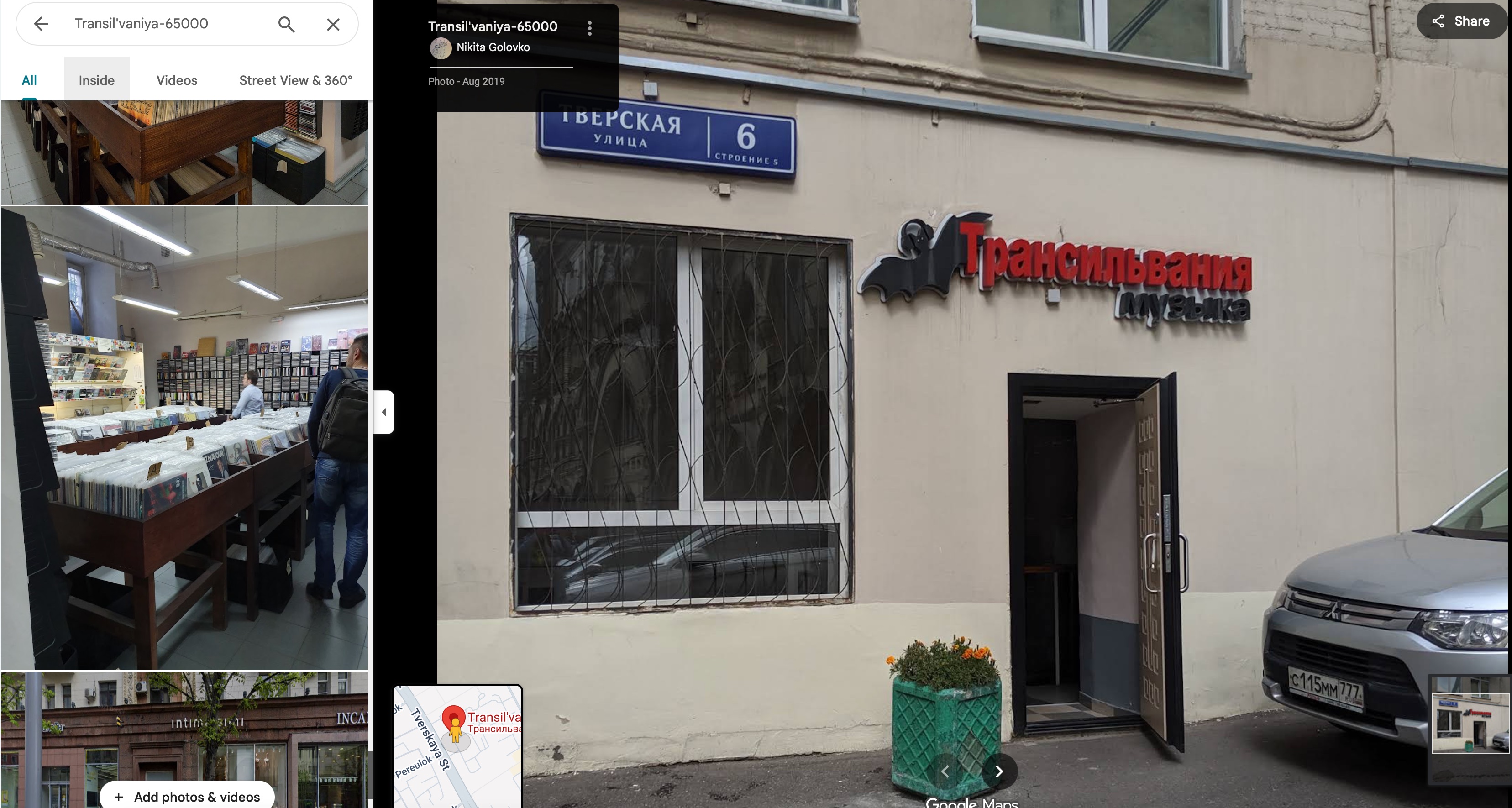
The distribution center of the doctrine of A. DUGIN is the "Transylvania" store (located in Moscow, at 6/1 5 Tverskaia Street, phone 229-87-86/33-45, website www.arktogaia.com). Let's quote the content of this site published in the newspaper:
- Philosophy
- History of religions
- Geopolitics
- Metaphysics
- Sociology
- economy
- Culturerology
- Political policy
- Oneirology
- Psychology of the depths
- Runology
- Sacred geography
- Conspiracy theory
- Analysis of current events
- Network version of Eurasia's periodicals, links to messages, forum.
In the facilities of "Transylvania" there is also the store "Artogaia-2", where practically all of A's works are exposed. DUGIN, as well as fundamental works on a vast circle of problems of theology, politics and economics (in particular the works of G. Wirth, A. Crowley and other apologists of anti-Christian beliefs, the programmatic documents of the "Eurasia" movement and their periodicals).
Taking into account the current positions of A. DUGIN, leader of a populist social movement, we can sume that, in the near future, the basis and sphere of diffusion of his doctrine will expand through the use of the possibilities offered by the Chamber of Deputies and the Federation Council and through their editorial and graphic possibilities. Above all, one should expect visible support from the government for the editorial conglomerate "Arktogaia", and the use of other mass media that should advertise the doctrine of A. DUGIN Already today the graphic basis, used for the printing of the works of the "Eurasia" movement, is the graphic production complex "VINITI", one of the most modern and powerful publishing companies in the technical-scientific and social information distribution system in Russia.
BIBLIOGRAPHY.
Regarding the section: "The doctrine of Aleksandr DUGIN":
- Serguei RIUTKIN. "The critic Dugin"// Internet, russ.ru,9.06.98.
- "Kind Anjo" - Moscow. Atogaia, volume 1, 1991, pag. 10.
- Ibidem, pag. 29.
- Dugin "The End of the world. Eschatology and tradition". Moscow. Artogaia, 1998, pag. 359.
- Ibidem, pag. 47.
- Ibidem, pag. 1.
- "Anjo Gentil", Artogaia, Volume 1, 1991, page. 23.
- Dugin The End of the world. Escatoçogia and tradition". Moscow. Artogaia, 1998, page 19.
- Ibidem, pag. 19.
- Ibidem, page 17.
- Ibidem, pag. 365.
- Dugin "The End of the world. Eschatology and tradition". Section "The traditionalism of Guénon".
- Dugin The Christian Church." Moscow. Artogaia, 1998, pag. 29.
- Dugin "The Mystery of Eurasia". Moscow. Artogaia, 1996, page 19.
- Dugin "The great metaphysical problem and tradition". Gentle Angel. Moscow. Artogaia, 1991, volume 1, page. 23.
- Verchillo R. "Against the new paganism" "Tver Orthodox", nº 7-8, 199.
- "Christian esotericism". Gentle Angel. Moscow. Artogaia, 1991, volume 1, page. 67.
- Dugin "The End of the world. Eschatology and tradition". Moscow. Artogaia, 1998, pag. 225.
- "Christian esotericism" Gentle Angel. Moscow. Artogaia, 1991, volume 1, page. 67.
- Ibidem, pag. 68.
- Dugin "The metaphysics of good news". Moscow. Artogaia, 1996, page 12.
- Ibidem, pag. 33-34.
- Archimandrite Alipio and archimandrite Isaiah. "Dogmatic theology - conference cycle". Troitsko Sergeivo Monastery, 2000.
- Dugin "The metaphysics of good news". Moscow. Artogaia, 1996, page 148.
- Dugin "The mystery of Eurasia". Moscow. Artogaia, 1996, page 55.
- Ibidem, pag. 245-246.
- Dugin "The end of the world. Eschatology and tradition". Moscow. Artogaia, 1998, pag. 29.
- Ibidem, pag. 10.
- Ibidem, pag. 10.
- Roman Verchillo "Against the new paganism" ("About the works of A. Dugin"). Orthodox Tver, nº 7-9, July-August 1999. (Mensager of the information and analysis center of Prelate Mark, bishop of Ephesus (issue 13).
- Khoj-Akhmed Nukhaev "We are not interested in Russia's defeat." Review on Eurasia, special issue, page. 4.
- Dugin "The third capital". In the collection: "The doctrine of Eurasia: theory and practice". Moscow. Artogaia, 2001, pag. 39.
- Ibidem, pag. 44.
- Dugin "The great metaphysical problem and tradition". Angel Gentil, volume 1, Artogaia, 1991, page. 22.
- N. Lotfullin and F. G. Islaev."The jiad of the Tartar people in Russia". Kazan, 1998, pag. 156.
- Dugin "Conspiracy theory". Moscow. Artogaia, 1991, volume 1, page. 48.
- Dugin "The end of the world. Eschatology and tradition". Section: "General conspiracy theory". Moscow. Artogaia, 1998, pag. 209.
- Ibidem, pag. 366.
- Dugin "The end of the world. Eschatology and tradition". Moscow. Artogaia, 1998, pag. 362.
- Ibidem, pag. 366.
- Crowley "Magic - theory and practice". Volume 1. Lokid-Mif Editions, page. 167-177.
- Ibidem, page 384 (quote from Crowley's book: "The book of laws", part 3, verse 24".
- Crowley "Magic - theory and practice". Volume 1, Editions Lokid-Mif, page. 17.
TRANSLATION: Luiz Heitor Guimarães
Thanks to my friend Saulo for making the Portuguese version available for this blog.
This conviction was in 2002, "indirectly" through a publication of the Dep. Patriarchy Missionary. With the guy being protected by Putin, unfortunately, an explicit excommunication may still take time. But the patriarchy has already said: there is a duck's beak, a duck feather, a duck's foot, a duck's tail, nothing like a duck, it walks like a duck and a duck's a crow.
Saturday, June 21, 2014
Book of the Patriarchate of Moscow condemns Dugin
Below, to put an end to the legend that Dugin would have something of an Orthodox Christian, the translation of the chapter of the Moscow Patriarchate booklet that denounces all the occult heresies and sects that haunt Russia. Dugin won an entire chapter just for him. Heretic, pagan and apostate, there is nothing orthodox. Anathema, anathema, anathema!

The doctrine of Aleksandr DUGIN. "New religious associations of Russia of a destructive and hidden nature: a guide / Missionary Department of the Moscow Patriarchate of the Russian Orthodox Church".
Newsletter and analytical bulletin Nº1 - Belgorod, 2002, 3º edition, enlarged, 4.9 The doctrine of Aleksandr DUGIN.
( Link to reference to the book on Google Books: http://is.gd/462IoK )
Guide.
Aleksandr DUGIN
Doctrine:
Among the neo-pagan doctrines, the opinions of A. DUGIN occupy a separate position. In particular, this is explained by the status of the author, leader of the "Eurasia" movement (by the fact that he is one of the well-known ideologists of the "Russia" movement), for his active collaboration with the Islamic Committee and for being an ambitious politician.
His teachings, harmoniously transformed into the ideology of the Eurasia movement, cannot be examined separately from the conception of the world of his spiritual mentor René GUÉNON, whose biography contains some data that allow us to more objectively evaluate the spiritual side of the doctrine of A. DUGIN
In addition, the role and position of the Orthodox Church, elaborated by A. DUGIN in programmatic documents and other writings related to the organization of the OPOD (Pan-Russian Social and Political Movement) Eurasia and the creation of the future Union of Eurasia.
All the documents used for the preparation of this section were published in public periodic information bodies. The opinions of A. DUGIN, his mentors and his followers were taken from monographs, almanacs, mass information organs directed by him and other editions, distributed basically by commercial companies controlled by the Eurasia movement and by other structures dependent on the author.
About the author of the doctrine:
Aleksandr Gelevitch DUGIN [1] was born in 1962 in the district of Chelyabinsk. His father was a general who worked in the central administration of the General Staff information system of the Armed Forces of the USSR. The general father put his son, who had not completed the Moscow Aviators School, in the KGB file. DUGIN knows about 10 European languages, and masters the Hebrew language. The claims of A. DUGIN became him, at the age of 35, the number 2 man of Eduard LIMONOV's Bolshevik National Party. He was enthusiastic about Freemasonry and fascism. He was an enemy of the "Soviet Empire". Currently, he defends totally opposite opinions.
In 1991 his first book "Caminho do Absoluto" was published where the foundations of his religious orientation are exposed. In 1992 he began to publish the magazine "Elementos". In 1993 he published the bestseller "Conspiracy Theory" which became the equivalent of the English action book "Spy Hunt". In the book "Conspiracy Theory" the theme of secret relations between the CIA and the KGB was developed.
According to his own confession, A. DUGIN in his youth called himself "a mystical fascist" and today he changed this name to "orthodox fascist".
A. DUGIN considers the French esoteric of the first half of the twentieth century René GUÉNON (15.11. 1886 - 07.01. 1951) as his master, as a recognized and indisputable authority, as an authentic emissary of the eschatological theory, considering him the key figure of this period. He writes: "René GUÉNON is the emissary of the supreme center for the last era, for the period of Kali Yuga, and the principles of Tradition formulated by him (the set of "non-human knowledge transmitted from one generation to another by the caste of priests or by other similar institutions) will serve as a bastion of salvation for those who will have to fight against "this World" and its "Prince", to reborn Tradition in its authentic, non-human and "angelic" dimension and, Closing the cycle, elaborating the sacred foundations of the approaching Golden Age." [2]
One of the fundamental objects of GUÉNON's research is a version of metaphysics, in which the conceptions of Hinduism exerted a great influence.
In an attempt to justify GUÉNON (and, therefore, his own conceptions about Christianity), A. DUGIN says that "the particularity of GUÉNON's traditionalism sometimes makes conservative members of the Church mistakenly consider esotericism and the synthesis to which he refers as occultism and syncretism."[ 3]
And, 1912 GUÉNON converted to Islam and adopted the Arabic name of Abd-el-Vakhed-Iakhia - Single Servant.
Later [4], however, DUGIN indicates that "GUÉNON received Masonic initiation from the neo-ro-rosecrian Theodor REUSS, who was a friend, comrade in arms and responsible for the initiation of A. CROWLEY". [5]
Let us remember that GUÉNON is an indisputable authority for A. DUGIN
Neopaganism in the light of the metaphysical conceptions of R. GUÉNON and A. DUGIN
The first religious research of A. DUGIN date from the early 90s of the last century and are linked to the foundation of the "Gentle Angle" almanac, in whose publications the spiritual sources of the teachings of a new messiah are examined. Here's what the writing team writes in this issue [6]:
"Our fundamental task ... is the restoration of integral tradition in all its total dimension ... The 'Gentle Anget Anal' almanack fights for the restoration of the medieval spirit, the medieval way of thinking, medieval religiosity and the medieval state conception." However, as we will see below, DUGIN interprets these "medieval" concepts from the point of view of neo-paganism.
Within the limits of the aforementioned Tradition, DUGIN recognizes the primacy of non-being: "any traditional metaphysics of full value recognizes the priority of non-being over being". [7] Here is one of the positions (answers) of A's eschatological gnosis. DUGIN: "The being appeared as proof that the non-being that contained it before its appearance is not the last instance, and that, beyond its limits, the Other is present, which coincides neither with the being nor with the non-being[8]. From his point of view the being "cannot also affirm its own primacy over the non-being, because it would contradict the truth, since the pure being is nothing more than the translation in reality, under its logical form, of the possibility of the non-being that preceded it."[ 9]
In a generalized way the spiritual doctrine of A. DUGIN is focused on the almanac "The End of the World. Eschatology and Tradition” (Moscow, Ed. Arktogaia, 1998). A himself. DUGIN calls this publication the "history of religion manual". However, the historical aspects of the various beliefs contained in this work are presented from their own (and totally peculiar) point of view. This contradicts the definition of the book as a historical work and gives it a dogmatic aspect. The mixture of Christian conceptions, runology, pagan concepts, various theories of cosmogony is just a small list of the freedoms of a dilettante to the materials of the collection.
By inserting in the historical collection [10] a chapter of the book "Path of the Absolute", ("Eschatological Gnosis"), A. DUGIN thus realizes that his religious doctrine is already formed.
Justifying the emergence of new religions and cults within the limits of Tradition, A. DUGIN writes the following literally: "The esoteric norms and structures of Tradition are transformed in accordance with the situation of the cosmic environment, and therefore new religions and traditions, new cult writings and new practices appear."[ 11]
This statement has far-reaching consequences. If the cosmic environment constitutes the non-being that generates the being, then the emergence of new religions and cults (possible only within the limits of being) is an objective fact (from a metaphysical point of view) and this means that sooner or later a new religion within the limits of the State of Eurasia will appear and beyond that it will be absurd to resist it.
It should be noted that this statement is inserted in the section of the "manual" devoted to the analysis of the religious teachings of A. CROWLEY
In this way, we can already define the religious doctrine of A. DUGIN as an interpretation of the metaphysics of Hinduism combined with concepts of Orthodox Marxism. From the linguistic aspect, this doctrine takes the form of a pseudoscientific terminology, extremely attractive to diletants who, like A himself. DUGIN, did not complete a university course, and who share the ideals of communist ideology.
(Blog note - by Saulo: I think that at the time Dugin had not graduated in anything yet - does he teach at the University of Moscow without having completed a university course? - "Dugin presents himself as an academic and philosopher, claiming two PhD titles, but who and how granted him such diplomas remains a carefully kept secret [ http://en.metapedia.org/Alexander_Dugin ] )
Orthodoxy in the interpretation of A. DUGIN
DUGIN makes an analysis of Orthodoxy from the traditionalist position of GUÉNON, advancing the thesis: "The Christian Church ... if it follows a traditionalist and conservative orientation, as a general rule, at best, it constitutes the fundamental support for the conservation of the esoteric, ritualistic and dogmatic aspect... . The Church either limits its non-liturgical activity by a simplified moralism, or, what is worse, tries to deal with apologetics based on fundamentally profane, contemporary and anti-traditionalist theories, or, what is terrible, tends to syncretism, ecumenism and even the lowest neospiritualism....". [12]
In the works of A. DUGIN clearly manifests the effect of the law of dichotomy. For example, the attempt to research Russia's pre-Christian and pre-Orthodox beliefs leads to A. DUGIN to paradoxical conclusions. Here is one of them: "Christianity did not replace, but raised and consolidated the ancient pre-Christian faith." [13
He writes: "When we have before us a really important and authentic tradition, we can almost always discover in it its transcendentalism and its immanent character, and this last characteristic constitutes its inner and esoteric part."[14], that is, for A. DUGIN paganism is also a supposed Orthodoxy, yet better and more original. "The immanent aspect" is the mystical conception of the world of A. DUGIN and his followers. This conception comes in particular from the fact that it is enough to think of a "conspiracy" and the idea of conspiracy already becomes reality and, to the extent that it is "I" who thinks, then this is a much more important reality from a metaphysical point of view than concrete reality [15]
The "immanent aspect" does not distinguish ideas that have their foundation in everyday life and also nominal (or ordinarily fictitious) ideas, and gives preference to fictitious ones. The inability of the attempt to associate the "immanent aspect" with Christianity manifests itself in a particularly visible way in the attempt to interpret the Creed, attempted by A. DUGIN, where he usually descends for a frank heresy[14]. Thus, he states that the Nicea Creed is a profession of faith with "a small concession to Christian prejudices". In addition, A. DUGIN usually calls the Creed the "Formula of Faith [16]. By doing this, he considers that the first three members (or, in the terminology of A. DUGIN, points) provide an absolute and finished image of metaphysics [17]
In his "works" [18] A. DUGIN simply blasphemes by affirming a certain real (existential or ontological) aspect of the Trinity. He denies the revelation that God is the creator of the world and that it always transcends any material aspect.
DUGIN introduces an innovation in the doctrine of the immortality of the soul. He writes in private: "The Soul, a subtle form, woven of substances from the atmosphere, survives the body in which it spent its earthly life and can live independently even after bodily death ... But the path to the heaven of the spirit ... is impossible for the individual soul, because this world, by definition, does not admit in itself beings dressed in form".[ 19] However, according to orthodox doctrine, God creates the soul by his creative breath [20].
DUGIN in a purely theosophical sense insists on the "discovery within the human personality" of a substance radically different from the old usual "I" of the individual. He states that this discovery takes place during baptism [21]. And in this A. DUGIN sees a way out for the "salvation" of the human being.
This statement diametrically contradicts João Damasceno's definition: "the soul is a living, simple and incorporeal substance, by nature invisible to human eyes, immortal, endowed with understanding and intelligence and does not have a determined image (form)". It acts with the help of the organic body and communicates life, growth, feeling and generational strength. Intelligence or spirit belongs to the soul not as something diverse, separated from it, but as its purest part. What are the eyes for the body, so is the intelligence for the soul. The soul is a free being, endowed with the capacity for will and action. She is "susceptible to change on the part of the will". [22]
The erroneous and sometimes frankly heretical conceptions and statements of A. DUGIN are complemented by runology, the doctrine on the cyclical character of the cosmic phases and the other pagan beliefs.
According to the aforementioned dichotomy law, used by A. DUGIN largely to elaborate his works, comes to the inevitable conclusion that there are two types of Hinduism according to GUÉNON - a good and a bad one. The "bad" is the western one and the "good", the oriental, supposedly orthodox. A. DUGIN sees "a bright future" for orthodoxy with the combination of the esoteric principle of the Church (that is, with the ecclesiastical organization) with pagan esoteric gnosis. This approach, as he describes, opens up "unlimited possibilities for a deep and unexpected understanding of Russian orthodoxy"[23]. Thus, A. DUGIN states that in the person of the "Gnostic heretics" there is already a background of orthodoxy, missing only the metaphysical apparatus. Therefore, the only way is to adopt the traditional religion and then try, within this religion, to penetrate through spiritual, ritual and intellectual practice in its inner esoteric aspects, in its mysteries" [24]. A. DUGIN advises that, "so that the Gnostics do not submit to the influence of Christian ideas, they must aspire to minimize the human, earthly and secular dimension of the Church ..., it is indispensable despite everything to insist on the mystical totality and perfection of the Church, highlighting its timeless, beneficial and transformative aspect"[25]. In addition, he thinks that: "the fundamental task to apply the principles of integral traditionalism to Christianity and, in particular, to orthodoxy, presupposes becoming an immediate and orthodox follower of GUÉNON" [26].
This is nothing more than a call for the creation within the orthodoxy of a new trend (sect), that is, an attempt at a simple schism.
DUGIN evidently ignores that the maintainer of true tradition - the Church - protects itself and will protect itself in advance against secret societies within it. He presents the situation in such a way that by his desire he can join the Church his pagan convictions.
According to the bold opinion of A. DUGIN, "If we were rescued by Christ, then, in principle, in us there is no sin, and it is necessary to go bravely to the world of deification and not meticulously tell its imperfections" [27]. For the same reason, a fundamental side of the spiritual life is questioned such as repentance, such as confession, in other words, the reader is in fact called to a voluntary refusal to participate in the most important mysteries of the Church, which constitute a mandatory part of the orthodox life.
"The religious revolution is seen by DUGIN as the preservation of all the dogmatic, ritual, doctrinal and symbolic aspects of the Orthodox faith. This revolution, however, destroys those intellectual contributions, of noble and Protestant or Soviet conformist character, and more often of a liberal background, which are mistakenly assimilated today with the Church and that remove from it many dignified, strong and noble people of revolutionary tendency" [28].
For your goals, A. DUGIN approaches the so-called modernists, followers of Kotchetkov, Men, Borisov and Jeludkov - and the like. He persistently tries to "assimilate" orthodoxy to paganism, and the modernists mentioned above go to meet him, exposing aorthoxy within them, and also in the spirit and soul of their followers. "This man placed himself outside the Divinity and human law, he chose for himself a point of view outside of good and evil, above the law and happiness" [29]. And if the representatives of the renewing currents listed above follow the path of a supposed simplification, DUGIN, on the contrary, strives with all its strength to make the obvious incomprehensible and ambiguous, using the conceptual and linguistic apparatus of metaphysics.
We can assume that the religious doctrines of A. DUGIN constitute a compilation of Western (Protestant) and Eastern (Hindu) beliefs. They have no spiritual foundation of orthodoxy and cannot be considered a complete religious doctrine in the sense attributed to this concept by men of science - theologians and philosophers.
Position of A. DUGIN regarding Islamism
One of the first official measures taken by the "Eurasia" movement was a conference on Islam "Threat of Islam and threat to Islam". The conference was held on June 29, 2001 in the "Hotel-Presidente" building under the presidency of the spokesman for the Chamber of Deputies, G. Seleznev, from the mufti grain of Russia Talgat Tadjuddin and A. Dugin (at this time he had become Seleznev's advisor for geopolitics issues). A special issue of the "Revista da Eurasia" was devoted to the Movement's relations with Islam. The Foreign Relations Division of the Orthodox Church of the Patriarchate of Moscow published in the pages of this edition an article by Father Vsevolod (Tchaplin), an article that occupies only a little more than 5% of the total volume of the magazine.
It should be noted that in all articles on Islam there is no reference to the numerous extremist demonstrations of pseudo-Muslims. In addition, in the article [31] of the permanent author of the newspaper, Khoj-Akhed Nukhaev, it is proposed to create “in the territory of southern Chechnya a common house of Eurasia, an organization built according to the principles of the doctrine of the Tartar Khans (meeting of Muslims, Christians and Jews and all men of good will, ready to submit to this organization around a common mission of revitalization of the Earth and healing of the soul of contemporary humanity).
Kh-A's ideas. Nukhaev are very close to those of DUGIN. For example, he proposes to build the State of Eurasia in two stages:
In the first stage, the CUEA - Unified Confederation of Authoritarian States will be founded.
On Monday, it will become the Common House of Eurasia.
We can imagine that Islam is closer to DUGIN as the spiritual foundation of the idea of Eurasia. DUGIN's reflections on the "third capital" are interesting [32]. When examining the role played by the cities of Kiev, Moscow and St. Petersburg in the history of Russia, he, noting the fact that in Moscow Russia the ethnicity becomes particularly Russian, designates this state, however, as Turkish-Slavic. From his point of view, the ideal capital of Eurasia would be Kazan. To confirm his words, he writes: "Ivan the Great (Terrible) presents himself with the legitimate heir of the geopolitical will of the Golden Horde, as an especially Great-Russian tsar, in which Slavic roots unite with Tartar blood under the banner of Byzantine orthodoxy". He considers that " Tartastan represents the model of a federative entity of Eurasia. Thanks to the Tartar, Turkish impulse, the Russians became aware as Great Russians, separating forever from the small Russian model of state. The Tartar element is the most important factor both for the ethno-genesis of the Great Russians and for the form of government - for the genesis of Russia itself - Eurasia". And finally, the most interesting statement: "The Islam of the Tatar Cans is valuable to Eurasia not as "an incomplete form of orthodoxy", but as the Orthodox variety of Islam. And, conversely, for Orthodox Islam there is no tradition closer than the Orthodox Church" [33].
DUGIN considers that metaphysical methods serve not only for the study of orthodoxy, but also for that of Islam. Thus, he cites the coincidence of the opinion of the well-known Muslim metaphysicist Gueidar Djemal with his own: "The End is more fundamental than the beginning ... Denial is the most fundamental of all realities"[34]. It is revealing that this article by A. DUGIN was published by him in the Russian communist newspaper "Amanhã" nº 21 (338) in the year 2000. By doing so, A. DUGIN revealed a total ignorance with an analytical document with "Jiad of the Tartar people in Russia"[35], in which Islam's aggressive "proximity" to orthodoxy was reflected in more than one sense.
If we take into account the appeal of A. DUGIN for the superiority of the union with the Muslim states, and the possible seizure of power by them from the European Union, then the following question arises:
Which mechanism A. DUGIN proposes to use to prevent the repetition of the situation that has formed today in Afghanistan (is it in view of the trial of Christian missionaries by the Taliban)?
Taking into account that, according to the words of Cheiq-ul-Islam Talgat Tadjuddin, the Muslim population expresses its full support for President Putin, we can safely consider that it will also proceed to A. DUGIN, who openly demonstrated a favorable position in relation to the actions of the country's leader.
Position in relation to contemporary masonry
In the conception of A. DUGIN, Freemasonry is in principle "a good initiatory movement, divided by the influence of external forces in a bad "Egyptian" branch and a good, Christian and Scottish"[36]. For this statement, A. DUGIN reveals his total misunderstanding of the Masonic theory, which denies any religion as the basis of the spiritual existence of society.
Despite this, it offers some interest in the conversation that A had. DUGIN (he in this case introduced himself as the author of the almanac "Nittle - AG) with the head of the French branch of the "Order of the Eastern Templars" (later reformed by A. CROWLEY), a certain brotherMarcion (Christophe Bouchet) [37] upon his arrival in Russia.
Examining the action of the Masons over the course of a few centuries, Brother Marcion analyzes the hidden side of the SS action in Hitler's Germany, considering that "most of the works dedicated to the research of National Socialism are vulgarizing simplifications that aspire to present it as an absolute evil". He, based on the publications of Savitri Devi Mukherji, wife of the Brahmin Mukherji, considers that "in the interior of National Socialism there was an obvious messianic tendency".
In this same passage, Brother Marcion states that "everything that is said to have happened in the Nazi concentration camps (and also in the Stalinists) is nothing more than a huge exaggeration". (Obviously Brother Marcion is unaware of the materials of Nurenberg's trial).
According to Brother Marcion's confession, sections of Masonic lodges exist in many Western European countries, including Yugoslavia, where, a few years ago, the number of Crowley's followers was very large. To the question related to the faith of the Masons he answers literally like this: "They believe in power and the need to dominate, subjugate and govern themselves".
Crowley's theories in the light of A's metaphysical approach. Dugin
The ill-disguised attempt to reconcile orthodoxy with opposite beliefs must warn us. In this sense, A. DUGIN even tries to demonstrate that A. Crowley is not dangerous for any belief as it is usually described. The author produces a series of quotes that justify Crowley, trying to prove that he is only one of the most important researchers (philosophs) of our times. Such an attitude towards the "messiah" of Satanism is more than revealing, as well as the fact that, analyzing Crowley's doctrine, he puts the word "satanism" in quotes. Externally, it tries to take the position of an independent analyst of the various beliefs, about which the collection contains information. Based on the reflections of A. DUGIN are also found here Guénon's metaphysical conceptions, well known to him. Opposing initiation and counter-initiation, he thinks that "the most terrible and serious misrepresentations and desacralizations belong to people with the best intentions, convinced that they are orthodox and carriers of the most evident good". And further on: "Most of the time religious nonconformists ("heretics", "satanists") seek the fullness of the sacred experience, which the representatives of orthodoxy cannot offer them. It's not their fault, but their misfortune, and the real fault lies with those who allowed their authentic tradition to turn into a superficial facade behind which there is simply nothing. And perhaps precisely these suspicious forces and groups move towards the deep reality, while the profane who remain in the periphery by all means create obstacles" [38].
Through everyday reflections, A. DUGIN later comes to the conclusion that the role "of the Satanists" (or the Order of Seth) in the division of the Orthodox, Catholic and Protestant churches is simply insignificant: because the formation of A. Crowley gave himself to the bosom of the Protestant brotherhood of Plymouth, whose propagator was his father. The following statement from A is interesting. DUGIN: "every time Crowley emphasized his "satanism", he only expressed a clear understanding of the value of his position in the face of the metaphysical field that he had consciously abandoned. And nothing else." In this way, the spiritual doctrine of A. Crowley is reduced only to a denial of the dogmas of Protestantism. By this same reasoning, it makes you understand that you don't know anything evil about Russian satanists and the activity of similar sects in many countries around the world. More than that, it proposes to consider A. Crowley as "heretic of heresy", "an Antichrist within anti-Christianity", and that it is especially indispensable to take into account, when evaluating Crowley, his authentic meaning for Russia [39].
In other words, A. DUGIN blames Christianity itself for the appearance of A's anti-Christian conceptions. Crowley: the identification that Crowley makes of himself with the "Antichrist" "was not for him the expression of the destructive character of his mission, but only an assimilation of denominations and titles to provoke, in the Christian cultural context; these titles that the Christian prophets attribute, within their religious context (the religion of a God who died and resurrected) to "prophets of a new era" [40] that are incomprehensible to them". And in general, from A's point of view. DUGIN, A himself. Crowley in a "reflex" and ironic way describes his sexual magic in terms of Antichrist. That is, Crowley's entire doctrine boils down to a joke! At this point it is appropriate to recall some of Crowley's formulations in one of his books on human sacrifices: “depending on the mystical objectives, stabbings, beatings to death, drownings, poisoning, decapitations, strangulations, acts of faith, etc.” [41], or even “Moon blood is the best, also the menstrual, the fresh blood of a child and a fragment of the sacred host, then the blood of the enemies, then that of a priest or a believer, and, finally, the blood of any animal” [42]. A. Crowley also recommends: "The most convenient object for these cases is a male, innocent and intellectually developed child ("Magical notes of the brother "Perturabo" - liturgical pseudonym of A.Crowley)". It is implied that in the period between 1912 and 1928 he executed such sacrifices on an average of up to 150 per year [43].
And the final part of the article. "It is impossible to exclude the possibility that its most repulsive and evident negativism, its antinomy and its "evil nature" are closer to the truth and help us acquire correct spiritual guidelines, because it is not true that the path of paradise is covered with bad thoughts"?[ 44]
To what has been said, it is not possible to add anything else. It is also true that in the book "The End of the World" the fundamental work of A was fully integrated. Crowley "The Book of the Law", which can be considered a form of propaganda for the followers of A. DUGIN
Let's try to formulate the religious positions of A. DUGIN from the brief analysis of the materials examined above:
- Vision of the world contrary to Orthodoxy, based on the primacy of non-being over being, with use of the conceptual and linguistic apparatus of metaphysics.
- Presence in his doctrine of conceptions directly linked to the Hindu worldview (tantrism, Indian metaphysics), and also with elements of Theosophy that reflect the opinions of R. Guénon (initiated in Freemasonry, supposedly in the Reformed Order of the Eastern Templars - or Ordo Templi Orientis, the O.T.O.).
- Calls for "a reform" of Orthodoxy, in particular through the erosion of Orthodoxy as a true belief, the introduction within the Church of its enemies, the liquidation of Orthodox traditions, its submission to Islam and, ultimately, its destruction by the use of the administrative apparatus of the infamous Union of Eurasia. As an intermediate stage, a conjunctural use of Orthodoxy to achieve its own political objectives in the confrontation with the supporters of the Atlantic alliance in the march for a real domination of the world.
- An evident preference for Islam to the detriment of other religious beliefs, within a condescending relationship with Freemasonry and Satanism.
- The religious belief of A. DUGIN, unlike other traditional religious doctrines, is directed to an elite social class. For its understanding, a specific preparation is required, in particular of a philosophical nature. And this puts this belief in the category of occult and mystical ideologies due to the criticism it makes of the conceptual positions of the main religions of the world.
- The arbitrariness in the interpretation of the fundamental postulates of Christianity and a diffusion of this type of material through publicly accessible information sources place A. DUGIN outside the walls of the Church.
The distribution center of the doctrine of A. DUGIN is the "Transylvania" store (located in Moscow, at 6/1 5 Tverskaia Street, phone 229-87-86/33-45, website http://www.arktogaia.com). Let's quote the content of this site published in the newspaper:
- Philosophy
- History of religions
- Geopolitics
- Metaphysics
- Sociology
- economy
- Culturerology
- Political policy
- Oneirology
- Psychology of the depths
- Runology
- Sacred geography
- Conspiracy theory
- Analysis of current events
- Network version of Eurasia's periodicals, links to messages, forum.
In the facilities of "Transylvania" there is also the store "Artogaia-2", where practically all of A's works are exposed. DUGIN, as well as fundamental works on a vast circle of problems of theology, politics and economics (in particular the works of G. Wirth, A. Crowley and other apologists of anti-Christian beliefs, the programmatic documents of the "Eurasia" movement and their periodicals).
Taking into account the current positions of A. DUGIN, leader of a populist social movement, we can sume that, in the near future, the basis and sphere of diffusion of his doctrine will expand through the use of the possibilities offered by the Chamber of Deputies and the Federation Council and through their editorial and graphic possibilities. Above all, one should expect visible support from the government for the editorial conglomerate "Arktogaia", and the use of other mass media that should advertise the doctrine of A. DUGIN Already today the graphic basis, used for the printing of the works of the "Eurasia" movement, is the graphic production complex "VINITI", one of the most modern and powerful publishing companies in the technical-scientific and social information distribution system in Russia.
BIBLIOGRAPHY.
Regarding the section: "The doctrine of Aleksandr DUGIN":
- Serguei RIUTKIN. "The critic Dugin"// Internet, russ.ru,9.06.98.
- "Kind Anjo" - Moscow. Atogaia, volume 1, 1991, pag. 10.
- Ibidem, pag. 29.
- Dugin "The End of the world. Eschatology and tradition". Moscow. Artogaia, 1998, pag. 359.
- Ibidem, pag. 47.
- Ibidem, pag. 1.
- "Anjo Gentil", Artogaia, Volume 1, 1991, page. 23.
- Dugin The End of the world. Escatoçogia and tradition". Moscow. Artogaia, 1998, page 19.
- Ibidem, pag. 19.
- Ibidem, page 17.
- Ibidem, pag. 365.
- Dugin "The End of the world. Eschatology and tradition". Section "The traditionalism of Guénon".
- Dugin The Christian Church." Moscow. Artogaia, 1998, pag. 29.
- Dugin "The Mystery of Eurasia". Moscow. Artogaia, 1996, page 19.
- Dugin "The great metaphysical problem and tradition". Gentle Angel. Moscow. Artogaia, 1991, volume 1, page. 23.
- Verchillo R. "Against the new paganism" "Tver Orthodox", nº 7-8, 199.
- "Christian esotericism". Gentle Angel. Moscow. Artogaia, 1991, volume 1, page. 67.
- Dugin "The End of the world. Eschatology and tradition". Moscow. Artogaia, 1998, pag. 225.
- "Christian esotericism" Gentle Angel. Moscow. Artogaia, 1991, volume 1, page. 67.
- Ibidem, pag. 68.
- Dugin "The metaphysics of good news". Moscow. Artogaia, 1996, page 12.
- Ibidem, pag. 33-34.
- Archimandrite Alipio and archimandrite Isaiah. "Dogmatic theology - conference cycle". Troitsko Sergeivo Monastery, 2000.
- Dugin "The metaphysics of good news". Moscow. Artogaia, 1996, page 148.
- Dugin "The mystery of Eurasia". Moscow. Artogaia, 1996, page 55.
- Ibidem, pag. 245-246.
- Dugin "The end of the world. Eschatology and tradition". Moscow. Artogaia, 1998, pag. 29.
- Ibidem, pag. 10.
- Ibidem, pag. 10.
- Roman Verchillo "Against the new paganism" ("About the works of A. Dugin"). Orthodox Tver, nº 7-9, July-August 1999. (Mensager of the information and analysis center of Prelate Mark, bishop of Ephesus (issue 13).
- Khoj-Akhmed Nukhaev "We are not interested in Russia's defeat." Review on Eurasia, special issue, page. 4.
- Dugin "The third capital". In the collection: "The doctrine of Eurasia: theory and practice". Moscow. Artogaia, 2001, pag. 39.
- Ibidem, pag. 44.
- Dugin "The great metaphysical problem and tradition". Angel Gentil, volume 1, Artogaia, 1991, page. 22.
- N. Lotfullin and F. G. Islaev."The jiad of the Tartar people in Russia". Kazan, 1998, pag. 156.
- Dugin "Conspiracy theory". Moscow. Artogaia, 1991, volume 1, page. 48.
- Dugin "The end of the world. Eschatology and tradition". Section: "General conspiracy theory". Moscow. Artogaia, 1998, pag. 209.
- Ibidem, pag. 366.
- Dugin "The end of the world. Eschatology and tradition". Moscow. Artogaia, 1998, pag. 362.
- Ibidem, pag. 366.
- Crowley "Magic - theory and practice". Volume 1. Lokid-Mif Editions, page. 167-177.
- Ibidem, page 384 (quote from Crowley's book: "The book of laws", part 3, verse 24".
- Crowley "Magic - theory and practice". Volume 1, Editions Lokid-Mif, page. 17.
TRANSLATION: Luiz Heitor Guimarães
Thanks to my friend Saulo for making the Portuguese version available for this blog.
This conviction was in 2002, "indirectly" through a publication of the Dep. Patriarchy Missionary. With the guy being protected by Putin, unfortunately, an explicit excommunication may still take time. But the patriarchy has already said: there is a duck's beak, a duck feather, a duck's foot, a duck's tail, nothing like a duck, it walks like a duck and a duck's a crow.
Share this:
- Click to share on X (Opens in new window) X
- Click to share on Facebook (Opens in new window) Facebook
- Click to share on Reddit (Opens in new window) Reddit
- Click to share on Tumblr (Opens in new window) Tumblr
- Click to share on Telegram (Opens in new window) Telegram
- Click to share on Bluesky (Opens in new window) Bluesky
- Click to share on Pinterest (Opens in new window) Pinterest
- Click to share on Pocket (Opens in new window) Pocket
- Click to print (Opens in new window) Print
- Click to share on WhatsApp (Opens in new window) WhatsApp