
Karl Marx and Lord Rothschild: the story of a forbidden relationship never told

Quote from Timothy Fitzpatrick on September 20, 2026, 12:03
August 12, 2026
By Cesare Sacchetti
Many still have a distorted idea of him, that of a man in the service of the proletariat, the one who founded a philosophy that in this collective imagination is a sort of shield in defense of the worker, the poor or the marginalied.
Some really think that Karl Marx's communism was really all this, despite the fact that in every moment of his life, this philosophy has never acted, not even for a moment, to elevate the fortunes of the popular classes, exploited and deceived by an idea that as soon as it came to power actually persecuted the weak.
Marx was not in fact born to redeem the worker exploited by capitalism, the ideology that after 1789 French had in fact taken over European monarchies, which had become hierarchically inferior to the power of capital and banks, the real baton of command from the beginning of the modern age onwards.
The story of Karl Marx is interesting from the beginning but it is silent because a serious and in-depth study of his ruthlessly dismantles all the false myths that have been built around this figure.
Marx was born in 1818 in Trier, a village in Germany, into a family of Jewish rabbis.
The father, Hirschel Mordechai, apparently converted to Protestantism in 1816, but in reality this decision was almost certainly a facade, the result of a choice made by Hirschel to allow him to better infiltrate certain environments.
Hirschel Marx, Karl's father
Rabbinism flowed powerfully in the family of young Karl.
His grandparents, paternal and maternal, were rabbis, since the Pressburgs like the Mordechai were fully among the oldest and most influential rabbi dynasties in the Jewish world.
The habitat of the young Mordechai was therefore, from the beginning, pregnant with the principles of the Jewish religion, from which Marx, when he chose to adopt this name, took a lot.
The origins of the ideas of communism
Communism, or socialism, in reality, according to several rabbis is nothing more than a mask of Judaism itself.
In Rabbi Harry Waton's work entitled "A program for Jews and a response to all anti-Semites: a program in humanity", Waton explains in very clear words the essence of modern Talmudism.
“Jewrism is communism, internationalism, universal brotherhood of humanity, emancipation of the working class and human society. It is with these spiritual weapons that the Jews will conquer the world and mankind.”
In Judaism, the words and concepts that will become the cornerstones of Freemasonry in the Age of enlightenment resonate a lot, especially that of universal brotherhood, as well as the principle of "an emancipation of the working class" which will be the supposed pillar of Marxian philosophy, which in reality is not even properly Marxian.
Marx's flour of the sack is in fact not his, and this is clearly understood in another passage of Waton's work where the philosophy at the base of modern Judaism is clearly explained.
“The Jews welcome this revolution in the Christian world and should set an example. It is no coincidence that Judaism gave rise to Marxism, nor that the Jews promptly embraced it; all this was in perfect harmony with the progress of Judaism and the Jews. Jews should understand that Jehovah no longer dwells in heaven, but dwells in us here on earth; we must no longer look at Jehovah as something superior and outside of us, but we must see him right within us.”
The American rabbi in practice simply explained the principle of historical materialism.
Rabbi Harry Waton
After all, Marx could be accused of plagiarism, that is, of having taken philosophical and religious principles from a religion, which he at least formally denied, to insert them into the system of a political philosophy that drawn greatly from Talmudism.
Marx argued that happiness and salvation should not be sought in Heaven, but here, on Earth, since the thought of an otherworldly life was in his eyes a lie, an anesthetic to deceive the masses, or, in his words, an opium of the peoples.
On his own, the "founder" of communism had actually invented nothing at all.
He had precisely drawn from the modern Jewish religion that looks with aversion to the idea that there is an otherworldly salvation.
From the rejection of the Beyond, a desire for domination is born, a search for a world political leader of pure power that allows Judaism to assert itself in every part of the planet, exactly as can be seen now in the spasmodic expectation of the moshiach by Netanyahu's Likud party.
Marx has therefore taken up the concepts of a religion handed down for many centuries by his family, dismaming them through the patina of communism, where then in the end the worker or the worker live in conditions of misery equal to or worse than those reserved by capitalism.
The hidden origins of Karl Mark
The "father" of the Communist Party manifesto, however, had an interest in pushing the masses towards such moral and economic misery because his history is not what many believe.
In his family's family tree there are already valuable information that was unknown to his contemporaries, and that if they had been made known immediately would probably have opened the eyes to many workers in search of a real social redemption.
If you look at Marx's great-grandparents and great-grandparents, you will find a very interesting name such as that of Barent Cohen, an exponent of a very rich Jewish family in Amsterdam, one of the most strategic commercial and financial centers for Askenazite finance.
On the right side, so to speak, of the Barent Cohen family, there are a whole series of influential characters, but the heaviest name is undoubtedly that of Nathan Mayer Rothschild, the son of Mayer Amschel, progenitor of the infamous Frankfurt bankers' family.
Marx's family tree
Nathan in fact married the niece of Barent Cohen, from whose union was born Lionel Baron de Rothschild who married his cousin Charlotte Baronin von Rothschild.
From the marriage between Lionel and Charlotte was born in 1840 Nathan Mayer, who, in turn, decided to marry his cousin, Emma Louise von Rothschild, because the Frankfurt family of bankers was so jealous of his secrets and his genetic "purity" that they often preferred to combine marriages between relatives just to be sure that their immense heritage did not leave the home walls.
Nathan and Emma have a son, Lionel Walter Rothschild, who inherits the title of 2nd Baron Rothschild, a position that automatically gave him the right to sit in the English House of Lords.
The Rothschilds were already in that era, in the first half of the 19th century, the undisputed masters of European politics, the true architects of political careers of the various liberals of the time who owed their sudden fortunes at the entrance to the various Masonic lodges, from which they were chosen from time to time by the richest bankers in the world who thus built a ruling class at their service.
While Lionel entered the British Upper House by right, his cousin, in the same years, wrote the Communist Party Manifesto.
Lionel Walter Rothschild
No, it's not a typo.
Karl Marx was really related to Lionel and his father because of the common origins of their families.
There was thus in the heart of Europe, in the midst of a supposed battle between capitalism and communism, an illustrious, rather cumbersome kinship between the two most famous exponents of their respective adverse camps.
Marx and Rothschild in London
In a very interesting documentary made by Nacionalistas Hispanos, it is told in detail of this kinship of which the communist Karl never mentioned to his associates, certainly not especially to the workers who were oppressed precisely by that family of bankers with whom the "founder" of the doctrine of historical materialism was related.
The "case" that the two were in the same place at the same time, that is, after Marx had been expelled from Belgium for his subversive activities, to head towards a place from which on paper he would have to keep himself far away like London, the privileged seat of the capital and finance of the Rothschilds who at that moment had the fates of the crown and the whole of Europe in their hands.
Liberal historians could be promptly led to dismiss everything, as their custom, as the result of a concatenation of unlikely coincidences, but there are definitive elements that show how Lionel was Karl Marx's benefactor.
In a documented article by the former lieutenant colonel of the Argentine army, Santiago Roque Alonso, the silent ties between the father of communism and the powerful banker of Jewish origin are analyzed in more detail.
An American researcher William Josiah Sutton wrote in his 1983 work entitled "Illuminati 666", that it was Lionel Rothschild himself who signed checks for the benefit of Marx, which were, if they were not conveniently removed, in the availability of the British Museum.
Same information reported by another researcher like Paul Koch who in his book "Illuminati" reports that Lionel had issued at least two checks in favor of the League of the Righteous, which later became League of Communists in 1847, on the proposal of Marx himself and his inseparable sodale, Friedrich Engels.
Koch agrees with Sutton in reporting how the evidence of this funding is kept by the British Museum.
Lionel Rothschild decided to give generous sums to a clear communist organization to reward the work done and especially the works of Karl Marx, fundamental for the spread of communist thought.
The two therefore knew each other and worked assiduously to accompany Europe and the whole world towards the abyss of a secularized, de-Christianized and inevitably deprived society of its roots.
Marx undoubtedly acted as an agent of the Rothschilds.
At no time did his communism pose a threat to the dominance of high finance, not even when several years later, his direct political heirs, the Bolsheviks, largely of Askenazi origin, came to power in Russia and massacred Tsar Nicholas II, his family, and millions of Christians.
The proletariat was never emancipated, but rather massacred.
The Russian monarchy was overthrown, its aristocracy was wiped out, in place of which a bourgeoisie of Jewish intellectuals came to power, financed, not by chance, by those Wall Street capitals that on paper should have opposed communism in every way, which they instead appreciated and financed.
Without the capital of bankers like the Rothschilds, communism would hardly have become the dominant ideology that became between the 19th and 20th centuries, and that was used as a very powerful tool against the enemies of the "great" capital, above all Russia, detested by both high finance and Marx himself.
Suspicions about Marx had begun to mature even among the circles of communism after the second half of the 19th century.
Some travel companions of Lionel's cousin had noticed an unusual agreement between the ends of capitalism and those of communism.
Among these was Mikhail Bakunin, a subversive of Russian origin who had already participated in the First International, the congress of communists from all over Europe, in which there was also a very high number of Freemasons, including Marx himself together with Giuseppe Mazzini, Benoit Malon, Paul Robin, Victor Le Lubez, Charles Longuet, and Ettore Ferrari, registered, according to the historian Boris I. Nicolaevsky at the Masonic lodge of the Philadelphi.
Bakunin
Bakunin had an equally strong hatred for Christianity and perhaps his considerations were more dictated by his "envy" for not having been chosen as the leader of the communist revolution, but his considerations on Marx expressed in December 1871 are certainly of interest.
Bakunin, simply, saw in Rothschild a sort of capital infiltrator and thus expressed himself on this issue.
"Well, this whole Jewish world, which forms a single exploitative sect, a sort of leech on the people, a collective, voracious and organized parasite, that not only beyond state borders but also beyond any difference of political opinion, this world is currently, at least in large part, at the disposal of Marx on the one hand and the Rothschilds on the other. I know that the Rothschilds, however reactionary they are and should be, greatly appreciate the merits of the communist Marx and, in turn, the communist Marx is inevitably attracted, by an instinctive attraction and a respectful admiration, to the financial genius of the Rothschilds. Jewish solidarity, this strong solidarity that has endured throughout history, unites them.
"This must seem strange. What could socialism and big banks have in common?»» Marx's authoritarian socialism or communism aims at a strong centralization of the state, and where there is centralization of the state, there must necessarily be a State Central Bank, and where there is such a bank, the Jews will always be sure not to die of cold or hunger.”
Bakunin's intuitions did not go very far from the reality of the facts as could be seen immediately after the Bolshevik revolution.
Jewish finance did not benefit so much in this case from a control of the Russian central bank, but from another bank, the Ruskombank, founded on the initiative of Lenin in 1922.
The Ruskombank was the portal for the Bolsheviks to international markets.
If there was a formal embargo on economic and trade relations with the Soviet Union, the Wall Street bankers, the lords of New York's finance, were able to accumulate huge profits through various mining concessions through the Ruskombank, of which they were direct financiers.
Communism was therefore the largest investment made by figures such as JP Morgan, Jacob Schiff and Paul Warburg who, after financing the Bolsheviks with large sums in 1917, were returning from their financing with interest.
Bakunin had not therefore gone far from the truth.
The convergence between the two worlds was not an inexplicable conjuncture of history, but the result of a cold programming of high finance that thus took possession of the strategic resources of a country rich in raw materials such as Russia, and, at the same time, used the hammer and sickle to persecute Christianity, the real black beast of communism and Talmudism.
Marx and Lionel de Rothschild were thus two expressions of the same power.
A power that wants to dominate the world and enslave the masses through the absolute domination of capital.
A power that for 200 years now has always taken care to build a false opposition, a controlled antithesis that better responds to its ends.
Karl Marx therefore was all this.
He was an emissary of this power and he was the man who deceived millions of workers around the world.

August 12, 2026
By Cesare Sacchetti
Many still have a distorted idea of him, that of a man in the service of the proletariat, the one who founded a philosophy that in this collective imagination is a sort of shield in defense of the worker, the poor or the marginalied.
Some really think that Karl Marx's communism was really all this, despite the fact that in every moment of his life, this philosophy has never acted, not even for a moment, to elevate the fortunes of the popular classes, exploited and deceived by an idea that as soon as it came to power actually persecuted the weak.
Marx was not in fact born to redeem the worker exploited by capitalism, the ideology that after 1789 French had in fact taken over European monarchies, which had become hierarchically inferior to the power of capital and banks, the real baton of command from the beginning of the modern age onwards.
The story of Karl Marx is interesting from the beginning but it is silent because a serious and in-depth study of his ruthlessly dismantles all the false myths that have been built around this figure.
Marx was born in 1818 in Trier, a village in Germany, into a family of Jewish rabbis.
The father, Hirschel Mordechai, apparently converted to Protestantism in 1816, but in reality this decision was almost certainly a facade, the result of a choice made by Hirschel to allow him to better infiltrate certain environments.

Hirschel Marx, Karl's father
Rabbinism flowed powerfully in the family of young Karl.
His grandparents, paternal and maternal, were rabbis, since the Pressburgs like the Mordechai were fully among the oldest and most influential rabbi dynasties in the Jewish world.
The habitat of the young Mordechai was therefore, from the beginning, pregnant with the principles of the Jewish religion, from which Marx, when he chose to adopt this name, took a lot.
The origins of the ideas of communism
Communism, or socialism, in reality, according to several rabbis is nothing more than a mask of Judaism itself.
In Rabbi Harry Waton's work entitled "A program for Jews and a response to all anti-Semites: a program in humanity", Waton explains in very clear words the essence of modern Talmudism.
“Jewrism is communism, internationalism, universal brotherhood of humanity, emancipation of the working class and human society. It is with these spiritual weapons that the Jews will conquer the world and mankind.”
In Judaism, the words and concepts that will become the cornerstones of Freemasonry in the Age of enlightenment resonate a lot, especially that of universal brotherhood, as well as the principle of "an emancipation of the working class" which will be the supposed pillar of Marxian philosophy, which in reality is not even properly Marxian.
Marx's flour of the sack is in fact not his, and this is clearly understood in another passage of Waton's work where the philosophy at the base of modern Judaism is clearly explained.
“The Jews welcome this revolution in the Christian world and should set an example. It is no coincidence that Judaism gave rise to Marxism, nor that the Jews promptly embraced it; all this was in perfect harmony with the progress of Judaism and the Jews. Jews should understand that Jehovah no longer dwells in heaven, but dwells in us here on earth; we must no longer look at Jehovah as something superior and outside of us, but we must see him right within us.”
The American rabbi in practice simply explained the principle of historical materialism.

Rabbi Harry Waton
After all, Marx could be accused of plagiarism, that is, of having taken philosophical and religious principles from a religion, which he at least formally denied, to insert them into the system of a political philosophy that drawn greatly from Talmudism.
Marx argued that happiness and salvation should not be sought in Heaven, but here, on Earth, since the thought of an otherworldly life was in his eyes a lie, an anesthetic to deceive the masses, or, in his words, an opium of the peoples.
On his own, the "founder" of communism had actually invented nothing at all.
He had precisely drawn from the modern Jewish religion that looks with aversion to the idea that there is an otherworldly salvation.
From the rejection of the Beyond, a desire for domination is born, a search for a world political leader of pure power that allows Judaism to assert itself in every part of the planet, exactly as can be seen now in the spasmodic expectation of the moshiach by Netanyahu's Likud party.
Marx has therefore taken up the concepts of a religion handed down for many centuries by his family, dismaming them through the patina of communism, where then in the end the worker or the worker live in conditions of misery equal to or worse than those reserved by capitalism.
The hidden origins of Karl Mark
The "father" of the Communist Party manifesto, however, had an interest in pushing the masses towards such moral and economic misery because his history is not what many believe.
In his family's family tree there are already valuable information that was unknown to his contemporaries, and that if they had been made known immediately would probably have opened the eyes to many workers in search of a real social redemption.
If you look at Marx's great-grandparents and great-grandparents, you will find a very interesting name such as that of Barent Cohen, an exponent of a very rich Jewish family in Amsterdam, one of the most strategic commercial and financial centers for Askenazite finance.
On the right side, so to speak, of the Barent Cohen family, there are a whole series of influential characters, but the heaviest name is undoubtedly that of Nathan Mayer Rothschild, the son of Mayer Amschel, progenitor of the infamous Frankfurt bankers' family.

Marx's family tree
Nathan in fact married the niece of Barent Cohen, from whose union was born Lionel Baron de Rothschild who married his cousin Charlotte Baronin von Rothschild.
From the marriage between Lionel and Charlotte was born in 1840 Nathan Mayer, who, in turn, decided to marry his cousin, Emma Louise von Rothschild, because the Frankfurt family of bankers was so jealous of his secrets and his genetic "purity" that they often preferred to combine marriages between relatives just to be sure that their immense heritage did not leave the home walls.
Nathan and Emma have a son, Lionel Walter Rothschild, who inherits the title of 2nd Baron Rothschild, a position that automatically gave him the right to sit in the English House of Lords.
The Rothschilds were already in that era, in the first half of the 19th century, the undisputed masters of European politics, the true architects of political careers of the various liberals of the time who owed their sudden fortunes at the entrance to the various Masonic lodges, from which they were chosen from time to time by the richest bankers in the world who thus built a ruling class at their service.
While Lionel entered the British Upper House by right, his cousin, in the same years, wrote the Communist Party Manifesto.

Lionel Walter Rothschild
No, it's not a typo.
Karl Marx was really related to Lionel and his father because of the common origins of their families.
There was thus in the heart of Europe, in the midst of a supposed battle between capitalism and communism, an illustrious, rather cumbersome kinship between the two most famous exponents of their respective adverse camps.
Marx and Rothschild in London
In a very interesting documentary made by Nacionalistas Hispanos, it is told in detail of this kinship of which the communist Karl never mentioned to his associates, certainly not especially to the workers who were oppressed precisely by that family of bankers with whom the "founder" of the doctrine of historical materialism was related.
The "case" that the two were in the same place at the same time, that is, after Marx had been expelled from Belgium for his subversive activities, to head towards a place from which on paper he would have to keep himself far away like London, the privileged seat of the capital and finance of the Rothschilds who at that moment had the fates of the crown and the whole of Europe in their hands.
Liberal historians could be promptly led to dismiss everything, as their custom, as the result of a concatenation of unlikely coincidences, but there are definitive elements that show how Lionel was Karl Marx's benefactor.
In a documented article by the former lieutenant colonel of the Argentine army, Santiago Roque Alonso, the silent ties between the father of communism and the powerful banker of Jewish origin are analyzed in more detail.
An American researcher William Josiah Sutton wrote in his 1983 work entitled "Illuminati 666", that it was Lionel Rothschild himself who signed checks for the benefit of Marx, which were, if they were not conveniently removed, in the availability of the British Museum.
Same information reported by another researcher like Paul Koch who in his book "Illuminati" reports that Lionel had issued at least two checks in favor of the League of the Righteous, which later became League of Communists in 1847, on the proposal of Marx himself and his inseparable sodale, Friedrich Engels.
Koch agrees with Sutton in reporting how the evidence of this funding is kept by the British Museum.
Lionel Rothschild decided to give generous sums to a clear communist organization to reward the work done and especially the works of Karl Marx, fundamental for the spread of communist thought.
The two therefore knew each other and worked assiduously to accompany Europe and the whole world towards the abyss of a secularized, de-Christianized and inevitably deprived society of its roots.
Marx undoubtedly acted as an agent of the Rothschilds.
At no time did his communism pose a threat to the dominance of high finance, not even when several years later, his direct political heirs, the Bolsheviks, largely of Askenazi origin, came to power in Russia and massacred Tsar Nicholas II, his family, and millions of Christians.
The proletariat was never emancipated, but rather massacred.
The Russian monarchy was overthrown, its aristocracy was wiped out, in place of which a bourgeoisie of Jewish intellectuals came to power, financed, not by chance, by those Wall Street capitals that on paper should have opposed communism in every way, which they instead appreciated and financed.
Without the capital of bankers like the Rothschilds, communism would hardly have become the dominant ideology that became between the 19th and 20th centuries, and that was used as a very powerful tool against the enemies of the "great" capital, above all Russia, detested by both high finance and Marx himself.
Suspicions about Marx had begun to mature even among the circles of communism after the second half of the 19th century.
Some travel companions of Lionel's cousin had noticed an unusual agreement between the ends of capitalism and those of communism.
Among these was Mikhail Bakunin, a subversive of Russian origin who had already participated in the First International, the congress of communists from all over Europe, in which there was also a very high number of Freemasons, including Marx himself together with Giuseppe Mazzini, Benoit Malon, Paul Robin, Victor Le Lubez, Charles Longuet, and Ettore Ferrari, registered, according to the historian Boris I. Nicolaevsky at the Masonic lodge of the Philadelphi.
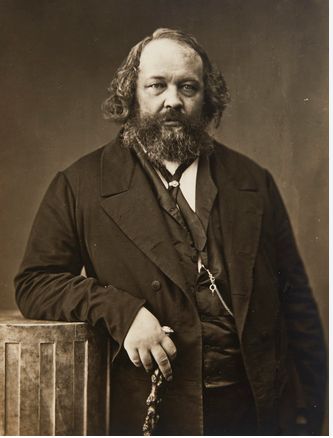
Bakunin
Bakunin had an equally strong hatred for Christianity and perhaps his considerations were more dictated by his "envy" for not having been chosen as the leader of the communist revolution, but his considerations on Marx expressed in December 1871 are certainly of interest.
Bakunin, simply, saw in Rothschild a sort of capital infiltrator and thus expressed himself on this issue.
"Well, this whole Jewish world, which forms a single exploitative sect, a sort of leech on the people, a collective, voracious and organized parasite, that not only beyond state borders but also beyond any difference of political opinion, this world is currently, at least in large part, at the disposal of Marx on the one hand and the Rothschilds on the other. I know that the Rothschilds, however reactionary they are and should be, greatly appreciate the merits of the communist Marx and, in turn, the communist Marx is inevitably attracted, by an instinctive attraction and a respectful admiration, to the financial genius of the Rothschilds. Jewish solidarity, this strong solidarity that has endured throughout history, unites them.
"This must seem strange. What could socialism and big banks have in common?»» Marx's authoritarian socialism or communism aims at a strong centralization of the state, and where there is centralization of the state, there must necessarily be a State Central Bank, and where there is such a bank, the Jews will always be sure not to die of cold or hunger.”
Bakunin's intuitions did not go very far from the reality of the facts as could be seen immediately after the Bolshevik revolution.
Jewish finance did not benefit so much in this case from a control of the Russian central bank, but from another bank, the Ruskombank, founded on the initiative of Lenin in 1922.
The Ruskombank was the portal for the Bolsheviks to international markets.
If there was a formal embargo on economic and trade relations with the Soviet Union, the Wall Street bankers, the lords of New York's finance, were able to accumulate huge profits through various mining concessions through the Ruskombank, of which they were direct financiers.
Communism was therefore the largest investment made by figures such as JP Morgan, Jacob Schiff and Paul Warburg who, after financing the Bolsheviks with large sums in 1917, were returning from their financing with interest.
Bakunin had not therefore gone far from the truth.
The convergence between the two worlds was not an inexplicable conjuncture of history, but the result of a cold programming of high finance that thus took possession of the strategic resources of a country rich in raw materials such as Russia, and, at the same time, used the hammer and sickle to persecute Christianity, the real black beast of communism and Talmudism.
Marx and Lionel de Rothschild were thus two expressions of the same power.
A power that wants to dominate the world and enslave the masses through the absolute domination of capital.
A power that for 200 years now has always taken care to build a false opposition, a controlled antithesis that better responds to its ends.
Karl Marx therefore was all this.
He was an emissary of this power and he was the man who deceived millions of workers around the world.
Share this:
- Share on X (Opens in new window) X
- Share on Facebook (Opens in new window) Facebook
- Share on Reddit (Opens in new window) Reddit
- Share on Tumblr (Opens in new window) Tumblr
- Share on Telegram (Opens in new window) Telegram
- Share on Bluesky (Opens in new window) Bluesky
- Share on Pinterest (Opens in new window) Pinterest
- Print (Opens in new window) Print
- Share on WhatsApp (Opens in new window) WhatsApp