Michael M. Roses Like Silicon From Clay: What Ancient Jewish Wisdom Can Teach Us About AI [Like silicon from clay. What old Jewish wisdom can tell us about artificial intelligence AEI Press, 2025. - 328 p.
I'm not a Jew, but the story of the golem - the defender of the Jews, created from clay by a certain wizard with the help of mysterious rituals - attracted me since the lower grades of school when I learned about the German expressionist film of 1920 with that title. And really, what kind of book-fassioned teenager dreams of getting a strong silent intercessor, ready to deal with all offenders on his order? Later, my wife Beth introduced me to a completely unusual play by Semyon An-sky "Dibuk", written in Yiddish, which is about an evil spirit that allegedly settles in a helpless victim.
That's why I was interested in the proposal to write a review of a book about golems, dibuks and magids (lesser-known spirits from Jewish folklore) - a book that directly connects these creatures with artificial intelligence.
After reading Michael Rosen's book "Like Silicon from Clay", interest in the topic did not fade away, although the author failed to convince me. According to Rosen, different points of view on AI and machine learning (ME), as well as our desire to ensure "the functioning of AI within the framework of ethical norms and responsibilities", may draw inspiration from these Jewish supernatural entities, and "we can draw the best of each such approach in order to develop a clear consistent line of conduct".
The task set in this way is extremely difficult, and ultimately Rosen's plan is too bold to be successfully completed. At the same time, "Like Clay Silicon" remains a very interesting, even exciting book: the author is passionately and eloquently immersed in the ongoing discussion about the future of AI and the secret nooks of Jewish mysticism.
Rosen starts with the division of the participants of the discussion. He calls one group of them autonomists - they consider the latest achievements in the field of AI truly revolutionary, capable of changing the foundations of human life. He baptized the second group as automatoners - they believe that AI is a simple extension (not a transformation) of existing digital technology, which can also be harmful.
Each group has a positive and negative wing (it remains to express regret that Rosen chose two names that are so obsessively, so annoyingly similar to each other). Positive autonomists are represented by Sam Altman from Open AIand "convinced that machines have already reached - or are about to achieve - a degree of independence" that allows them to function without human management and supervision. They believe that this development of AI is a good thing, because it improves the quality of life and empowers a person. Negative autonomists (Rosen refers to Jeffrey Hinton to themand Elon Musk) consider the same development of AI dangerous and potentially threatening humanity.
On the other hand, Rosen's automatoners believe that AI technology is essentially "a lifeless robot doomed to follow the commands of its developer", that is, only "an improved, albeit to a large extent, version of existing computer technology". Positive automatoners see the possibilities of AI to improve the quality of human life without threatening him, but only if the program has the ability to correct human control. It is to this group that Rosen has a special disposition.
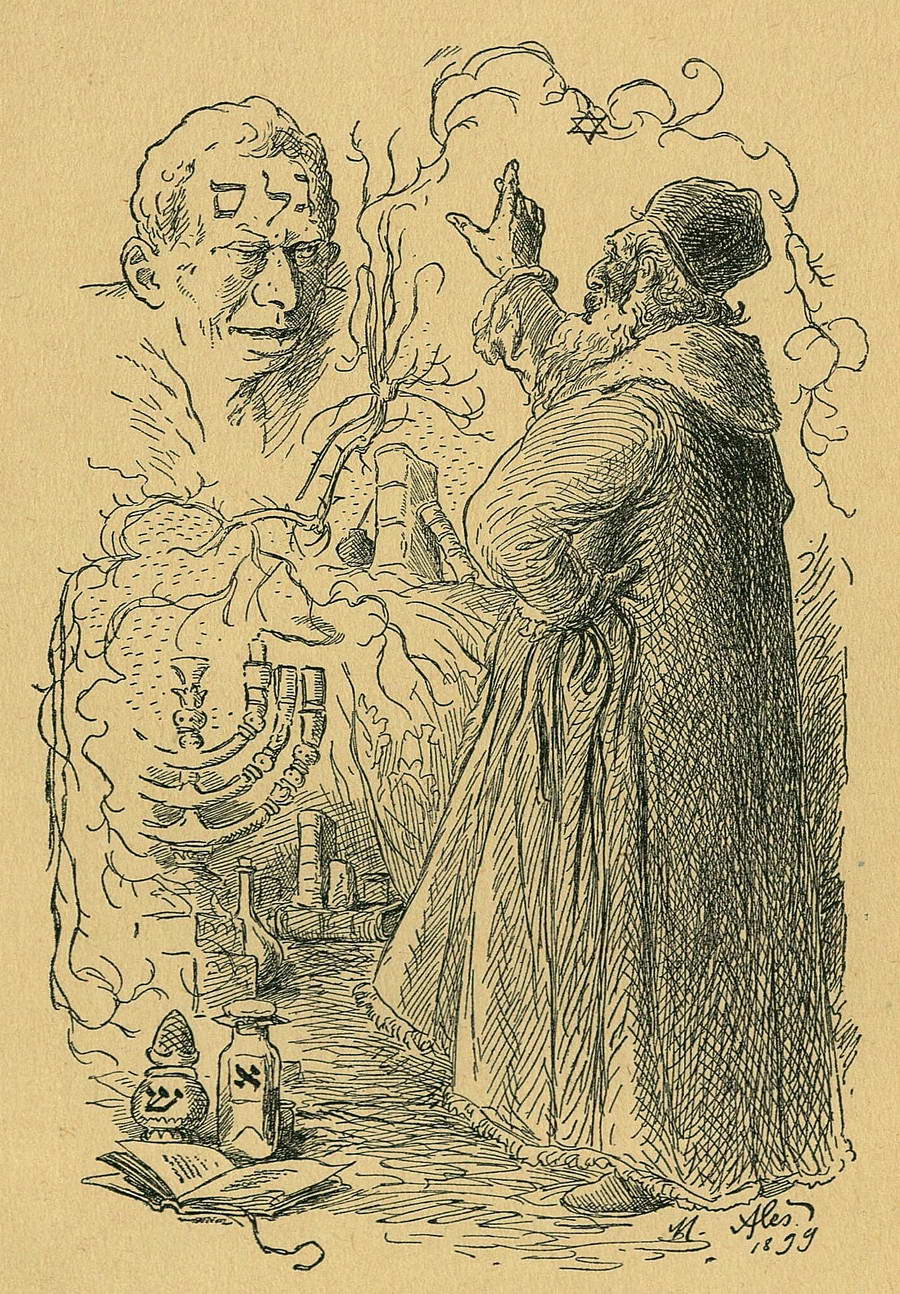
The idea of artificial intelligence as a "lifeless robot doomed to follow the commands of its developer" leads Rosen to reflect on the golem, a powerful humanoid machine gun, which, according to legend, was created in the 17th century by Rabbi Yeuda Lev ben Betzalel, also known as Maaral, to protect the inhabitants of the ghetto from Jewish persecutors. Rosen describes in detail the procedure in which, using Kabbalistic techniques, Maaral and two assistants molded this creature from clay, and then inserted a parchment under his tongue with the text "Adonai emet" ("G-sup is the truth") to revive it and allow him to move. The room in which Rabbi Lev allegedly placed the golem and where he should have been before the need arises, the attic of the synagogue in Prague, remains inaccessible to visitors to this day. (Those who still managed to get there testify that they found only a pile of red dust there, covered with old talite.)
Rabbi Lev revives the golem. Drawing: Mykolas Ales
Going beyond Jewish history, Rosen says that "the golem embodies the idea of positive autonomists about the ideal AI - a supernatural being born by the creator-man, but surpassing his capabilities, the power of good that appeared in the world to improve and prolong our lives", but at the same time admits that "even with good intentions, even with optimal design and even after scrupulous adherence to instructions, the functioning of such a device can go wrong" - as in the case of a wizard's disciple or Frankenstein's monster.
On the other hand, dibuk is a "folklore version of the concept of [AI] of a negative automatoner, an external embodiment of a harmful internal state", which should be exorcised - expelled. Rosen writes that the procedures for the expulsion of the dibuks have become part of the religious practice of some Jewish communities in North Africa and have spread to Muslims who blamed the Jewish spirit for harming them too. The rituals of dibuk's expulsion can be easily imagined as a mechanism for making a scapegoat, but Rosen looks deeper: he sees in generative AIthe danger that AI can saddle "our lowest instincts and turn them into a new, inevitable digital code for humans", which its creators impose on the public against its will.
Nevertheless, Rosen himself remains optimistic about the capabilities of AI. This optimism, in his opinion, is expressed in another branch of the Kabbalistic tradition - the mythology of the Magids. Rosen quotes the words of philosopher Gershom Sholem that magids are holy angels or souls of deceased saints. "Magids were products of unconscious mental activity, which crystallized at the conscious level of the Kabbalists' mind into mental entities," Scholem wrote. They are the reverse side of the dibuk, a form of manifestation of our best motives instead of the worst ones.
In Rosen's words, the Magi express "our inner nature, our subconscious, striving to do good, but necessarily requiring our command". The next step is to recognize that the deep psychological semantic content of the magid, as well as dibuks and golems "makes it possible to reveal our productive abilities, which would otherwise be suppressed or displaced" - or would even fall out of the sphere of discussions about AI.
Having stated all this, Rosen again immerses the reader in the vicissitudes of the struggle of the autonomists with the automatoners. Instead of offering a choice of one of the camps, Rosen wants us to look for ways to reconcile them. He believes that a person can control artificial intelligence without hindering its development and provide strict ethical standards, while eliminating unfair preferences in programming AI platforms. According to Rosen, the main thing is not in the specific chosen line of behavior, but in what attitude and mind with which we approach the solution of the task, as it is personified by its three supernatural beings.
Rosen concludes: assuming that AI is represented by a golem, that is, a non-thinking machine that does good or evil depending on the commands received, we find ourselves in a situation where "our inner dibuki - dark instincts - will determine the course of our thoughts in the process of programming and decision-making, if we do not activate our inner magicians - light angels capable of resisting dibuks".
Well, it's a very nice mind, but I'm not sure it's more insightful than any typical statement at most conferences on the development of AI.
And here two gaps in Rosen's reasoning catch your eye. The first concerns the question of whether Judaistic (or, for that matter, Christian) religious teachings themselves can serve as a moral guideline in the creation and dissemination of AI and machine learning technologies? Is it worth limiting the conversation about the future of AI to mythological and psychological concepts - or Kabbalah, which itself is a side branch of Judaism - ignoring the main Judeo-Christian religious tradition that has been preserved for thousands of years? And if "Adonai Emet" was able to revive the golem then, why can't we do it now?
The second space is China. Do not guess what our "dark instincts" will be like if they fall on us from the bowels of artificial intelligence: all this has already happened in Xi Jinping's China - from total observation of the state to attempts to manipulate consciousness and biotechnology war. At the same time, Rosen is practically silent about how China turns the technology created in the United States into a totalitarian nightmare, except for the quoting of venture investor Mark Andrissenthat "the only major risk of AI is that China will gain global dominance in the field of artificial intelligence, and we - the United States and the West - will not".
Beijing Institute of General Artificial Intelligence, established in 2020Photo: Wikipedia
Rosen, of course, does not try to look at the threat of Chinese AI through the prism of ancient Jewish wisdom. Otherwise, he would have come to a completely different classification based on mythological characters, according to which American AI is a golem, an automaton silently waiting to be activated for service and protection, and China is a dibuk capable of "saddleing our lowest instincts and turning them into a new, inevitable digital code for humans".
Well, the magician can be our own Judeo-Christian moral code based on truth and goodness. Here, it seems, we find a landmark pointing the way to the victory of the West and the transformation of artificial intelligence into a productive and useful tool, which is what its first creators always hoped for.
Michael M. Roses Like Silicon From Clay: What Ancient Jewish Wisdom Can Teach Us About AI [Like silicon from clay. What old Jewish wisdom can tell us about artificial intelligence AEI Press, 2025. - 328 p.
I'm not a Jew, but the story of the golem - the defender of the Jews, created from clay by a certain wizard with the help of mysterious rituals - attracted me since the lower grades of school when I learned about the German expressionist film of 1920 with that title. And really, what kind of book-fassioned teenager dreams of getting a strong silent intercessor, ready to deal with all offenders on his order? Later, my wife Beth introduced me to a completely unusual play by Semyon An-sky "Dibuk", written in Yiddish, which is about an evil spirit that allegedly settles in a helpless victim.
That's why I was interested in the proposal to write a review of a book about golems, dibuks and magids (lesser-known spirits from Jewish folklore) - a book that directly connects these creatures with artificial intelligence.
After reading Michael Rosen's book "Like Silicon from Clay", interest in the topic did not fade away, although the author failed to convince me. According to Rosen, different points of view on AI and machine learning (ME), as well as our desire to ensure "the functioning of AI within the framework of ethical norms and responsibilities", may draw inspiration from these Jewish supernatural entities, and "we can draw the best of each such approach in order to develop a clear consistent line of conduct".
The task set in this way is extremely difficult, and ultimately Rosen's plan is too bold to be successfully completed. At the same time, "Like Clay Silicon" remains a very interesting, even exciting book: the author is passionately and eloquently immersed in the ongoing discussion about the future of AI and the secret nooks of Jewish mysticism.
Rosen starts with the division of the participants of the discussion. He calls one group of them autonomists - they consider the latest achievements in the field of AI truly revolutionary, capable of changing the foundations of human life. He baptized the second group as automatoners - they believe that AI is a simple extension (not a transformation) of existing digital technology, which can also be harmful.
Each group has a positive and negative wing (it remains to express regret that Rosen chose two names that are so obsessively, so annoyingly similar to each other). Positive autonomists are represented by Sam Altman from Open AIand "convinced that machines have already reached - or are about to achieve - a degree of independence" that allows them to function without human management and supervision. They believe that this development of AI is a good thing, because it improves the quality of life and empowers a person. Negative autonomists (Rosen refers to Jeffrey Hinton to themand Elon Musk) consider the same development of AI dangerous and potentially threatening humanity.
On the other hand, Rosen's automatoners believe that AI technology is essentially "a lifeless robot doomed to follow the commands of its developer", that is, only "an improved, albeit to a large extent, version of existing computer technology". Positive automatoners see the possibilities of AI to improve the quality of human life without threatening him, but only if the program has the ability to correct human control. It is to this group that Rosen has a special disposition.
The idea of artificial intelligence as a "lifeless robot doomed to follow the commands of its developer" leads Rosen to reflect on the golem, a powerful humanoid machine gun, which, according to legend, was created in the 17th century by Rabbi Yeuda Lev ben Betzalel, also known as Maaral, to protect the inhabitants of the ghetto from Jewish persecutors. Rosen describes in detail the procedure in which, using Kabbalistic techniques, Maaral and two assistants molded this creature from clay, and then inserted a parchment under his tongue with the text "Adonai emet" ("G-sup is the truth") to revive it and allow him to move. The room in which Rabbi Lev allegedly placed the golem and where he should have been before the need arises, the attic of the synagogue in Prague, remains inaccessible to visitors to this day. (Those who still managed to get there testify that they found only a pile of red dust there, covered with old talite.)
Rabbi Lev revives the golem. Drawing: Mykolas Ales
Going beyond Jewish history, Rosen says that "the golem embodies the idea of positive autonomists about the ideal AI - a supernatural being born by the creator-man, but surpassing his capabilities, the power of good that appeared in the world to improve and prolong our lives", but at the same time admits that "even with good intentions, even with optimal design and even after scrupulous adherence to instructions, the functioning of such a device can go wrong" - as in the case of a wizard's disciple or Frankenstein's monster.
On the other hand, dibuk is a "folklore version of the concept of [AI] of a negative automatoner, an external embodiment of a harmful internal state", which should be exorcised - expelled. Rosen writes that the procedures for the expulsion of the dibuks have become part of the religious practice of some Jewish communities in North Africa and have spread to Muslims who blamed the Jewish spirit for harming them too. The rituals of dibuk's expulsion can be easily imagined as a mechanism for making a scapegoat, but Rosen looks deeper: he sees in generative AIthe danger that AI can saddle "our lowest instincts and turn them into a new, inevitable digital code for humans", which its creators impose on the public against its will.
Nevertheless, Rosen himself remains optimistic about the capabilities of AI. This optimism, in his opinion, is expressed in another branch of the Kabbalistic tradition - the mythology of the Magids. Rosen quotes the words of philosopher Gershom Sholem that magids are holy angels or souls of deceased saints. "Magids were products of unconscious mental activity, which crystallized at the conscious level of the Kabbalists' mind into mental entities," Scholem wrote. They are the reverse side of the dibuk, a form of manifestation of our best motives instead of the worst ones.
In Rosen's words, the Magi express "our inner nature, our subconscious, striving to do good, but necessarily requiring our command". The next step is to recognize that the deep psychological semantic content of the magid, as well as dibuks and golems "makes it possible to reveal our productive abilities, which would otherwise be suppressed or displaced" - or would even fall out of the sphere of discussions about AI.
Having stated all this, Rosen again immerses the reader in the vicissitudes of the struggle of the autonomists with the automatoners. Instead of offering a choice of one of the camps, Rosen wants us to look for ways to reconcile them. He believes that a person can control artificial intelligence without hindering its development and provide strict ethical standards, while eliminating unfair preferences in programming AI platforms. According to Rosen, the main thing is not in the specific chosen line of behavior, but in what attitude and mind with which we approach the solution of the task, as it is personified by its three supernatural beings.
Rosen concludes: assuming that AI is represented by a golem, that is, a non-thinking machine that does good or evil depending on the commands received, we find ourselves in a situation where "our inner dibuki - dark instincts - will determine the course of our thoughts in the process of programming and decision-making, if we do not activate our inner magicians - light angels capable of resisting dibuks".
Well, it's a very nice mind, but I'm not sure it's more insightful than any typical statement at most conferences on the development of AI.
And here two gaps in Rosen's reasoning catch your eye. The first concerns the question of whether Judaistic (or, for that matter, Christian) religious teachings themselves can serve as a moral guideline in the creation and dissemination of AI and machine learning technologies? Is it worth limiting the conversation about the future of AI to mythological and psychological concepts - or Kabbalah, which itself is a side branch of Judaism - ignoring the main Judeo-Christian religious tradition that has been preserved for thousands of years? And if "Adonai Emet" was able to revive the golem then, why can't we do it now?
The second space is China. Do not guess what our "dark instincts" will be like if they fall on us from the bowels of artificial intelligence: all this has already happened in Xi Jinping's China - from total observation of the state to attempts to manipulate consciousness and biotechnology war. At the same time, Rosen is practically silent about how China turns the technology created in the United States into a totalitarian nightmare, except for the quoting of venture investor Mark Andrissenthat "the only major risk of AI is that China will gain global dominance in the field of artificial intelligence, and we - the United States and the West - will not".
Beijing Institute of General Artificial Intelligence, established in 2020Photo: Wikipedia
Rosen, of course, does not try to look at the threat of Chinese AI through the prism of ancient Jewish wisdom. Otherwise, he would have come to a completely different classification based on mythological characters, according to which American AI is a golem, an automaton silently waiting to be activated for service and protection, and China is a dibuk capable of "saddleing our lowest instincts and turning them into a new, inevitable digital code for humans".
Well, the magician can be our own Judeo-Christian moral code based on truth and goodness. Here, it seems, we find a landmark pointing the way to the victory of the West and the transformation of artificial intelligence into a productive and useful tool, which is what its first creators always hoped for.
There's something I read years and years ago about how the antichrist will establish a new system which will work well for a while until it becomes a disaster. I don't know if that's canonical, may have just been someone's opinion. Still it makes me think that may be AI. Though AI is pretty overrated IMO.
On a side note, did you see they came out with a Rabbi AI a couple years ago?
There's something I read years and years ago about how the antichrist will establish a new system which will work well for a while until it becomes a disaster. I don't know if that's canonical, may have just been someone's opinion. Still it makes me think that may be AI. Though AI is pretty overrated IMO.
On a side note, did you see they came out with a Rabbi AI a couple years ago?


By Arthur Herman