The Jerusalem Patriarch received money from Russian funds for many years and finally received Trump's blessing for the peacekeeping mission to Moscow
By Lera Furman
The patriarch went on tour
Patriarch Theophilus III of Jerusalem, who occupies the 4th place in the table of ranks (diptych) of the primates of the local Orthodox churches, developed unprecedented foreign policy activity at the beginning of this summer. He visited the United States and Greece, and also announced his visits to Russia and, possibly, Ukraine. This tactic is not typical for the head of one of the smallest (only 65 parishes) Orthodox churches, which, according to tradition, is focused on serving pilgrims visiting the main shrines of Christianity associated with the earthly life of Jesus Christ and other events of biblical history. The foreign policy activity of the Patriarch of Jerusalem, who has a reputation as a satellite of the Russian Orthodox Church, challenges the first honored patriarch of the Orthodox world - Constantinople, who is traditionally actively engaged in international affairs.
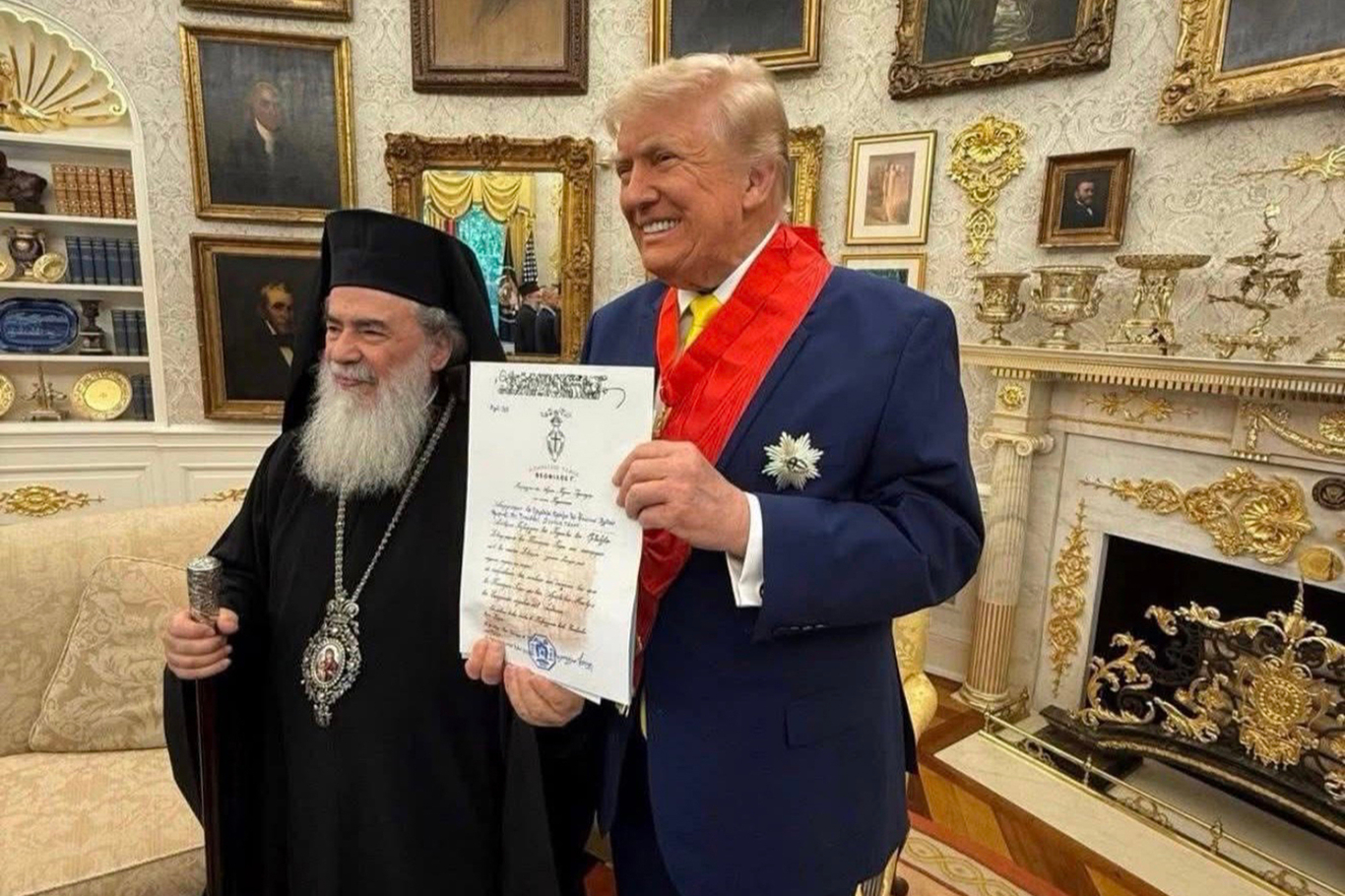
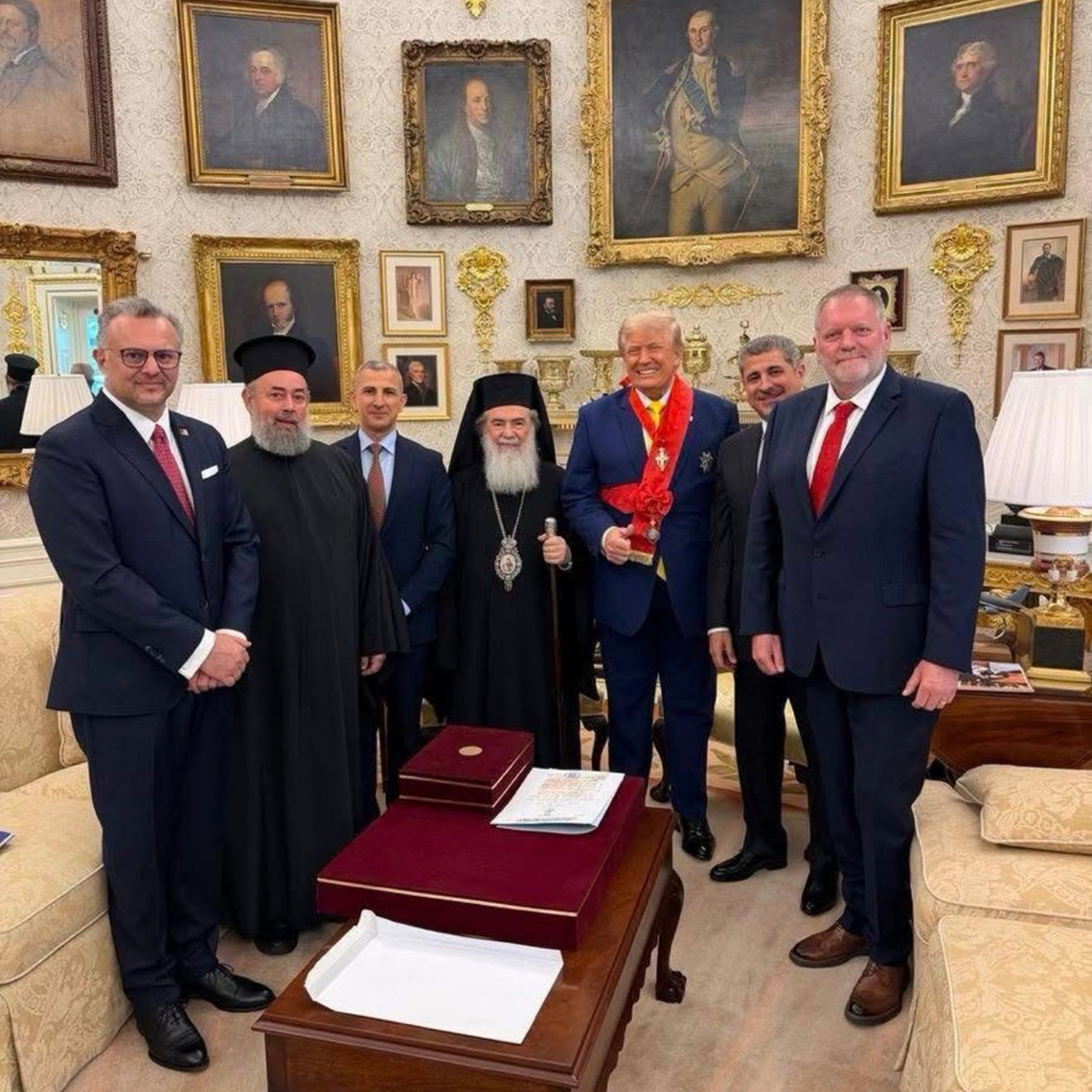
On the evening of June 4, Donald Trump received Theophilus III in the Oval Office. The main topic of their almost hour-long conversation was the situation of Christians in the Middle East and the preservation of the status quo of the holy places of Jerusalem, which are under the care of the King of Jordan (despite the defeat of Jordan and its allies in the Six-Day War of 1967, Israel recognizes the rights of the Hashemite Kingdom to manage Muslim and Christian facilities in the Old City of Jerusalem). According to the official report of the patriarchate, Theophilus and Trump agreed on the inadmissibility of "restriction of access to places of worship and religious ceremonies" in Jerusalem, which was undertaken by the Israeli authorities this spring against the background of the war with Iran. Being a subject of the Jordanian king, Theophilus III called his kingdom "a model of religious and social stability". Trump, who has not hidden his irritation with the leadership of Israel in recent days, also praised Abdullah II. The Patriarch presented the president with the highest award of the Jerusalem Church - the Knight's Order of the Holy Sepulchre, awarding Trump the title of "great crusader". In conclusion, in the context of Theophilus III's visit to Moscow scheduled for the end of June, the parties discussed the settlement of the Russian-Ukrainian conflict.
It is unlikely that Trump gave any specific "instrictions" to the patriarch, but a number of media regarded this message as the emergence of a new "mediator" for the preparation of peace negotiations.
The visit of Theophilus III to Greece, the state that is the main national sponsor of the Greek Orthodox Jerusalem Patriarchate, was much longer and more meaningful on June 6-11. During the meetings of the patriarch with the president, prime minister, ministers and other influential people of the Greek state, many words were heard about the inadmissibility of violating the rights of Christians in the Holy Land, about the status quo and even about solidarity with the people of Palestine. Theophilus III has traditionally strained relations with the Israeli authorities, he has a reputation as a "pro-Arab". For many years, Israel did not recognize the removal of Patriarch Irenaeus (2005), who was considered more friendly to Israel and placed under unofficial house arrest by Theophilus (Irenaeus died in 2023). The President of Greece handed over high awards through the patriarch to Archbishop Alexy of Tiberias and Archimandrite Sila, who feeds the Orthodox Arabs in the Gaza Strip. Discussing Theophilus' upcoming visit to Moscow, the Greek authorities called it "the opening of a new spiritual channel" for the Russian-Ukrainian settlement.
REFERENCE "NOVAYA GAZETA EUROPE":
The Greek Orthodox Patriarch of Jerusalem bears the magnificent title "His Divine Beatitude Patriarch of the Holy City of Jerusalem and All Palestine". Patriarch Theophilus III is 74 years old, his secular name is Elijah Yannopoulos, he was born in the Peloponnese, moved to Jerusalem at the age of 22, where he made a fast church career. He graduated from the Patriarchal School in Jerusalem, the Faculty of Theology of the University of Athens and postgraduate studies at Durham University in England, but did not receive a doctorate. He was tonsured monks and ordained a deacon in 1970, hieromonk in 1975, elevated to the rank of archimandrite in 1978. He held a number of positions in the Jerusalem Patriarchate, in 1986 he became secretary of the synod and head of the press service of the patriarchy, represented his church in the Central Committee of the World Council of Churches. In 2001-2003 he served in Moscow as a representative of the Patriarch of Jerusalem to the Russian Orthodox Church, and in 2003-2005 - as an exarch in Qatar. On February 14, 2005, he was ordained Archbishop of Favor, less than six months later he was elected Patriarch. During his patriarchy, the Jerusalem Church returned to the ecumenical movement, became close to the Patriarchate of Constantinople, but, at the same time, fell into serious financial dependence on the Russian Orthodox Church and Russian funds.
The milestones of great friendship
Before the start of full-scale military operations in Ukraine in 2022, the main flow of Orthodox pilgrims to the shrines of the Jerusalem Patriarchate came from Russia and Ukraine. But the contacts of Theophilus III with the leadership of these states were, so to speak, uneven. The Jerusalem Patriarch visited the Russian Federation on official visits in 2013 and 2019; for his part, Vladimir Putin visited the Jerusalem Patriarchate in 2012 and 2020. Theophilus visited Ukraine three times - but only during the reign of Viktor Yanukovych: in 2011, 2012 and 2013. Especially memorable was the visit of the Patriarch of Jerusalem to Moscow in November 2019, when the International Foundation for the Unity of Orthodox Peoples solemnly presented him with its award. At the same time, at meetings with Putin and Patriarch Kirill, a grandiose project of "reformatting world Orthodoxy" was conceived - the so-called "Amman format". Bypassing Patriarch Bartholomew of Constantinople, who "supported the church schism in Ukraine," Theophilus and Cyril invited the primates of the local churches to the capital of Jordan to agree on a common course of weakening the leader of world Orthodoxy. The meeting in Amman was barely held before the beginning of covid restrictions in March 2020, but in addition to the initiators, only the heads of the Serbian and Czechoslovak churches came to it.
Patriarch Bartholomew of Constantinople sharply condemned "self-contribution" - and most of the primates listened to him.
The last meeting of Theophilus and Kirill took place in Astana on September 17 last year. The Russian side was apparently satisfied with the results of the meeting: already in November there was a decree of Putin to award the Jerusalem Patriarch with the Order of Friendship "for a great contribution to strengthening friendship, cooperation and spiritual ties with the Russian Federation". During his last year's visit to Moscow, during a meeting with Putin, Serbian Patriarch Porfiry gave him the characteristic that Theophilus III gave to the Russian autocrat: "Orthodox has one trump card".
Patriarch Theophilus III of Jerusalem and Donald Trump. Photo: Jerusalem Patriarchate /jerusalem-patriarchate.info
"Money is the blood of the church"
Like all churches of the Christian East and the Balkans, the Jerusalem Patriarchate was completely financially dependent on Moscow under Ivan the Terrible. Under Ottoman rule, the life of most Orthodox churches was reduced to the desire to physically survive and to the constant search for donations. As the Russian Empire strengthened, its strategic confrontation with the Ottoman Empire intensified, and the same Orthodox churches under Turkish rule (including Jerusalem) were considered strategic bridgeheads in the rear of the enemy. In 1725, the St. Petersburg government put the funding of the Jerusalem Church on a regular basis, introducing "Palestinian states", the size of which was constantly increasing. With the weakening of the Ottoman Empire, the flow of Russian pilgrims to the Holy Land grew, in the middle of the 19th century a Russian spiritual mission was established in Palestine, which by the beginning of the 20th century became the largest landowner in the region (more than 150 hectares), built 11 temples (including 6 in Jerusalem), 7 monasteries, more than a dozen farmsteads, hospitals, schools and shelters. Several times a year, tens of thousands of churches of the Russian Empire held a circle gathering "for the holy places".
After 1917, Russian property in Palestine was under the control of white emigrants, who, of course, did not have such means to maintain it. Therefore, it was not difficult for Stalin, who conceived his "Near Eastern plan" in the midst of the war and revived the Moscow Patriarchate, to buy the Jerusalem Patriarchate. Already at the Moscow Council of 1945, which "elected" Patriarch Alexy I, guests from foreign Orthodox churches, including Jerusalem, were presented with 42 precious exhibits from the museums of the Moscow Kremlin and 28 exhibits from the Zagorsky Museum (the former sacristy of the Trinity-Sergius Lavra). On May 4, 1945, Stalin approved the proposal of the Council for the Affairs of the Russian Orthodox Church under the Council of Ministers of the USSR to send a delegation of the Moscow Patriarchate headed by Alexei I to the Middle East, the appearance of which in Jerusalem led to the rupture of contacts of the Jerusalem Patriarchate with the emigrant Russian Foreign Church and to unconditional support for the "revived" Russian Orthodox Church. The archive of the Council for the Affairs of the Russian Orthodox Church kept a report on the transfer of 40 thousand dollars to the Jerusalem Patriarch Timothy, which was a very considerable amount in the conditions of post-war devastation.
Having created its own spiritual mission in Jerusalem, the Moscow Patriarchate pumped millions of dollars through it during the 1940s and 1980s - more than to any other foreign institutions.
After the rupture of diplomatic relations between the USSR and Israel in 1967, the mission of the Moscow Patriarchate remained the only legal representation in Israel that solved both diplomatic and intelligence tasks. According to the certificate of the Council for Religious Affairs dated November 22, 1988 (GARF, f. P-6991, op. 5, d. 4323, l. 32), only from 1983 to 1988 the patriarchy transferred 1,605,730 US dollars to Jerusalem, a certain part of which went to the Jerusalem Patriarchate. In 1989, the courtyard of the Jerusalem Church on Arbat in Moscow, which was engaged in collecting donations from Soviet believers, resumed its activities.
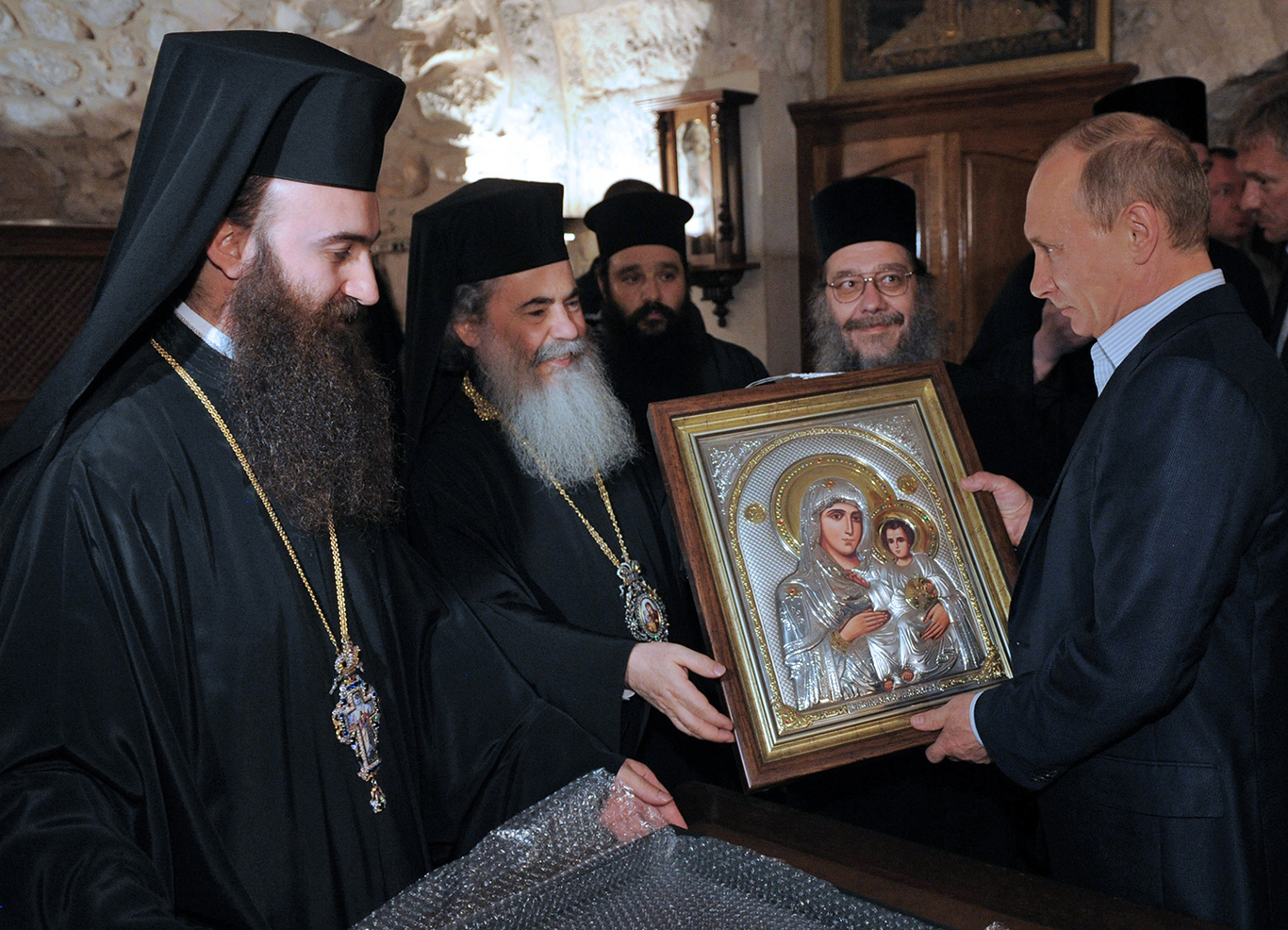
Vladimir Putin presents an icon to Patriarch Theophilus III of Jerusalem during a visit to the Church of the Holy Sepulchre in Jerusalem, Israel, June 26, 2012. Photo: Alexey Dragunin / EPA
Kremlin tools in Jerusalem
Today, the Russian authorities finance the Jerusalem Church through a number of funds - including the aforementioned International Foundation for Spiritual Unity of Orthodox Peoples - an instrument of "soft power" of the Kremlin, operating in countries with an Orthodox majority and, in all likelihood, closely associated with Russian special services. The first winner of the fund's cash prize (its amount is not announced) was Patriarch Diodorus of Jerusalem, who died in 2001.The Andrew the First-Called Foundation, headed by Vladimir Yakunin, former president of Russian Railways and member of the Ozero cooperative, is famous, first of all, for its actions to deliver the Holy Fire to the churches of Russia at Easter, lit at the Holy Sepulchre on Holy Saturday. According to Russian propaganda, this fire is miraculously sent from the sky and symbolizes God's support of Russian power, although the Jerusalem Patriarch himself hinted that he lights the fire naturally. The Yakunin Foundation secretly finances various aspects of the activities of Patriarch Theophilus, who receives a Moscow guest with special honor. "This place is our home," Vladimir Yakunin himself speaks without hesitation about his perception of the Christian quarter of Jerusalem.
An even more subtle instrument of Russian influence in the Holy Land is the Imperial Orthodox Palestinian Society (IPPO), headed by former Prime Minister and former Director of the FSB of Russia, Colonel-General Sergei Stepashin. Of course, the society does not disclose all the data about its projects, but admits that it has made a decisive contribution to the large-scale restoration of the Church of the Holy Sepulchre in Jerusalem and the Basilica of the Nativity of Christ in Bethlehem. The IPPO calls its "stub" in the Middle East the Sergievskoye farmstead in Jerusalem, which was transferred to the property of the Russian Federation in 2008 and opened after a billion-dollar restoration in 2017. The courtyard building with a majestic tower, on which the IPPO flag flies, is located half a kilometer from the Holy Sepulchre. Stepashin's people placed a luxury hotel, a restaurant and a business center there, where the events of the Russian embassy are periodically held. Now the IPPO is fighting for the transfer of the Alexander courtyard, located literally behind the wall of the Church of the Holy Sepulchre: in 2020, the Israeli authorities had already decided to transfer it as part of the deal to return to their homeland the Israeli Naama Issahar, who was arrested in Moscow, but later the court overturned this decision.
On the territory of the Palestinian Authority, the society supports a network of Russian language schools and courses, the best graduates of which are provided with scholarships for further education in the Russian Federation.
The IPPO is engaged in the reconstruction of Russian monasteries on the Olivet in Jerusalem and Ein Karem, as well as other sections of the Russian Spiritual Mission, which after 2008 were under the control of the Moscow Patriarchate. The company does not publish open reports on the amounts of financing, but you can guess about them by reviewing the list of members of the IPPO Board of Trustees: President of PJSC "Transneft" Nikolai Tokarev, Deputy General Director of the Ural Mining and Metallurgical Company, representatives of the USM holding Alisher Usmanov, etc. Some commercial giants from the Russian Federation directly invest in the objects of the Jerusalem Patriarchate - for example, the Guryev company "FosAgro".
Patriarch Theophilus III of Jerusalem and Donald Trump. Photo: Jerusalem Patriarchate /jerusalem-patriarchate.info
Each project in the Holy Land, in which Russian structures are represented, is estimated at millions of dollars. Only according to official data, the restoration of the Basilica of the Nativity of Christ in Bethlehem cost 10 million. Having accepted such a generous flow of "aid", Patriarch Theophilus was bound hand and foot - according to the Russian Ambassador to Israel Anatoly Viktorov, a very "high level of church and diplomatic cooperation between the Jerusalem Patriarchate and Russia, in particular with the Ministry of Foreign Affairs of the Russian Federation" has been achieved. The ambassador does not hide that this is especially valuable in the era of "SVO", which was condemned by the leadership of most other Christian churches: "The world is turned upside down". According to the page of the Russian embassy in the social network banned by the Russian Federation, during one of the recent visits to the diplomatic mission, Theophilus said: "The Kiev regime made a new vicious norm attacks on clergy and parishioners, discrediting priests in the eyes of their flock, closing and capturing churches, acts of vandalism and blasphemy against holy places. Unfortunately, such trends are gaining momentum in the Baltic States." In general, the manual works out.
Obviously, such a "negotiator" is unlikely to be accepted in Ukraine - in fact, it is the same Gerhard Schroeder, only in a casso. A high-ranking Ukrainian diplomat told journalists: "The man (Theophilus. - Author's note) took a clear position, walks in an embrace with the Russian ambassador, participates in Russian events. He definitely won't do anything good for us." Loud phrases about Theophilus' "peacekeeping mission" in Moscow in practice are likely to come down to attempts to knock out the next tranches for the "persecuted" Jerusalem Patriarchate, if possible, expanding the circle of donors. Taking into account "special geopolitical circumstances".